By Nanoscribe
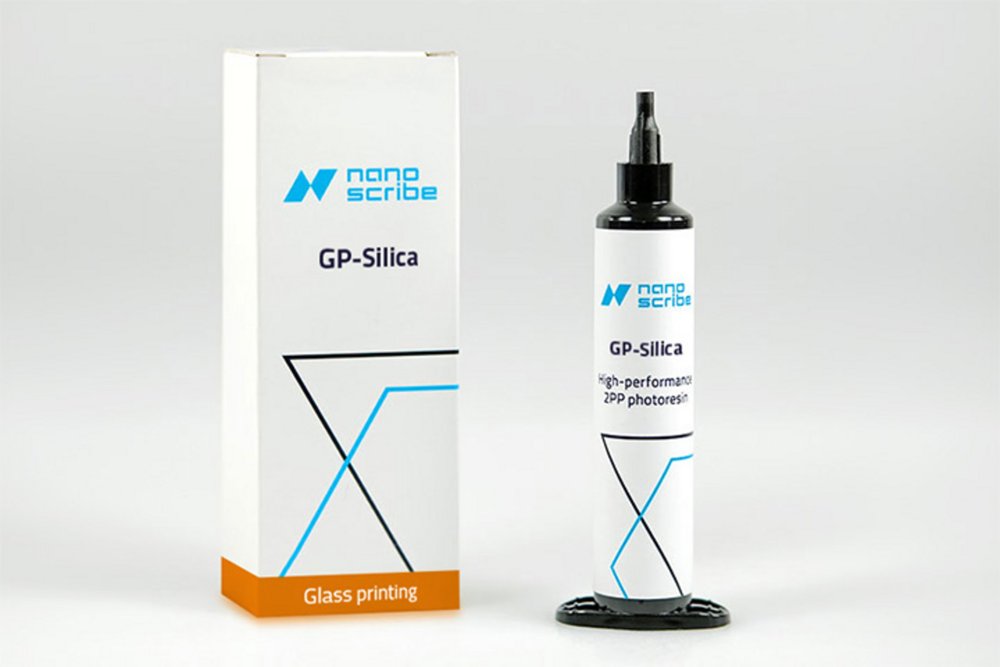
GP-Silica is the world’s first photoresin for 3D printing silica glass microstructures by Two-Photon Polymerization (2PP). High optical transparency combined with thermal, mechanical and chemical stability enable new applications. Specifically designed for 3D printing glass microstructures. GP-Silica is the centerpiece of the Glass Printing Explorer Set and was developed in a joint research project with Glassomer. Discover glass printing with our explorer set. Two-Photon Polymerization (2PP) of fused silica glass encourages the exploration of new applications in life sciences or other fields that require the outstanding properties of glass. Please note that, due to its special manufacturing process including thermal sintering, fabricating glass structures with GP-Silica is more complex than with classical IP Photoresins, and the achievable resolution is lower. However, with some experience, you can achieve excellent results. The features of GP-Silica at a glance: - High mechanical, chemical and thermal stability - High optical transparency from UV to IR - Smooth optical quality surfaces - Inorganic material for the exploration of new applications Two-photon curable silica nanocomposite: The glass printing material GP-Silica was developed in collaboration with Glassomer GmbH, a pioneer in room-temperature forming of glass based on silica nanocomposite technology. The photoresin GP-Silica is a composite of silica nanoparticles dispersed in a photocurable binder matrix that can be printed directly with Nanoscribe’s microfabrication systems. GP-Silica requires a two-step fabrication process: First, the desired microstructures are printed from GP-Silica and unpolymerized material is washed away, resulting in the so-called green part. In a second step, the green part is thermally treated. Here, initially the polymerized binder matrix is removed at 600 °C, followed by a sintering process at 1,300 °C. During this step, the part shrinks in volume as the silica nanoparticles fuse, revealing a 3D microstructure of pure fused silica glass. With GP-Silica, we introduced a new material class designed for 3D microfabrication. This new, inorganic print material features the excellent characteristics of silica glass, such as its high thermal and chemical stability. Combined with an optical transmission window that extends from 200 nm to the infrared region, the new material is an excellent candidate for imaging applications in life sciences, microfluidics, microreactors or micro-optics. Furthermore, the new printing material has a Young’s modulus about ten times higher than standard printing materials such as IP-Q, opening up new possibilities in the field of MEMS and material engineering. All organic compounds of GP-Silica are removed during post processing, resulting in 3D-printed structures of pure silica glass. The optical transparency of GP-Silica is identical to that of other commercially available fused silica. Properties: - Young’s modulus [GPa]: 68.3 - Thermal stability [°C]: > 1,000 - Refractive index at 589 nm, 20 °C: 1.458 - Lateral resolution [µm]: 20 - Surface roughness Ra [nm]: < 10 - Post-processing: Sintering - Sintering shrinkage [Vol. %]: 27 (isometric) 1 Measured on 3D printed or UV-cured structures; results depend on the printing conditions and geometry 2 Glass transition temperature T g 3 Structure and print parameter dependent
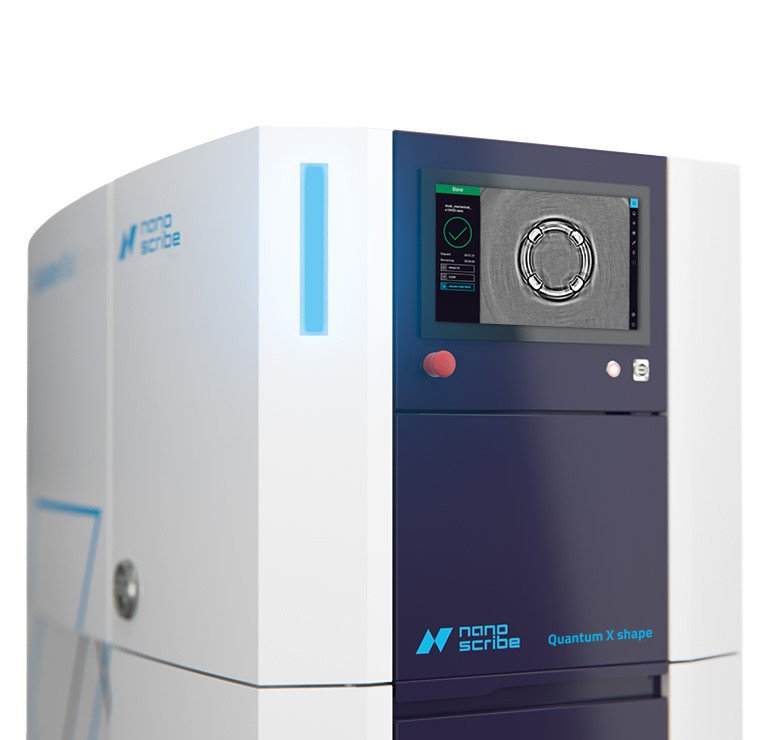
Achieve unparalleled performance in 3D microfabrication with this versatile, high-resolution 3D printer. Ideal for science and research labs, it covers multiple scales and applications, from MEMS to micromechanics and more. High-resolution 3D printer that covers multiple scales and applications. The Quantum X shape is a configurable high-resolution 3D printer based on Two-Photon Polymerization. It delivers optimal performance in rapid prototyping and wafer-scale batch production of complex 2.5D and 3D shapes across various scales with submicron precision and accuracy. Reshaping precision, output & usability: Quantum X shape offers outstanding versatility and flexibility for science and research applications. It covers multiple orders of magnitude – from nanometer-scale structures to centimeter-sized objects with high-volume throughput. It’s designed for research-driven environments such as universities, R&D centers, and multi-user labs. Operate your multiphoton lithography system via touchscreen or nanoConnectX across diverse materials and substrates. Benefit from industrial-grade precision, reliability and time-efficient wafer batch production. Achieve success in a wide range of applications, from micromechanics and MEMS to material engineering, micro-optics and life sciences, with our high-resolution 3D printer. Included features: - High-resolution 3D printing based on Two-Photon Polymerization for intricate nano-, micro-, meso- and macrostructures Optional features: - Rapid and accurate surface patterning enabled by Two-Photon Grayscale Lithography (2GL®) - Aligned 3D printing, e. g. high-precision optics aligned to fiber cores, chip surfaces and edges, or fiducials using Aligned 2-Photon Lithography (A2PL®) - Up to 60 times faster speeds at superior quality compared to classic 2PP, achieved through 3D printing by 2GL® (Two-Photon Grayscale Lithography) - Automatic dispenser for efficient batch-processing and wafer-level microfabrication - Automatic printing aligned to fiber cores enabled by the Fiber Printing Set - Automatic 3D mapping of complex substrate topographies enabled by Chip Printing Set with a confocal detection module - CO₂, temperature, and humidity control with heatable cell culture dishes enabled by Bioprinting Set Benchmark scores: - Surface roughness (Ra) down to ≤ 5 nm - Feature size control down to 100 nm in x/y direction - Shape accuracy (S a) down to ≤ 200 nm - Batch processing up to 200 typical mesoscale structures overnight - Stitching-free part diameter up to 4,000 µm - Maximum scan speed 6.25 m/s divided by lens magnification (Peak values, only achieved under specific conditions such as printing parameters, print heads, photoresins, and designs.) General system properties: - Stage Positioning volume 150 x 150 x 20 mm³ - Stage repeatability ≤ 150 nm - Fully printable wafers: 2", 4", and 6" - Manufacturable wafers: up to 8" - Substrates: Microscope slides (3” x 1” / 76 x 26 mm²); Wafers from 1” to 8” (25.4 mm to 200 mm); Various flat substrates up to a size of 100 x 100 mm²; Various glass bottom dishes; Glass, silicon, other transparent and opaque materials - Photoresins: Nanoscribe photoresins (polymer printing); Nanoscribe GP-Silica (glass printing); Open for third-party or custom materials Designed for flexibility with features that expand capabilities: This high-resolution 3D printer is part of the industry-proven Quantum X platform, the first 3D printing platform for 3D laser lithography that can process standard wafers ranging in size from 1” to 8”.
CATEGORY
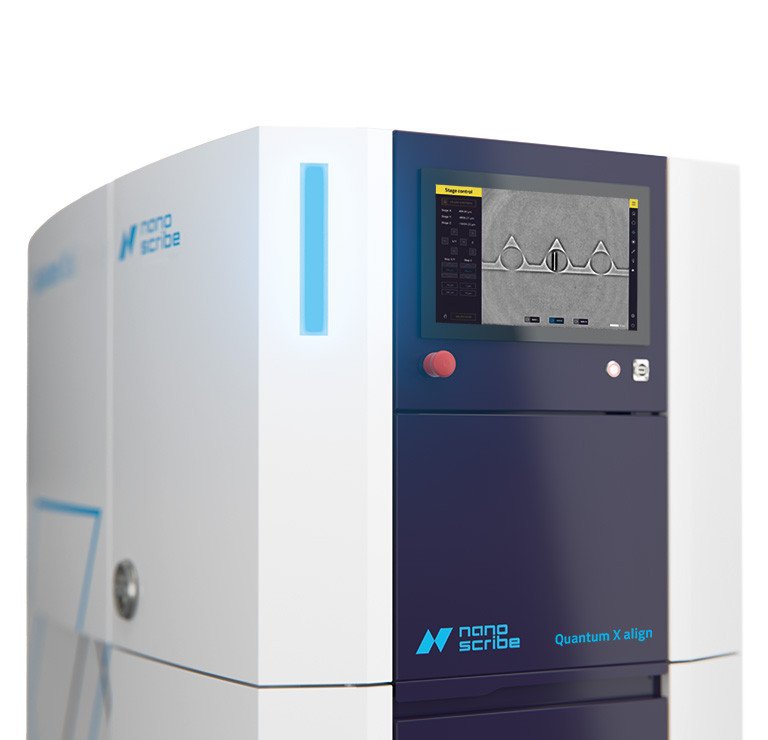
Unlock scalable optics manufacturing with high-resolution 3D printing and automated alignment on fibers, chips, and wafers – enabling reliable, low-loss photonic coupling as well as sensing and imaging applications. Powered by the cutting-edge technology of 3D printing by 2GL®, Quantum X align produces freeform micro-optics with exceptional shape accuracy and surface quality. Dynamic voxel size control during the printing process significantly reduces the number of layers, thus boosting printing speed without compromising precision or quality. With Aligned 2-Photon Lithography A2PL®, Quantum X align automatically detects chip edges, fiber cores, fiducials on chip surfaces, on wafers, and on prestructured substrates. It then prints freeform micro-optics directly in place with nanometer-scale alignment accuracy, ensuring that the optics are printed aligned to optical axes. This makes the printer ideal for photonics packaging, saving time and costs for additional fabrication and assembly steps for mounting or fixation. Quantum X align delivers reliable results and is designed with smart automation features, easy-to-use software and streamlined workflows to accelerate 3D printing processes from prototyping to production. The system supports a broad range of validated resins for optics manufacturing. Nanoscribe photopolymers offer high transparency across the entire visible spectrum and into NIR and UV, different refractive indices and Abbe numbers. Designed for demanding applications, they offer proven stability under laser exposure, thermal stress, and humidity. Included features - Aligned 3D printing, e. g. high-precision optics aligned to fiber cores, chip surfaces and edges, or fiducials using Aligned 2-Photon Lithography (A2PL®) - Up to 60 times faster speeds at superior quality compared to classic 2PP, achieved through 3D printing by 2GL® (Two-Photon Grayscale Lithography) - 3D printing on different material platforms for photonics packaging, e.g. SiN, Si, SOI, GaAs, LNOI … - Automatic printing aligned to fiber cores enabled by the Fiber Printing Set - Automatic 3D mapping of complex substrate topographies enabled by the Chip Printing Set with a confocal detection module Optional features - Rapid and accurate surface patterning enabled by Two-Photon Grayscale Lithography (2GL®) Benchmark scores 3D alignment detection accuracy down to 100 nm in x/y direction Surface roughness Ra down to ≤ 5 nm Shape accuracy Sa down to ≤ 200 nm Feature size control down to 100 nm in x/y direction Typical processing time 10 min. for 8x lensed fiber array Achievable coupling losses down to ≤ 1 dB Peak values, only achieved under specific conditions such as printing parameters, print heads, photoresins, and designs. With confocal detection. Accuracy depends on selected print head. Best case for typical applications, depending on design, substrate quality and measurement method General system properties Stage Positioning volume 150 x 150 x 20 mm³ Stage repeatability ≤ 150 nm Fully printable wafers: 2", 4", and 6" Manufacturable wafers: up to 8" Substrates: Microchips, TO cans; Single cleaved fibers (single-/multimode/polarization-maintaining); Fibers in FC or SMA connectors; Fiber arrays (v-groove); Wafers from 1” to 8” (25.4 mm to 200 mm); Glass, silicon, other transparent and opaque materials Photoresins: Nanoscribe polymer photoresins; Open for third-party and custom materials
CATEGORY
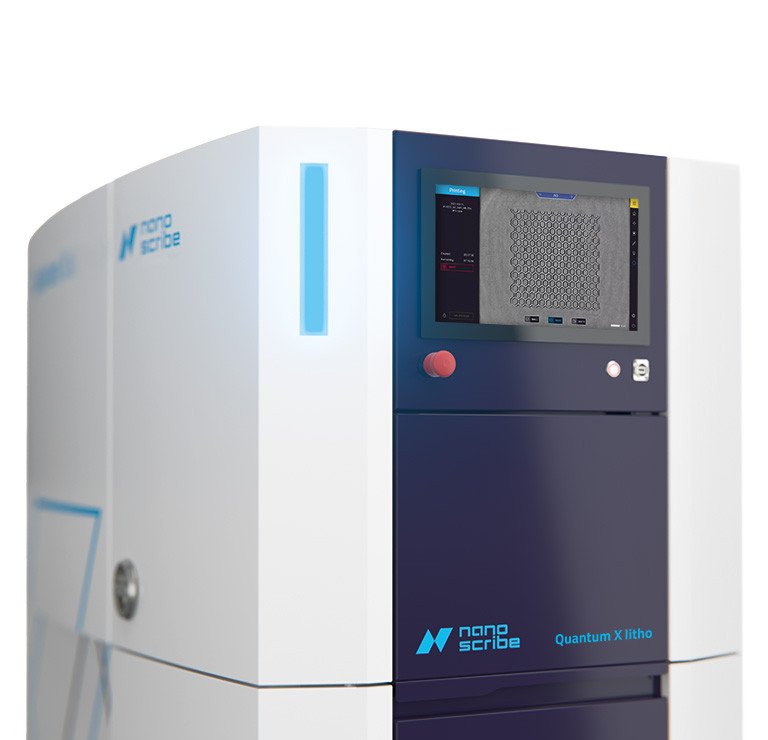
Quantum X litho enables precise, versatile and aligned grayscale lithography for high-throughput 2.5D microfabrication – powering rapid prototyping, patterning, master template fabrication and wafer-scale production. Quantum X litho is a versatile grayscale lithography system offering superior design freedom and streamlined workflows – from fast job setup to high-performance printing and post-processing. It enables high-throughput 2.5D microfabrication for applications such as rapid prototyping, advanced patterning, master template fabrication, and wafer-scale production. Powered by Two-Photon Grayscale Lithography 2GL®, the system delivers high-precision freeform micro-optics, microlens arrays, Fresnel lenses, and hybrid optical components that combine diffractive and refractive features. Grayscale lithography for advanced designs Quantum X litho also supports patterning of complex microfluidic architectures and bioinspired topographies, including organic nano- and microstructured surfaces. The proprietary 2GL® technology combines high throughput with exceptional shape accuracy, enabling advanced 2.5D designs with tall features up to 1,000 µm, thus exceeding conventional height limitations. Top-tier industrial performance 2GL® accelerates innovation through rapid design iteration — enabling sub-day cycles from concept to printed part. Structures printed with Quantum X litho seamlessly integrate into industrial replication workflows such as nanoimprint lithography, hot embossing, and micro injection molding. Combined with nanoPrintX, the confocal detection module ensures precise alignment for wafer-level production. The optional 3D printing by 2GL® mode expands the system’s capabilities toward advanced 3D printing. Included features - Stunningly rapid and accurate 2.5D printing enabled by Two-Photon Grayscale Lithography (2GL®) - Wafer-scale production on transparent and opaque wafers Optional features - High-resolution 3D printing based on Two-Photon Polymerization (2PP) for intricate nano-, micro- and mesostructures - Up to 60 times faster speeds at superior quality compared to classic 2PP, achieved through 3D printing by 2GL® (Two-Photon Grayscale Lithography) - Aligned 3D printing on various substrates enabled by Aligned 2-Photon Lithography (A2PL®) - Automatic alignment to fiducials on wafers enabled by confocal detection module - Automatic printing aligned to fiber cores enabled by the Fiber Printing Set - Automatic dispenser for efficient batch processing and wafer-level production Benchmark scores Surface roughness (R a) down to ≤5 nm Feature size control down to 100 nm in x/y direction Shape accuracy (S a) down to ≤ 200 nm Stitching-free part diameter up to 1,750 µm Maximum scan speed 6.25 m/s divided by lens magnification Given peak values, only achieved under specific conditions such as printing parameters, print heads, photoresins and designs. General system properties Stage Positioning volume 150 x 150 x 20 mm³ Stage repeatability ≤ 150 nm Fully printable wafers: 2", 4", and 6" Manufacturable wafers: up to 8" Substrates Wafers from 1" to 8" (25.4 mm to 200 mm) Glass, silicon, and further transparent and opaque materials Photoresins Nanoscribe polymer photoresins Open to third-party or custom materials
CATEGORY
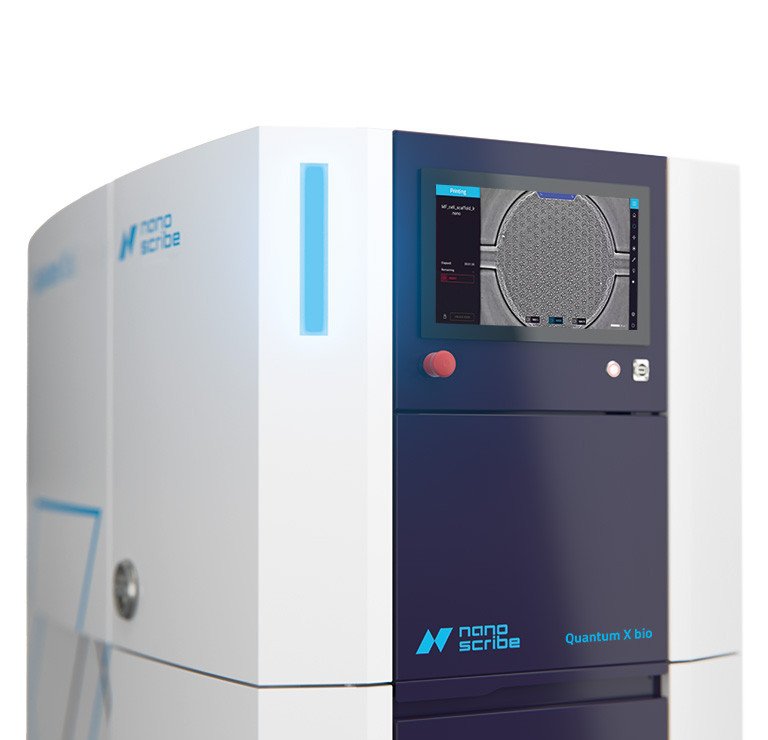
Empower your biomedical research with Quantum X bio, the high-resolution 3D bioprinter for tissue engineering, microfluidics and more. Enjoy unmatched freedom across a variety of substrates and biomaterials, from polymers to hydrogels. The Quantum X bio is a highly versatile, high-resolution 3D bioprinter powered by Two-Photon Polymerization (2PP). It enables the fabrication of detailed structures from subcellular to millimeter scale and supports sterile printing for biomedical research, tissue engineering, and microfluidics. Quantum X bio precisely prints organic designs and complex 3D structures into microfluidic chips and onto diverse substrates, using biomaterials from Nanoscribe, our partners or custom sources. Essential features like temperature and humidity control, a premixed air/CO₂ connection and HEPA-filtered airflow create a well-regulated environment, with the filtered airflow ensuring sterility. The high-resolution 3D bioprinter Quantum X bio is the optimal 3D biofabrication tool when resolution, precision, speed, biocompatible materials, and sterility are essential. Bioprinting library and smart workflow With Quantum X bio, you benefit from Nanoscribe’s intuitive software with touchscreen control, enabling easy print setup, execution, and monitoring — either directly on the device or remotely via nanoConnectX. The Bioprinting Model Library offers a growing selection of verified 3D designs to simplify your entry into high-resolution bioprinting. Continuous logging of temperature and humidity ensures cell-friendly conditions throughout the printing process. Included features - High-resolution bioprinting process with feature sizes down to ≤ 1 µm for subcellular structures based on Two-Photon Polymerization (2PP) - CO₂, temperature, and humidity control with heatable cell culture dishes enabled by Bioprinting Set - Access to the Bioprinting Model Library - Holders for a wide variety of substrates such as microscope slides and cell dishes Optional features - Rapid and accurate surface patterning enabled by Two-Photon Grayscale Lithography (2GL®) - Printing relative to fiducials/markers or chip edges, to support e.g. printing in microfluidic channels using Aligned 2-Photon Lithography (A2PL®) - Up to 60 times faster speeds at superior quality compared to classic 2PP, achieved through 3D printing by 2GL® (Two-Photon Grayscale Lithography) Benchmark scores Feature size control down to 100 nm in x/y direction Stitching-free part diameter up to 4,000 µm Maximum scan speed 6.25 m/s divided by lens magnification Live cell printing viability 90% Given values may vary depending on the photoresin and structure geometry. General system properties Stage Positioning volume 150 x 150 x 20 mm³ Stage repeatability ≤ 150 nm Fully printable wafers: 2", 4", and 6" Manufacturable wafers: up to 8" Substrates Microscope slides / microfluidic chips (3” x 1” / 76 x 26 mm 2) Cell culture imaging dishes (35 mm or 50 mm) Various flat substrates up to a size of 100 x 100 mm 2 Glass, silicon, and further transparent/opaque materials, and coated/uncoated substrates Photoresins Nanoscribe photoresins (polymer printing) Nanoscribe GP-Silica (glass printing) Open for third-party or custom materials Hydrogel bioresins from Advanced BioMatrix and BIO INX
CATEGORY
