An international collaboration involving Hokkaido University's high-voltage electron microscope has solved a puzzle about the atomic structure of metallic glasses that has baffled scientists for four decades.
Unlike crystalline alloys, atoms in metallic glasses are randomly organized, a structure called amorphous. This makes them stronger, more flexible and resistant to corrosion. Due to these excellent physical properties, they are used in sports equipment, medical devices and electricity transformers. But improving their properties requires a better understanding of their atomic structure.
In 1976, researchers used a technique, called differential scanning calorimetry, to measure the difference in the amount of heat required to increase the temperature of metallic glass alloys made of palladium, nickel and phosphorous (Pd-Ni-P). As they heated the Pd-Ni-P alloys, they found a thermodynamic inconsistency in the resulting curve that they couldn't properly explain, but it must have had to do with their structures.
Now, forty years later, an international research consortium led by City University of Hong Kong developed a method that combined various measuring techniques, allowing them to directly correlate changes in the structure of Pd-Ni-P metallic glass to temperature changes.
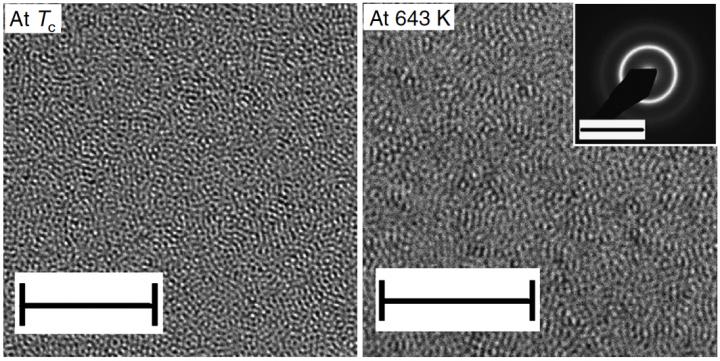
High-energy synchrotron X-ray diffraction was carried out while constant heating was simultaneously applied to Pd-Ni-P metallic glass at Argonne National Laboratory in the US. Separately, small-angle neutron scattering was performed at the OPAL reactor at the Australian Nuclear Science and Technology Organization. This was complemented by obtaining high-resolution images and electron diffraction patterns of the material's atomic structure using Hokkaido University's high voltage electron microscope.
The combined measurements revealed that Pd-Ni-P metallic glass has a hidden amorphous phase within a certain temperature range and the thermodynamic inconsistency is the consequence of a phase transition.
"The phase transition was found to involve the changes in how atom clusters were packed together. The atomic structure underwent significant changes over the medium-range length scales as large as 18Å," explains Dr. Tamaki Shibayama of Hokkaido University.
His collaborator Dr. Seiichi Watanabe added "This newly verified property appears to be linked to some metals' ability to form glass, which could allow us to manipulate their structures to develop larger and stronger novel materials."
This research was initiated as part of Hokkaido University's "Top-Collaboration Support Project."
Hidden amorphous phase and reentrant supercooled liquid in Pd-Ni-P metallic glasses
S. Lan, Y. Ren, X. Y. Wei, B. Wang, E. P. Gilbert, T. Shibayama, S. Watanabe, M. Ohnuma & X. -L. Wang
Nature Communications 8, Article number: 14679 (2017)
doi:10.1038/ncomms14679
Hokkaido University
#Nanostructures #MaterialScience