Argonne National Laboratory (ANL)
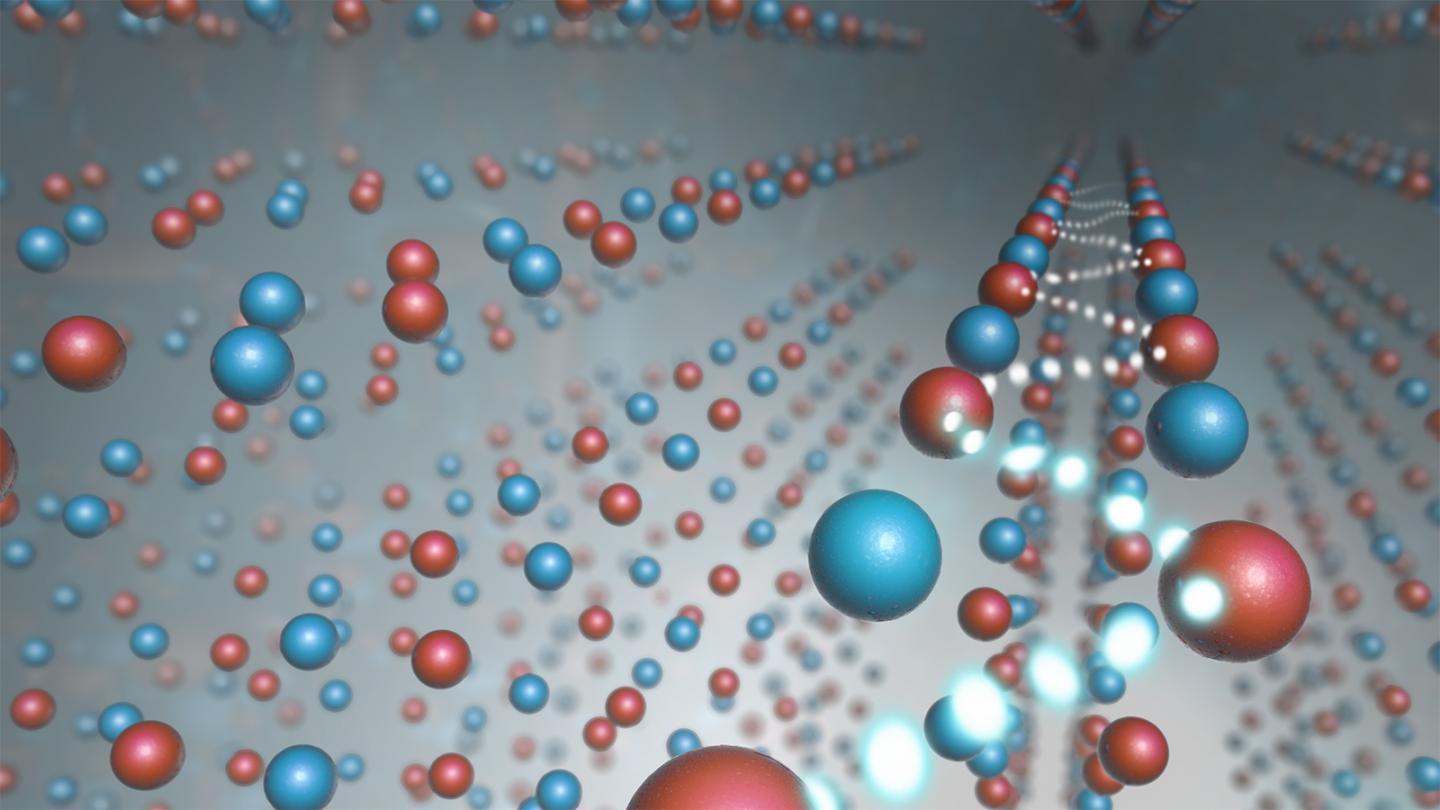
Argonne team develops a powerful technique for probing in three dimensions the crystalline structure of cathode materials at the nanoscale.
One of the many strengths of the U.S. Department of Energy's (DOE) Argonne National Laboratory is its ability to assemble deep and broad multidisciplinary teams to solve complex scientific problems. These teams have at their disposal a wealth of world-class facilities for conducting research, including the Advanced Photon Source (APS) -- a DOE Office of Science User Facility that provides ultra-bright, high-energy X-ray beams for forefront materials research.
One such Argonne team has developed a powerful new technique for probing in three dimensions the crystalline microstructure for the cathode materials of next-generation batteries. Such batteries could one day revolutionize energy storage for both transportation and the electric grid.
"Our project demanded a multidisciplinary team with expertise in battery materials and chemistry, X-ray scattering, computer programming and complex data analysis -- expertise readily available at Argonne," said Raymond Osborn, co-principal investigator of this project in Argonne's Materials Science division along with Stephan Rosenkranz. "This is a perfect example of science at scale, leveraging Argonne's multidisciplinary team and world-class facilities to solve complex problems with a potential societal impact."
The team included researchers from four Argonne divisions: Materials Science, Chemical Sciences and Engineering, Data Science and Learning and X-ray Science. Postdoctoral appointee Matthew Krogstad in the Materials Science division was responsible for key innovations that made success in the project possible.
Also key to success was use of the high-energy X-ray beams available only at synchrotron facilities such as the APS and the Cornell High Energy Synchrotron Source (CHESS) located at Cornell University. "Very high-energy X-rays, such as those available at the APS, penetrate deep within the cathode material, making these cutting-edge measurements possible," said Jonathan Lang, director of the APS X-ray Science division.
"Our project demanded a multidisciplinary team with expertise in battery materials and chemistry, X-ray scattering, computer programming and complex data analysis -- expertise readily available at Argonne." -- Raymond Osborn, co-principal investigator.

The fruit of this multidisciplinary project is an important new tool for probing what happens during the process of "intercalation" -- the insertion of ions between the layers of a cathode when a battery generates electricity. Following this process is "deintercalation" -- the extraction of those same ions from the cathode when a battery is charging.
The conventional lithium-ion battery operates by this process. In the search for better cathode materials, scientists have employed X-ray and electron diffraction to determine how lithium ions or other intercalants can develop long-range ordered structures. Such structures impede the motion of the metal ions within the cathode, thereby hindering their extraction and insertion during cycling and diminishing battery performance.
Hidden from view until now, however, has been the short-range order, which also disrupts ionic mobility, but cannot be observed by conventional diffraction techniques.
"Short-range order is extremely challenging to measure and even harder to model," Osborn noted, "but recent advances at synchrotron sources now make it practical to utilize new techniques to visualize the results and monitor the ionic correlations in detail as a function of temperature."
The research team first prepared a single crystal of a layered vanadium oxide cathode material with inserted sodium ions. They selected this material because sodium-ion batteries are being considered as an alternative to lithium-ion batteries due to the greater abundance and lower cost of sodium.
At APS and CHESS, team members then measured the scattering of high-energy X-rays from the crystal and determined the short-range correlations between the sodium ions within the crystal structure at different temperatures. From these measurements, they determined the probability of whether every possible atomic site within the crystal structure was occupied by an atom or not, using a method known as "3D-ΔPDF."
"The data are of such high quality that these 3D probability maps look just like atomic-scale images," Krogstad said. "You can see where the sodium ions are without having to perform any complicated analysis. We were stunned when we first saw how intuitive the results were to understand."
These three-dimensional "images" revealed that the sodium ions form a zig-zag pattern in separate columns among the vanadium oxide atoms (see figure). This atomic ordering within the crystal structure increases with decreasing temperature below room temperature. In a sodium battery, the ions would diffuse along the zig-zag pathways.
"The greater the disruption in that zig-zag pattern," explained Osborn, "the better for ion mobility. And the better the ion mobility, the better the performance of the cathode material."
"These findings are yielding a much improved understanding of how order-disorder transitions limit the mobility of sodium ions," Rosenkranz said. "Researchers might also use such measurements to assess the effectiveness of strategies to diminish such negative effects and thereby boost cathode performance."
"While our research focused on a select cathode material in a sodium-ion battery," added Rosenkranz, "our method applies to investigating the short-range order in many other crystalline materials with a variety of technological applications as a function of temperature or other variables."
Reciprocal space imaging of ionic correlations in intercalation compounds
Matthew J. Krogstad, Stephan Rosenkranz, Justin M. Wozniak, Guy Jennings, Jacob P. C. Ruff, John T. Vaughey & Raymond Osborn
Nature Materials (2019)
DOI: 10.1038/s41563-019-0500-7
Contact information:
Raymond Osborn, Senior Physicist at ANL
rosborn@anl.gov (630) 252-9011
Stephan Rosenkranz, Senior Physicist at ANL
SRosenkranz@anl.gov (630) 252-5475
Justin M. Wozniak, Computer Scientist at ANL
woz@anl.gov (630) 252-3351
John T. Vaughey, Senior Chemist at ANL
vaughey@anl.gov (630) 252-8885
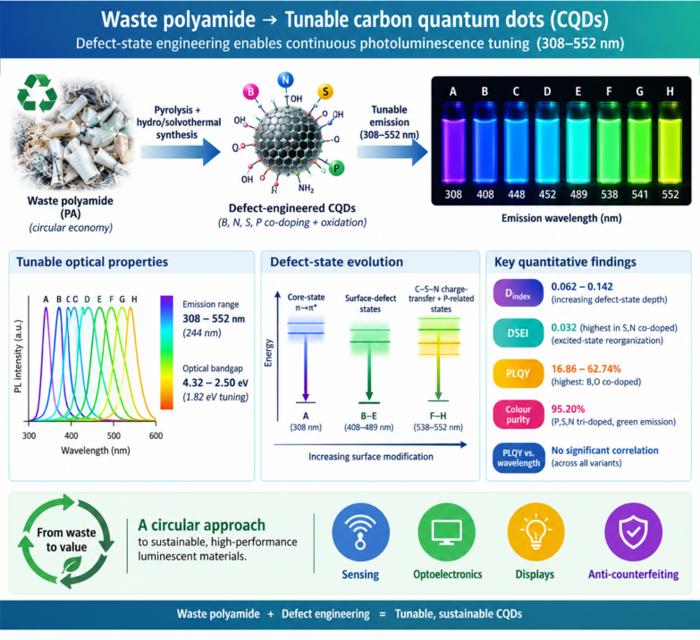
Waste polyamide-derived CQDs show continuous photoluminescence tuning from 308 to 552 nm through sequential defect-state engineering, with optical transition energies decreasing from 4.32 to 2.50 eV. @Christian Ebere Enyoh from Saitama University Carbon quantum dots (CQDs) are fluorescent carbon nanomaterials with potential applications in sensing, optoelectronics, displays, anti-counterfeiting, and environmental technologies. Their optical properties can be adjusted by modifying the carbon...
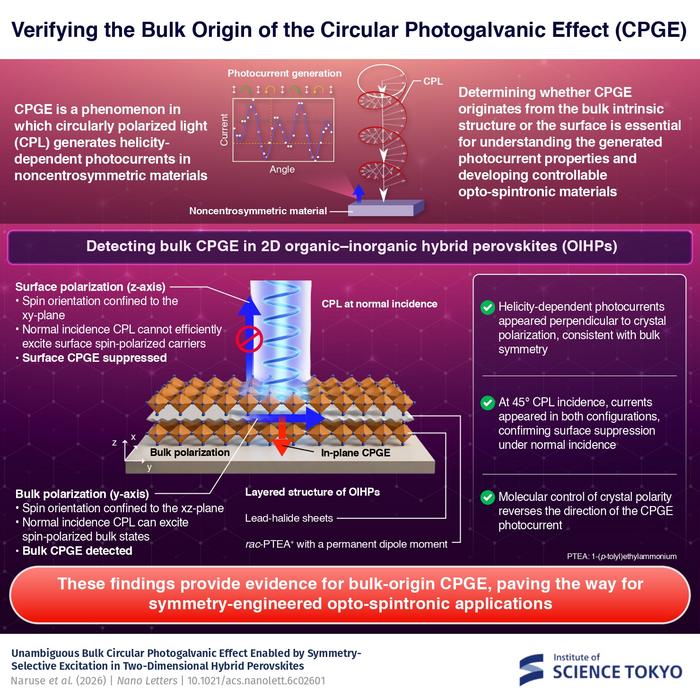
The researchers used circularly polarized light at normal incidence and found that helicity-dependent photocurrents appeared perpendicular to the crystal’s polarization but vanished when measured parallel to it, supporting a bulk origin of CPGE. @Institute of Science Tokyo The circular photogalvanic effect (CPGE), a phenomenon that generates helicity-dependent photocurrents in noncentrosymmetric materials, can originate purely from a crystal's internal structure without contribution from the...
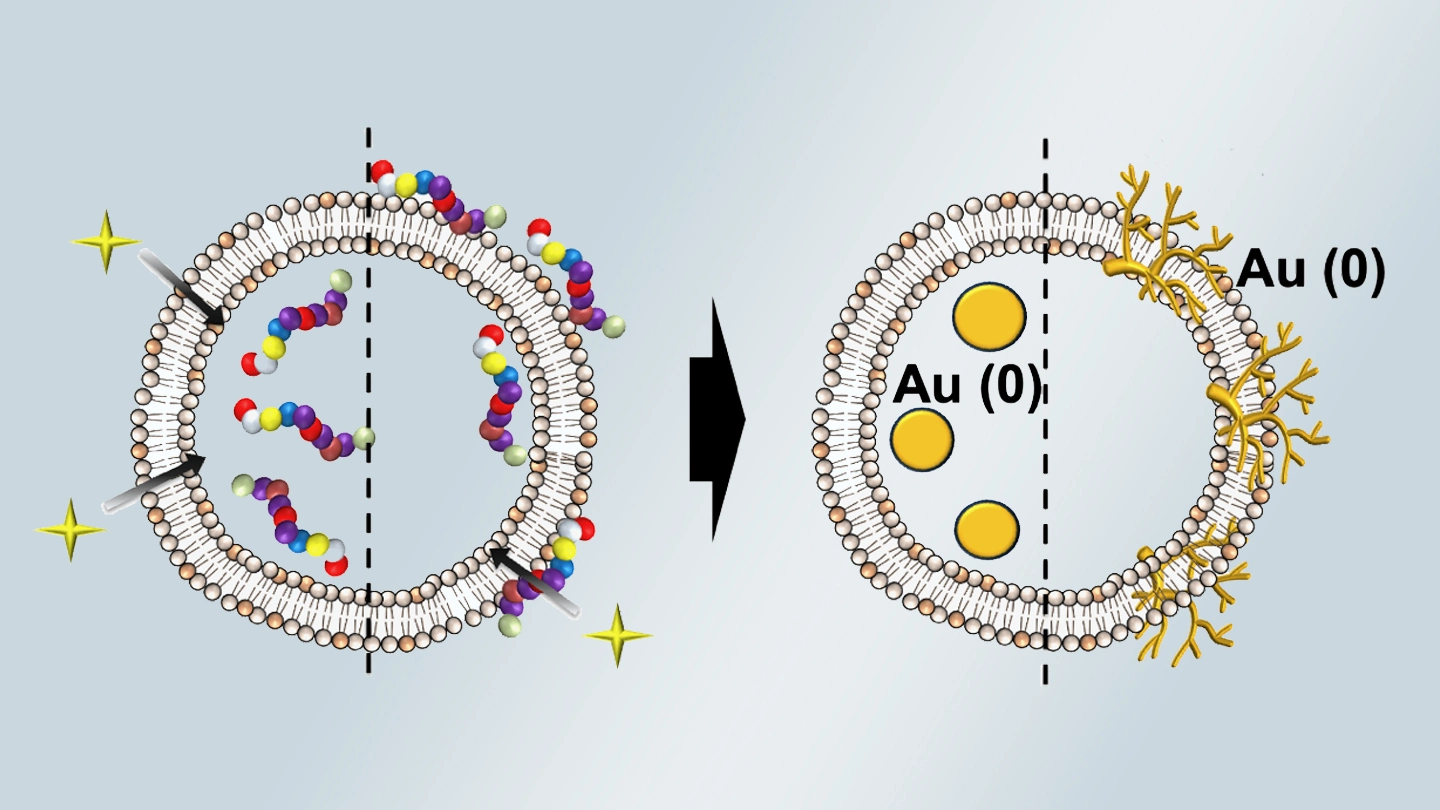
Summary of gold nanoparticle growth programming in liposome based on localization of biomineralization peptide The position of biomineralization peptides within liposomes can influence how gold nanoparticles grow, reports a research team from Institute of Science Tokyo. Peptides localized at the membrane interface promote branched structures, while those confined to the liposome interior favor spherical nanoparticles. The findings offer a new strategy for controlling nanoscale reaction...
