
Caltech and Broadcom today announced a multi-year partnership to advance quantum science research and discoveries with the potential to seed new innovative technologies and applications.
The partnership, supported with a significant investment from Broadcom, will establish the Broadcom Quantum Laboratory at Caltech, a physical collaboration space that will bring together experts in the fields of quantum computing, quantum sensing, quantum measurement, and quantum engineering. Broadcom's investment will support joint programming and research to accelerate discovery.
Additionally, over the next five years, Broadcom and Caltech have agreed to host an annual symposium where scientists and engineers from both organizations will explore areas of mutual interest and future development opportunities in relevant fields.
"Developing deep connections to technology leaders like Broadcom amplifies the power of the science and engineering that Caltech can accomplish," says Caltech President Thomas F. Rosenbaum, the Sonja and William Davidow Presidential Chair and professor of physics. "We share a belief in the transformative potential of quantum discoveries across the disciplines and welcome this new partnership."
"Broadcom is thrilled to partner with Caltech to launch this critical R&D initiative on quantum computing. As a world-class leader in science and engineering research, Caltech has a long and rich history of technology innovation," says Hock Tan, President and CEO of Broadcom. "This multi-year investment and engineering collaboration reinforces our continued commitment to supporting advanced R&D and represents our relentless pursuit of innovation to connect our customers, employees and communities worldwide."
Caltech is one of the world's preeminent institutions for quantum science research, with faculty positioned across the Institute working on theoretical and experimental advances that have the potential to impact everything from energy storage to drug design, to information processing and security. The Institute's faculty have been at the forefront of the field since the 1980s when the late Richard Feynman, a Caltech theoretical physicist who pioneered quantum computing and introduced the concept of nanotechnology, first posited that quantum computers would be necessary for future advanced computing systems and problems.

Researchers from Rutgers, IBM and collaborators demonstrated real-time quantum feedback control on a 156-qubit Heron processor, using up to 100 connected qubits. By alternately scrambling information and resetting qubits nearly 5,000 times each, they steered the system from chaos to an ordered state, revealing a sharp phase transition.

Oxford physicists used a hybrid quantum computer, pairing trapped-ion qubits with quantum oscillators, to simulate the Aharonov-Bohm effect inside a lattice gauge theory. Encoding magnetic flux in entangled qubits made the gauge field dynamical, and the resulting destructive interference froze matter tunneling entirely.
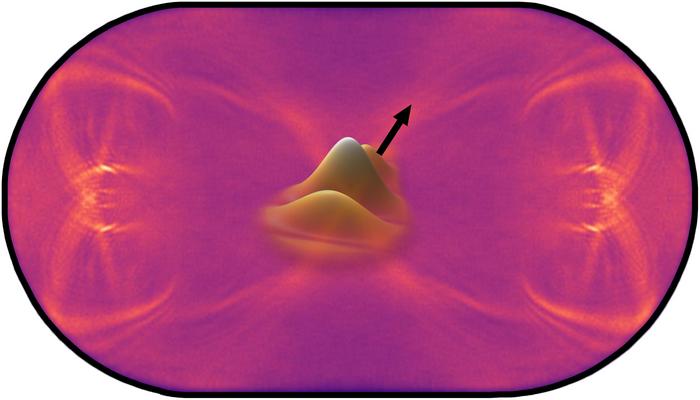
A quantum "wave packet" (in the middle) launched from the same kind of starting point behaves differently. Even after bouncing around for a very long time, faint filament-like patterns (bright glow) are still visible, a tattoo tracing back to its early history. This lingering imprint is the "quantum birthmark" described in the study. Credit: Joonas Keski-Rahkonen, Tampere University Even the most chaotic quantum systems keep a permanent mark of their own past – a "quantum birthmark" – that...






