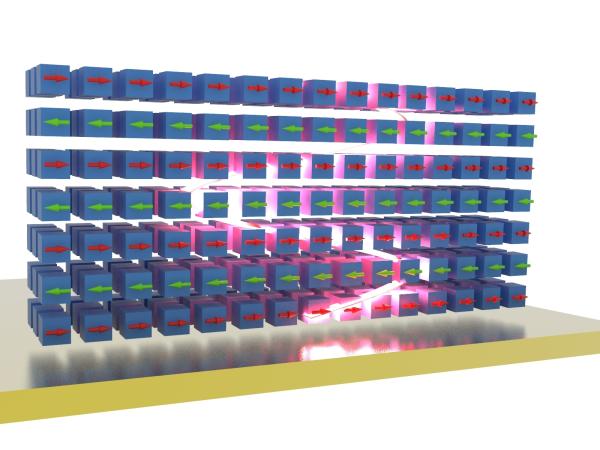
A new study led by Vinod M. Menon and his research group at The City College of New York shows that trapping light inside magnetic materials may dramatically enhance their intrinsic properties. Strong optical responses of magnets are important for the development of magnetic lasers and magneto-optical memory devices, as well as for emerging quantum transduction applications.
In their new article in the journal "Nature," Menon and his team report the properties of a layered magnet that hosts strongly bound excitons -- quasiparticles with particularly strong optical interactions. Because of that, the material is capable of trapping light -- all by itself. As their experiments show, the optical responses of this material to magnetic phenomena are orders of magnitude stronger than those in typical magnets. "Since the light bounces back and forth inside the magnet, interactions are genuinely enhanced," said Dr. Florian Dirnberger, the lead-author of the study. "To give an example, when we apply an external magnetic field the near-infrared reflection of light is altered so much, the material basically changes its color. That's a pretty strong magneto-optic response."
"Ordinarily, light does not respond so strongly to magnetism," said Menon. "This is why technological applications based on magneto-optic effects often require the implementation of sensitive optical detection schemes.”
On how the advances can benefit ordinary people, study co-author Jiamin Quan said: “Technological applications of magnetic materials today are mostly related to magneto-electric phenomena. Given such strong interactions between magnetism and light, we can now hope to one day create magnetic lasers and may reconsider old concepts of optically controlled magnetic memory." Rezlind Bushati, a graduate student in the Menon group, also contributed to the experimental work.
Reference
Magneto-optics in a van der Waals magnet tuned by self-hybridized polaritons
Florian Dirnberger, Jiamin Quan, Rezlind Bushati, Geoffrey M. Diederich, Matthias Florian, Julian Klein, Kseniia Mosina, Zdenek Sofer, Xiaodong Xu, Akashdeep Kamra, Francisco J. García-Vidal, Andrea Alù & Vinod M. Menon
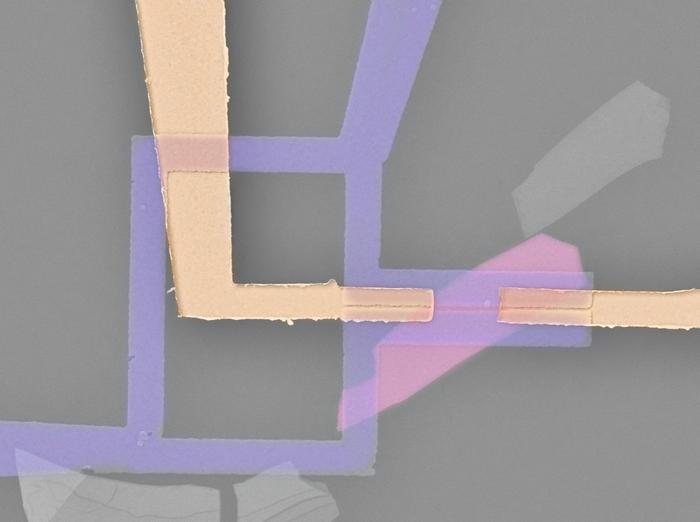
Physicists at the University of Cologne have observed quantum states in a topological insulator Josephson junction that match theoretical predictions, using tunneling spectroscopy to probe highly transmissive Andreev states across a range of charge-carrier densities. The results support a long-standing model of how superconductivity interacts with topological surface states, a key step toward Majorana zero modes and topological qubits.
Infleqtion operated its Tiqker optical atomic clock continuously for two weeks aboard the U.S. Navy's RV Merlin during the Maritime Big Play Pacific exercise, in the Southern California operating area.

IQM Quantum Computers said its cloud-accessible IQM Emerald system fully entangled all 54 qubits simultaneously. The company reported a fidelity of 0.516 at the full 54 qubits with readout error mitigation applied.
This week in nanotech
$3.4M raised
1 funding round · 17 deals tracked
New products
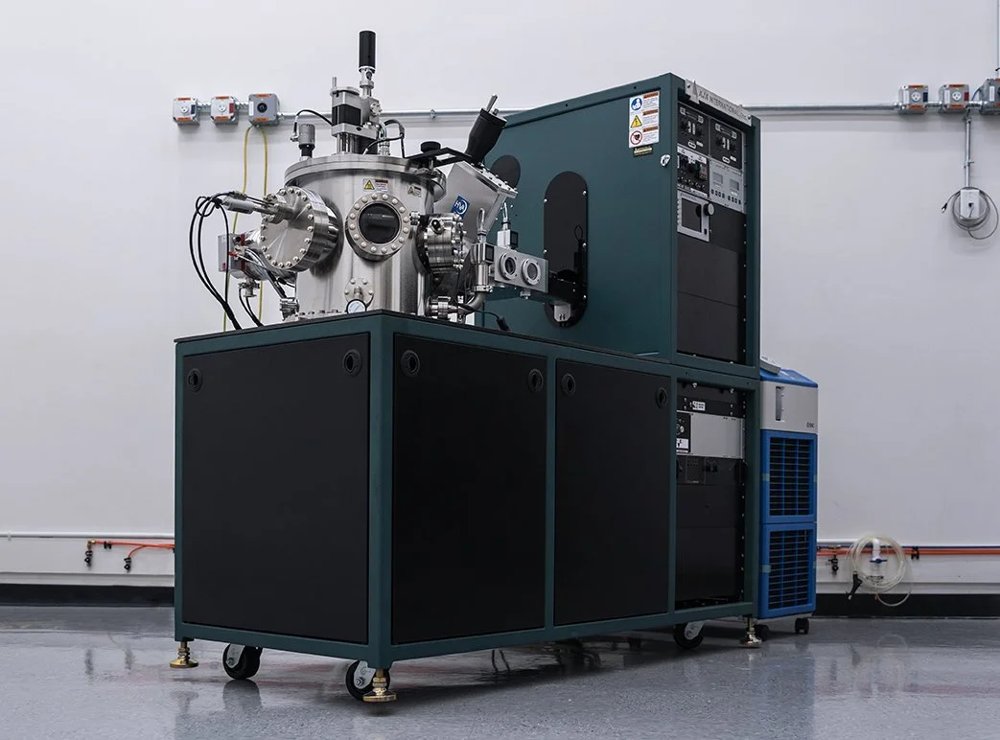 Orion Sputtering Deposition SystemsAJA International Featured
 Nion-compatible In Situ STEM Holders for Electrical BiasingHummingbird Scientific Featured
 GiiiGii
Market insights
Last 30 days: Quantum Technologies was the busiest vertical: 60 of 192 events (31%).
Money raised per month