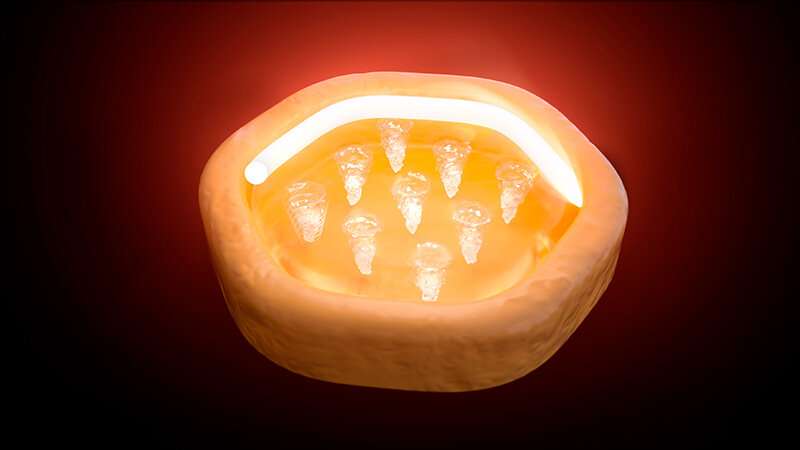
Graphene has been the focus of intense research in both academic and industrial settings due to its unique electrical conduction properties. As the thinnest material known to man, graphene is essentially two-dimensional and has distinct electronic and photonic properties from conventional 3D materials. Researchers at Purdue University (Todd Van Mechelen, Wenbo Sun and Zubin Jacob) have shown that graphene's viscous fluid (colliding electrons in solids can behave like fluids) support unidirectional electromagnetic waves on the edge. These "edge waves" are linked to a new topological phase of matter and symbolize a phase transition in the material, not unlike the transition from solid to liquid.
A remarkable feature of this new phase of graphene is that light travels in one direction along the edge of the material and is robust to disorder, imperfections and deformation. Purdue researchers have harnessed this nonreciprocal effect to develop "topological circulators"—one-way routers of signals, the smallest in the world—that could be a breakthrough for on-chip, all-optical processing.
Circulators are a fundamental building block in integrated optical circuits but have resisted miniaturization because of their bulky components and the narrow bandwidth of current technologies. Topological circulators overcome this by being both ultra-subwavelength and broadband, enabled by a unique electromagnetic phase of matter. Applications include information routing and inter-connects between quantum and classical computing systems.
The research was published in Nature Communications.
Reference
Optical N-invariant of graphene’s topological viscous Hall fluid
Todd Van Mechelen, Wenbo Sun & Zubin Jacob
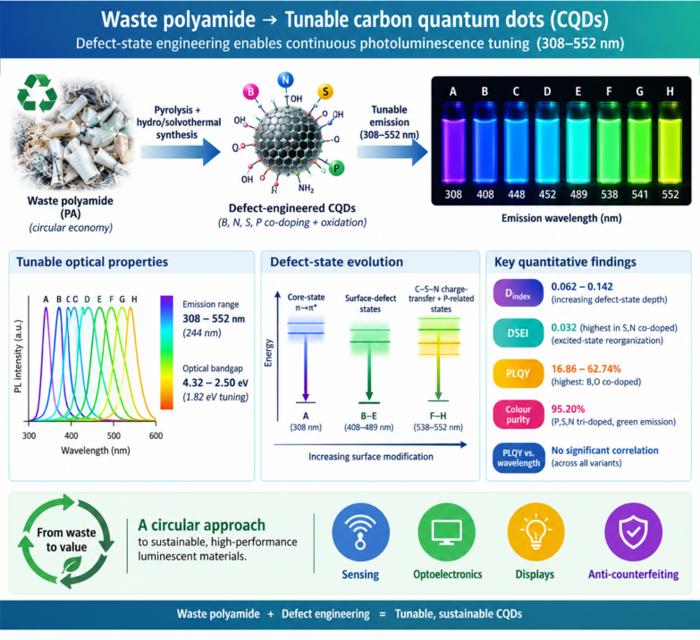
Waste polyamide-derived CQDs show continuous photoluminescence tuning from 308 to 552 nm through sequential defect-state engineering, with optical transition energies decreasing from 4.32 to 2.50 eV. @Christian Ebere Enyoh from Saitama University Carbon quantum dots (CQDs) are fluorescent carbon nanomaterials with potential applications in sensing, optoelectronics, displays, anti-counterfeiting, and environmental technologies. Their optical properties can be adjusted by modifying the carbon...
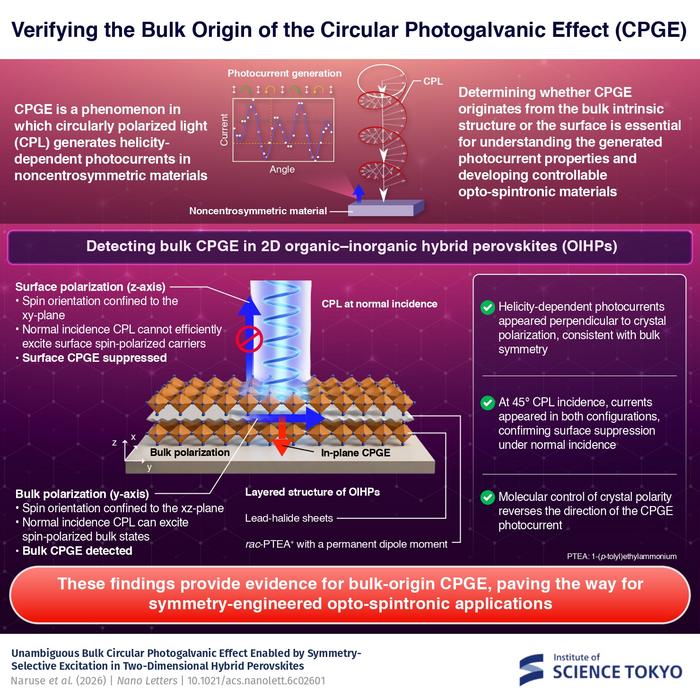
The researchers used circularly polarized light at normal incidence and found that helicity-dependent photocurrents appeared perpendicular to the crystal’s polarization but vanished when measured parallel to it, supporting a bulk origin of CPGE. @Institute of Science Tokyo The circular photogalvanic effect (CPGE), a phenomenon that generates helicity-dependent photocurrents in noncentrosymmetric materials, can originate purely from a crystal's internal structure without contribution from the...
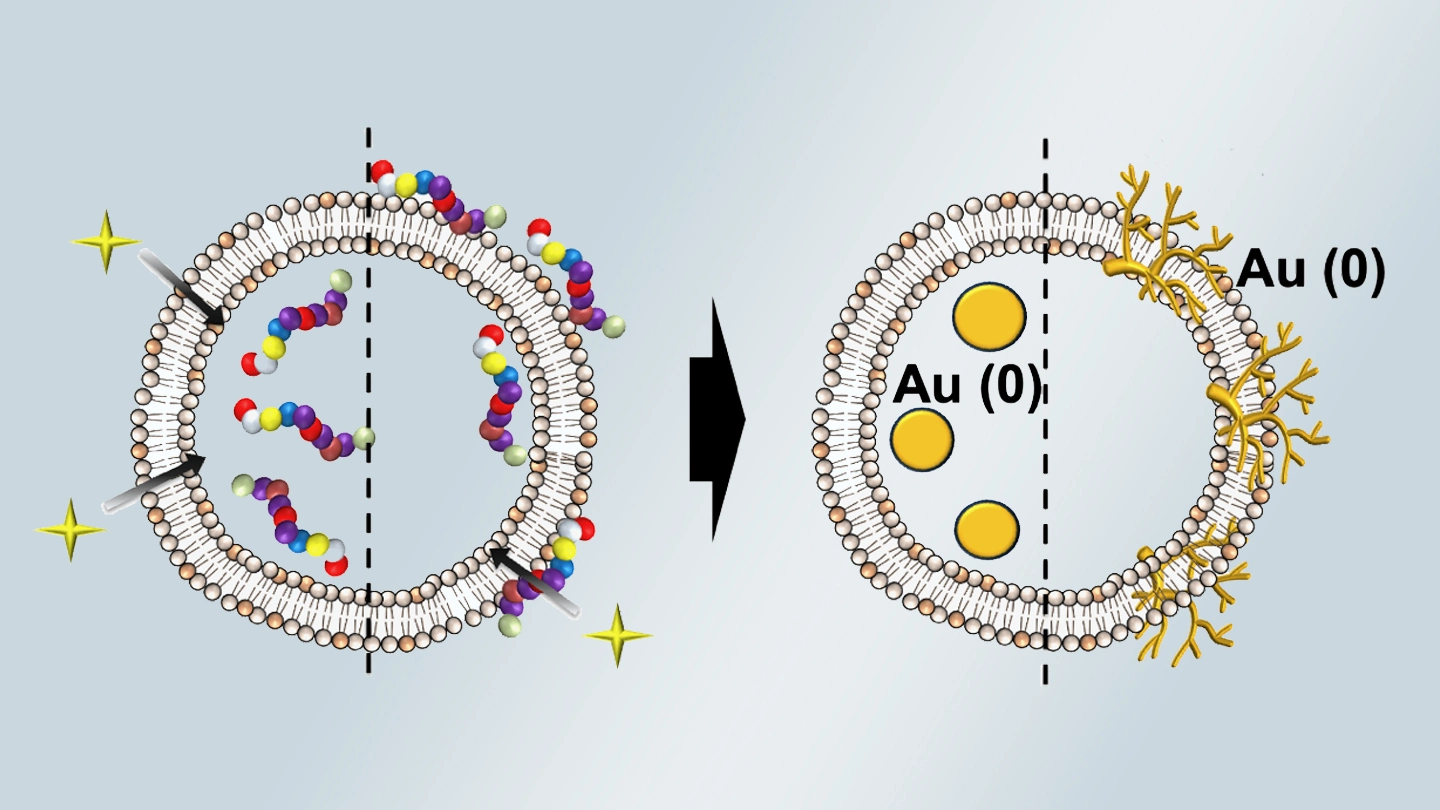
Summary of gold nanoparticle growth programming in liposome based on localization of biomineralization peptide The position of biomineralization peptides within liposomes can influence how gold nanoparticles grow, reports a research team from Institute of Science Tokyo. Peptides localized at the membrane interface promote branched structures, while those confined to the liposome interior favor spherical nanoparticles. The findings offer a new strategy for controlling nanoscale reaction...
