Deutsches Elektronen-Synchrotron

Photocatalysis, sensors, solar cells: nanoparticles that are excited by light promise a variety of applications, if the processes behind their behaviour can be controlled. One such process is a type of collective electron motions. These movements lead to energy exchange in the nanoparticle that give them their characteristics but that can also be disruptive. However, so far the exact behaviour of those movements was unclear. A research team comprising scientists from the Center for Free-Electron laser Science (CFEL) at DESY, Universität Hamburg, the Max-Planck-Institute for the Structure and Dynamics of Matter, Hamburg, and TU Berlin reports in the journal Nano Letters experimental observations of a molecular movie recorded at DESY’s FLASH free-electron laser that cannot be explained by established models. In response to these findings, the team has provided a new theoretical model that explains their experimentally observed dynamics of the excited gold nanoparticles.
The collective electron oscillations found in nanoparticles, called plasmons, are associated with highly localized fields. Scientists have debated how these oscillations decay – in other words, how the motion tapers off, like how ripples in a pond fade. Researchers assumed that plasmons generated very energetic “hot” electrons, which would then lose their energy by scattering off other electrons within the plasmon field, forming what is called a “warm” electron gas. That gas would then heat up the nanoparticle, which would eventually release the excess energy into the environment – something that should be controlled. The efficiency of the energy transfer between the “hot electron”, “warm electron”, and “warm particle” stages is important for applications making use of these processes, such as in solar cells and sensors. In particular, the energy transfer from the warm electron gas to the overall nanoparticle appears to be so efficient that the particle is heated extremely quickly. In the process, it expands explosively, causing the entire nanoparticle to oscillate collectively, almost as if it were a breathing sphere.
However, up so far there were no experimental studies directly observing this “breathing” oscillation. For their current study, the researcher team, led by Holger Lange, DESY leading scientist Jochen Küpper, and Kartik Ayyer, who all conduct research in the Cluster of Excellence "CUI: Advanced Imaging of Matter", and Andreas Knorr from TU Berlin, combined theory and experiment for an accurate description of the dynamics of excited gold nanoparticles. Using FLASH, the team performed single-particle xX-ray diffractive imaging, which they combined with transient absorption spectroscopy performed in the laboratory at Universität Hamburg to determine both the structural size and the electron energies of the nanoparticles after optical excitation as a function of time. Their results were surprising: the particles had already expanded with the optical excitation pulse, much faster than previously assumed, and before the “warm” electron gas could form. This meant that the excitation of electrons by the light directly played a much stronger role in the expansion of the particle.
To explain their findings, the researchers set up a new, fundamental model of plasmon behaviour. Their explanation, based on new calculations, now provides a consistent picture of the observations and why the nanoparticle was expanding so quickly. The calculations confirmed the experimental results, giving a consistent picture of all observed aspects of the excitation. Two source terms for the “particle breathing” emerge from the calculations: the "classical" thermal expansion and a new effect, optically induced redistributions of the electrons, which directly drive the oscillation. The new excitation term shows that plasma-dynamics processes are a lot more intertwined than assumed and that existing models on warm and hot electrons must be questioned, with implications for photocatalysis and other energy transformation pathways.
The new theoretical model also provides a general approach to the plasmon particle interaction and is already being used further projects.
Reference
Time-Resolved Single-Particle X-ray Scattering Reveals Electron-Density Gradients As Coherent Plasmonic-Nanoparticle-Oscillation Source
Dominik Hoeing, Robert Salzwedel, Lena Worbs, Yulong Zhuang, Amit K. Samanta, Jannik Lübke, Armando D. Estillore, Karol Dlugolecki, Christopher Passow, Benjamin Erk, Nagitha Ekanayake, Daniel Ramm, Jonathan Correa, Christina C. Papadopoulou, Atia Tul Noor, Florian Schulz, Malte Selig, Andreas Knorr, Kartik Ayyer, Jochen Küpper, and Holger Lange
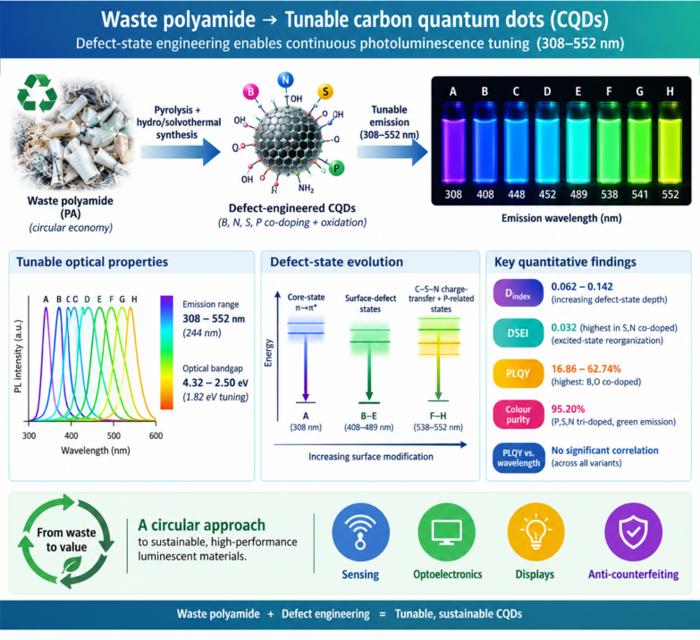
Waste polyamide-derived CQDs show continuous photoluminescence tuning from 308 to 552 nm through sequential defect-state engineering, with optical transition energies decreasing from 4.32 to 2.50 eV. @Christian Ebere Enyoh from Saitama University Carbon quantum dots (CQDs) are fluorescent carbon nanomaterials with potential applications in sensing, optoelectronics, displays, anti-counterfeiting, and environmental technologies. Their optical properties can be adjusted by modifying the carbon...
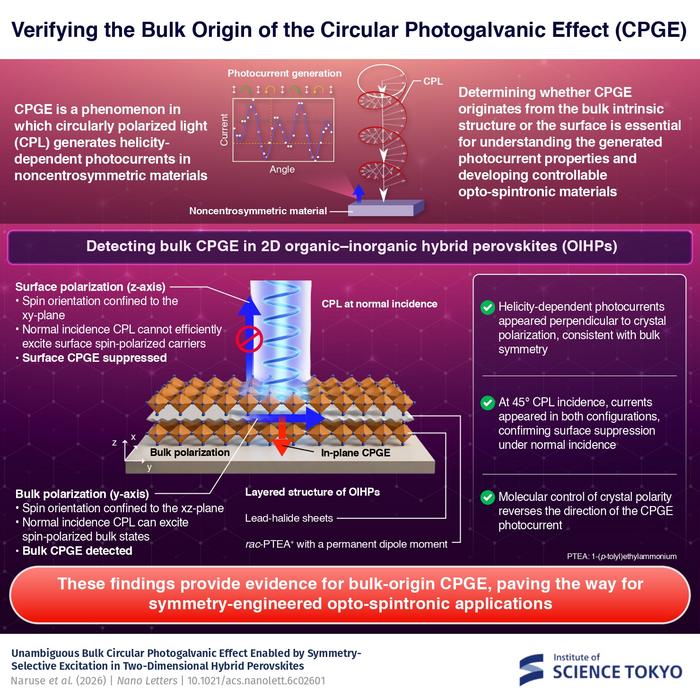
The researchers used circularly polarized light at normal incidence and found that helicity-dependent photocurrents appeared perpendicular to the crystal’s polarization but vanished when measured parallel to it, supporting a bulk origin of CPGE. @Institute of Science Tokyo The circular photogalvanic effect (CPGE), a phenomenon that generates helicity-dependent photocurrents in noncentrosymmetric materials, can originate purely from a crystal's internal structure without contribution from the...
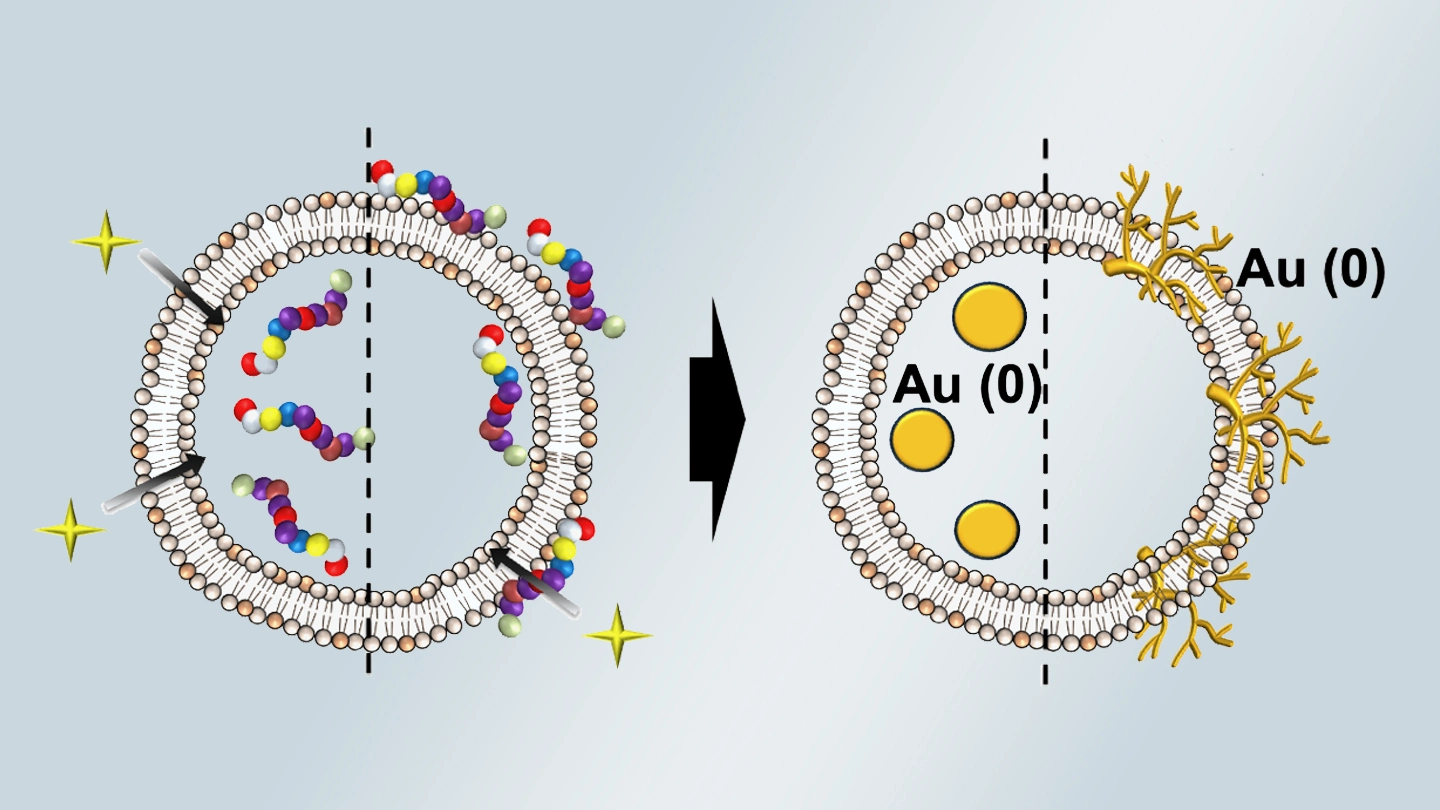
Summary of gold nanoparticle growth programming in liposome based on localization of biomineralization peptide The position of biomineralization peptides within liposomes can influence how gold nanoparticles grow, reports a research team from Institute of Science Tokyo. Peptides localized at the membrane interface promote branched structures, while those confined to the liposome interior favor spherical nanoparticles. The findings offer a new strategy for controlling nanoscale reaction...
