Science China Press
What if recharging your electric car took no longer than filling up a tank of gas, and the battery lasted for decades? Scientists have long pinned their hopes on lithium metal batteries to make this a reality. Dubbed the "holy grail" of energy storage, lithium metal offers a theoretical capacity nearly ten times that of the graphite used in today's smartphones and electric vehicles. Yet every time researchers get close, the metal sprouts microscopic, tree-like filaments called dendrites that pierce the battery, cause short circuits, and can even trigger fires.
Now, a team at Xidian University in China may have found a way to tame this unruly metal with a surprisingly simple chemical trick: painting its surface with a liquid that turns into a durable, multi-functional armor in situ.
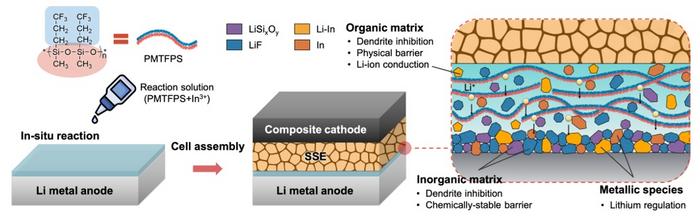
In a study published in SCIENCE CHINA Chemistry, researchers led by Professors Siwu Li, Weiwei Wu, and Chuang Yu describe a one-step solution-cast coating that transforms a standard lithium metal surface into a hybrid shield. The coating combines a silicon-based polymer with indium chloride. When applied to lithium, the metal's natural chemical drive triggers an in-situ reduction reaction. The polymer's fluorine groups convert into lithium fluoride, a rock-solid electrical insulator, while indium ions reduce and alloy with lithium to form tiny nanoparticles. All of this happens within a flexible, 12-micrometer-thick film that clings tightly to the lithium surface.
"This hybrid layer acts like a smart fortress," explains corresponding author Siwu Li. "The polymer backbone provides flexibility to absorb the mechanical stress of lithium expanding and contracting. The lithium fluoride phase blocks electrons to prevent dendrite nucleation. And the lithium-indium alloy nanoparticles act as traffic conductors, guiding lithium ions to deposit evenly rather than piling up in dangerous spikes."
The numbers tell a striking story. In symmetric cell tests, the protected lithium anode sustained a critical current density of 3.5 mA cm⁻², more than four times the 0.8 mA cm⁻² that unprotected lithium can handle before failing. In full cells paired with a nickel-cobalt-manganese oxide cathode and a sulfide solid electrolyte, the new design delivered an initial capacity of 129.8 mA h g⁻¹ and retained 82.3% of that capacity after 300 cycles at 0.5C. Bare lithium cells retained only 43.0%.
The researchers used advanced spectroscopy and microscopy to confirm the hybrid architecture. X-ray diffraction and photoelectron spectroscopy revealed organic siloxane networks alongside crystalline lithium fluoride, metallic indium, and lithium-indium alloy. Cross-sectional electron microscopy showed a dense, uniform film with no cracks or gaps.
Importantly, the chemistry is compatible with industrial roll-to-roll manufacturing. Because the coating is applied as a simple liquid solution, it could be integrated into existing battery production lines using slot-die or gravure coating techniques, with no expensive vacuum chambers required.
Solid-state batteries are widely viewed as the next frontier for electric vehicles and grid-scale energy storage because they replace flammable liquid electrolytes with safer solid materials. Sulfide electrolytes are particularly attractive due to their exceptionally high ionic conductivity, but their instability against lithium metal has been a major roadblock. This new interface engineering strategy effectively removes that roadblock without sacrificing performance.
The team believes their approach opens the door to designing other hybrid interfaces by swapping indium for alternative metals such as tin or zinc. For now, the polysiloxane-indium chemistry offers a scalable, low-cost path toward the high-energy, long-life batteries that could one day power everything from electric aviation to renewable energy grids.
Reference
In situ reductive construction of a silicon-based polymer/indium alloy hybrid layer for stable lithium metal anodes in sulfide solid-state batteries
Kun Song, Qun Zhao, Xianbo Zhao, Siwu Li, Jun Liu, Haitao Chen, Weiwei Wu, and Chuang Yu
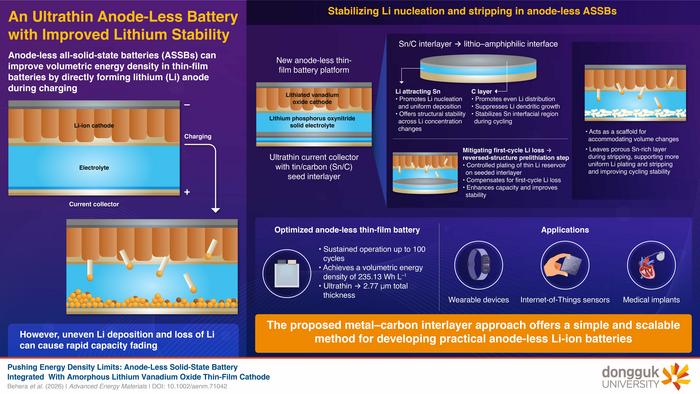
An anode-less solid-state thin-film battery using an ultrathin tin/carbon interlayer on a copper current collector has been developed, guiding uniform lithium plating and cutting lithium loss during cycling. The 2.77 micrometer cell pairs a lithium vanadium oxide cathode with a LiPON solid electrolyte and reached 235.13 Wh/L at the 100th cycle. A prelithiation step supplies a lithium reservoir to offset early losses.
Researchers at the University of Córdoba have used vitamin B12, or cobalamin, as a catalyst in a zinc-air battery for the first time, anchoring the biomolecule to single-walled carbon nanotubes to keep it stable in an aqueous electrolyte. The cobalt at its core drives oxygen reduction on discharge and oxygen production on recharge, enabling up to 250 cycles.
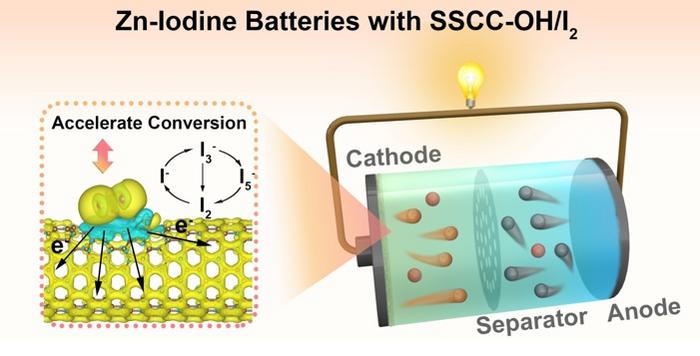
Researchers at Jilin University and the Changchun Institute of Applied Chemistry have shown that hydroxyl functional groups on self-supporting carbon nanotube cathodes stabilize aqueous zinc-iodine batteries. Density functional theory guided the choice of surface groups, and the hydroxyl-modified cathode confined iodine species within its porous nanotube channels. It retained 89.34% of capacity after more than 10,000 cycles and suppressed the iodine shuttle effect.
This week in nanotech
$13.6M raised
3 funding rounds · 20 deals tracked
New products
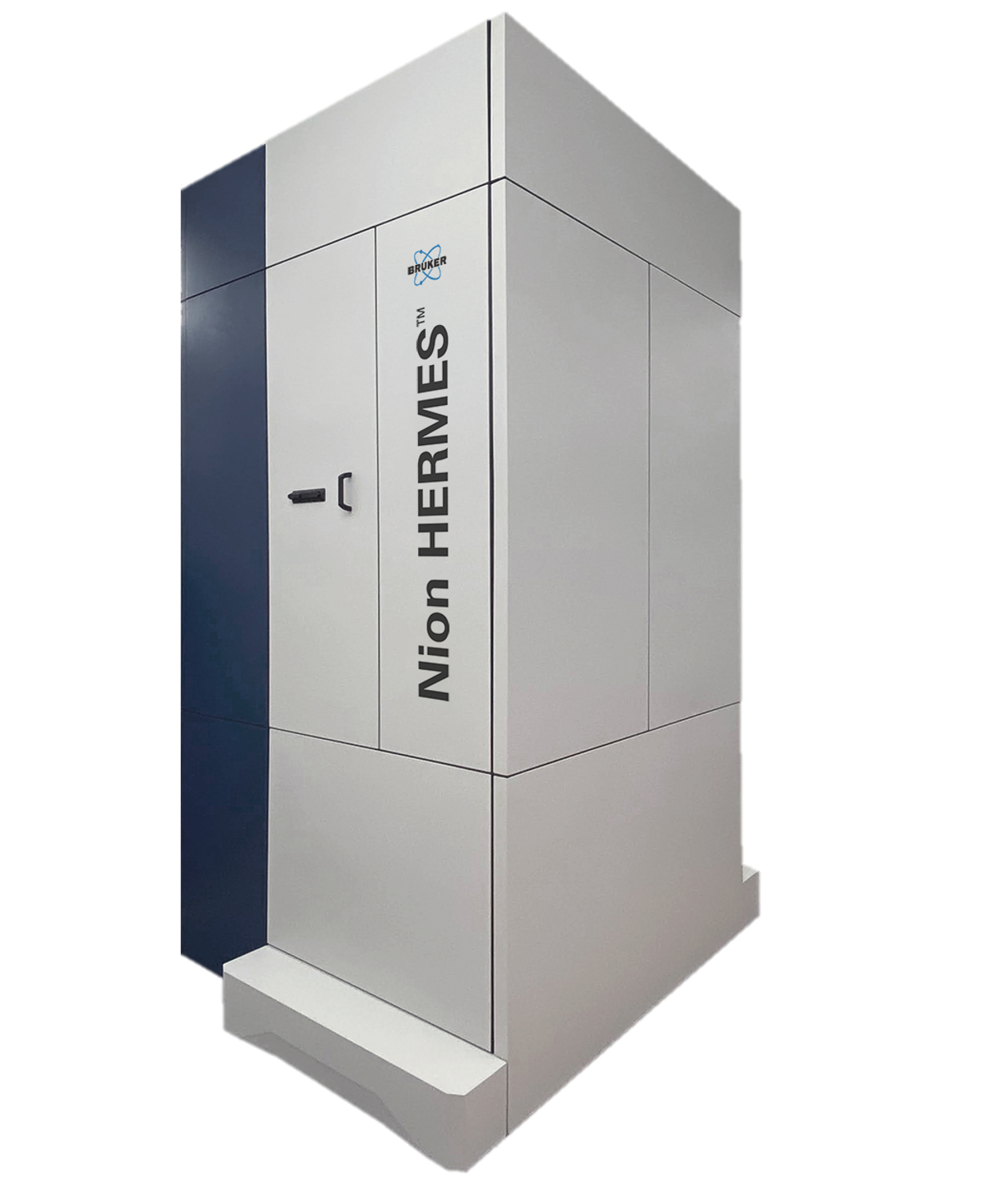 Nion-compatible In Situ STEM Holders for Electrical BiasingHummingbird Scientific Featured
 Ti-WCMBN Nanomaterialia Featured
 Aether®Lam Research
Market insights
Last 30 days: Quantum Technologies was the busiest vertical: 61 of 192 events (32%).
Money raised per month
Behind the deal
Who led Sandia National Laboratories’s $3.4M Grant?
See the investors with Insights Pro →