Penn Engineers have developed a new chip that uses light waves, rather than electricity, to perform the complex math essential to training AI. The chip has the potential to radically accelerate the processing speed of computers while also reducing their energy consumption.
The silicon-photonic (SiPh) chip’s design is the first to bring together Benjamin Franklin Medal Laureate and H. Nedwill Ramsey Professor Nader Engheta’s pioneering research in manipulating materials at the nanoscale to perform mathematical computations using light — the fastest possible means of communication — with the SiPh platform, which uses silicon, the cheap, abundant element used to mass-produce computer chips.
The interaction of light waves with matter represents one possible avenue for developing computers that supersede the limitations of today’s chips, which are essentially based on the same principles as chips from the earliest days of the computing revolution in the 1960s.
In a paper in Nature Photonics, Engheta’s group, together with that of Firooz Aflatouni, Associate Professor in Electrical and Systems Engineering, describes the development of the new chip. “We decided to join forces,” says Engheta, leveraging the fact that Aflatouni’s research group has pioneered nanoscale silicon devices.
Their goal was to develop a platform for performing what is known as vector-matrix multiplication, a core mathematical operation in the development and function of neural networks, the computer architecture that powers today’s AI tools.
Instead of using a silicon wafer of uniform height, explains Engheta, “you make the silicon thinner, say 150 nanometers,” but only in specific regions. Those variations in height — without the addition of any other materials — provide a means of controlling the propagation of light through the chip, since the variations in height can be distributed to cause light to scatter in specific patterns, allowing the chip to perform mathematical calculations at the speed of light.
Due to the constraints imposed by the commercial foundry that produced the chips, Aflatouni says, this design is already ready for commercial applications, and could potentially be adapted for use in graphics processing units (GPUs), the demand for which has skyrocketed with the widespread interest in developing new AI systems. “They can adopt the Silicon Photonics platform as an add-on,” says Aflatouni, “and then you could speed up training and classification.”
In addition to faster speed and less energy consumption, Engheta and Aflatouni’s chip has privacy advantages: because many computations can happen simultaneously, there will be no need to store sensitive information in a computer’s working memory, rendering a future computer powered by such technology virtually unhackable. “No one can hack into a non-existing memory to access your information,” says Aflatouni.
Reference
Inverse-designed low-index-contrast structures on a silicon photonics platform for vector–matrix multiplication
Vahid Nikkhah, Ali Pirmoradi, Farshid Ashtiani, Brian Edwards, Firooz Aflatouni & Nader Engheta
https://www.nature.com/articles/s41566-024-01394-2
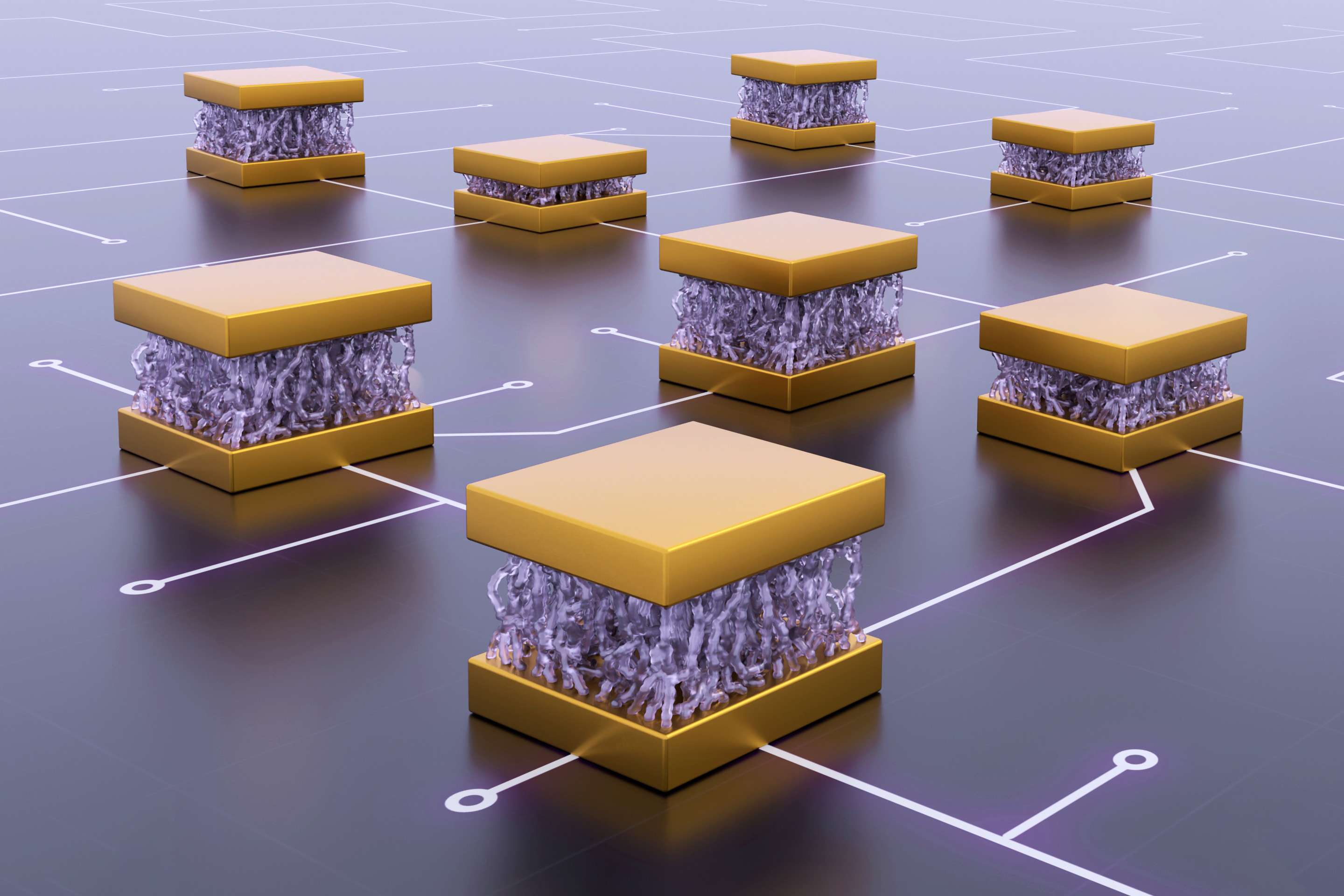
This illustration shows the nano-mechanical devices the researchers developed. Inspired by neurons, they can perform computing tasks with high energy efficiency. Image: Emily Theobald MIT researchers have created a new computing platform that could be used to develop intelligent and adaptive next-generation electronics that can simultaneously perform multiple functions, like computing and memory, all within one extremely compact, energy-efficient device. Such a platform opens opportunities...
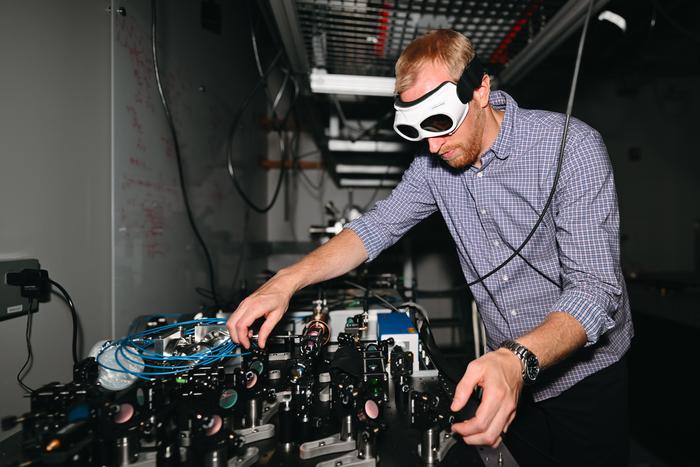
Breakthrough from a team led by Jacob Covey, associate professor in the University of Chicago’s Pritzker School of Molecular Engineering and Department of Physics, turns helium-3’s low mass into a quantum resource
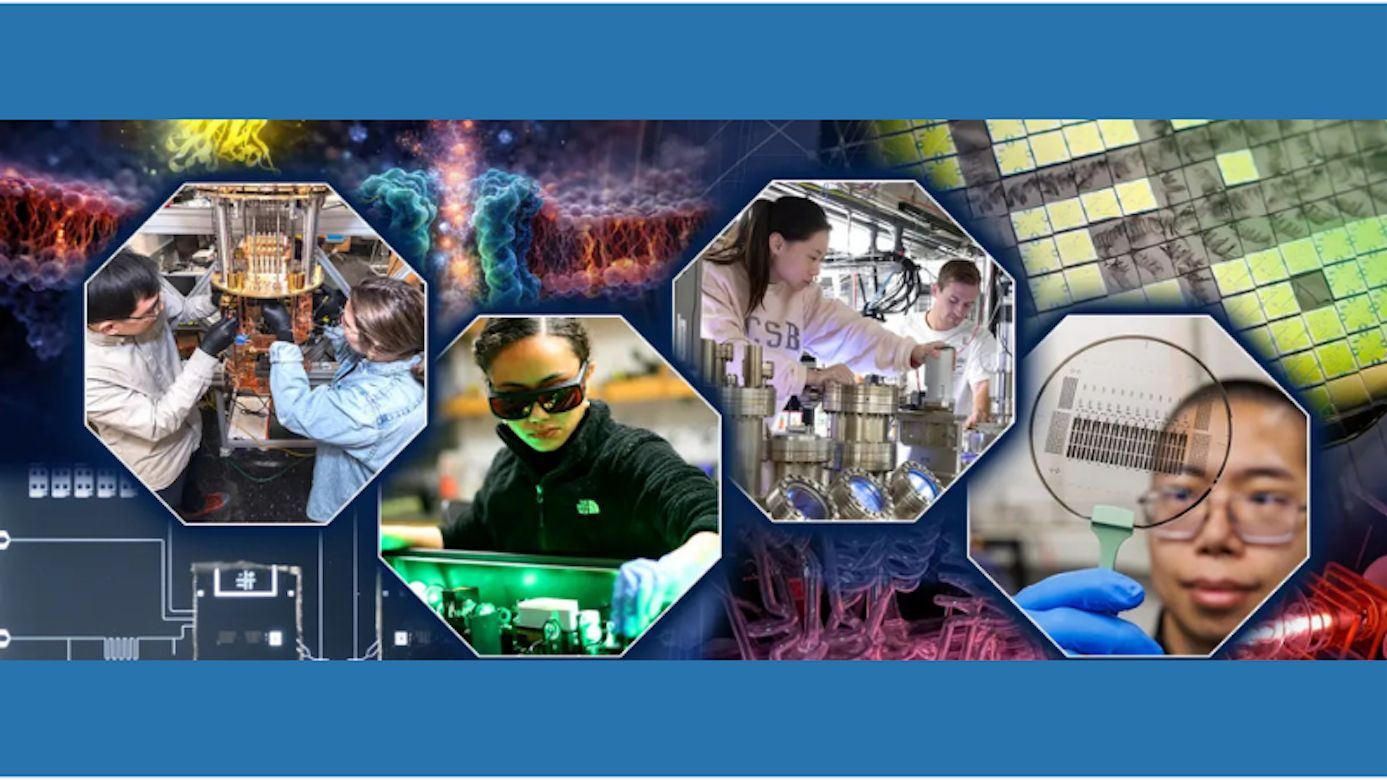
Courtesy of the National Science Foundation The NSF's Quantum Leap Challenge Institutes are taking on some of the hardest scientific hurdles in the global race to create powerful quantum-based technologies. Two UCLA computer scientists will help lead major national efforts to address some of quantum computing’s biggest challenges, serving as co-principal investigators for separate research institutes backed by five-year, $37.5 million grants from the National Science Foundation. The two...