Max Planck Institute for Polymer Research (MPI-P)
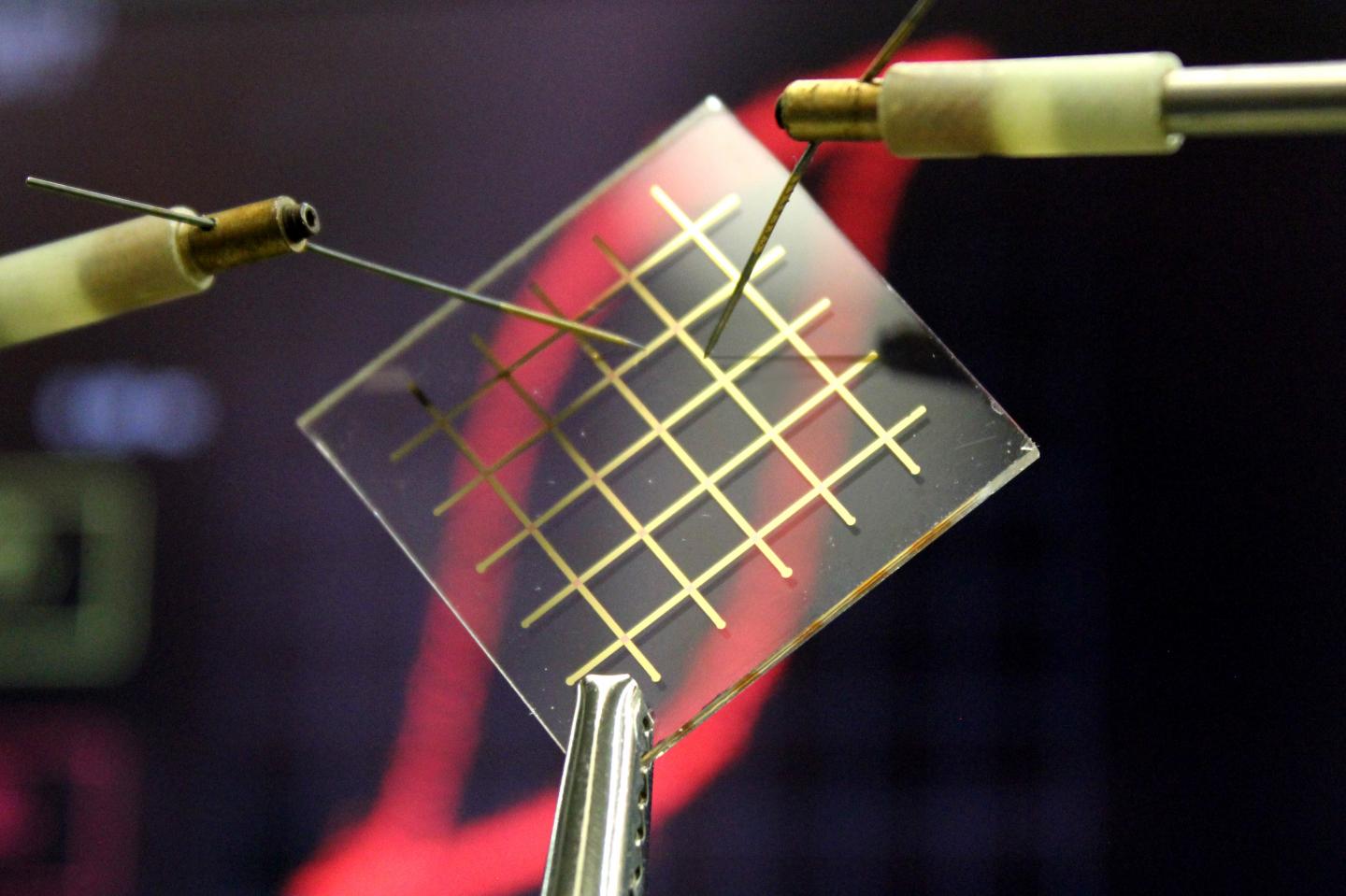
As the microelectronic industry is now shifting toward wearable electronic gadgets and electronic (e-)textiles, the comprising electronic materials, such as ferroelectrics, should be integrated with our clothes. Nylons, a family of synthetic polymers, were first introduced in the 1940s' for women's stockings and are nowadays among the most widely used synthetic fibers in textiles. They consist of a long chain of repeated molecular units, i.e. polymers, where each repeat unit contains a specific arrangement of hydrogen, oxygen, and nitrogen with carbon atoms.
Besides the use in textiles, it was discovered that some nylons also exhibit so called "ferroelectric properties". This means that positive and negative electric charges can be separated and this state can be maintained. The ferroelectric materials are used in sensors, actuators, memories and energy harvesting devices. The advantage in using polymers is that they can be liquified using adequate solvents and therefore processed from solution at low cost to form flexible thin-films which are suitable for electronic devices such as capacitors, transistors and diodes. This makes ferroelectric polymers a viable choice for integration with e-textiles. Although nylon polymers have found over the years significant commercial applications in fabrics and fibers, their application in electronic devices was hindered because it was impossible to create high quality thin films of ferroelectric nylons by solution processing.
Scientists at the MPI-P, in collaboration with researchers from the Johannes Gutenberg University of Mainz and Lodz University of Technology, have now solved this forty year old problem, and developed a method to fabricate ferroelectric nylon thin-film capacitors by dissolving nylon in a mixture of trifluoroacetic acid and acetone and solidifying it again in vacuum. They were able to realize thin nylon films that are typically only a few 100 nanometers thick, several 100 times thinner than human hair. "Using this method, we have produced extremely smooth thin-films. This is very important because it prevents electrical break down of for example capacitors and destroying the electronic circuits. At the same time, the smoothness allows for having transparent thin-films and eventually transparent electronic devices," says Dr. Kamal Asadi, group leader at the MPI-P.
By using their newly developed method, the group around Kamal Asadi was able to produce high performance nylon capacitors. The scientists subjected the prototypes of the capacitors to extended stress cycles and demonstrated robustness of ferroelectric nylons under millions of operation cycles. The thin nylon films could become an important component for use in flexible electronics in the future and find applications in bendable electronic devices or for electronics in clothing. These new findings pave the way towards multi-functional fabrics that serve as cloth for covering our body and at the same time can generate electricity from our body movement.
Solution-processed transparent ferroelectric nylon thin films
Saleem Anwar, Daniel Pinkal, Wojciech Zajaczkowski, Philipp von Tiedemann, Hamed Sharifi Dehsari, Manasvi Kumar, Thomas Lenz, Ulrike Kemmer-Jonas, Wojciech Pisula, Manfred Wagner, Robert Graf, Holger Frey and Kamal Asadi
Science Advances 16 Aug 2019: Vol. 5, no. 8, eaav3489
Contact information:
Kamal Asadi
Group leader of MPI-P Humboldt Research Group
asadi@mpip-mainz.mpg.de
Phone: +49 6131 379-126
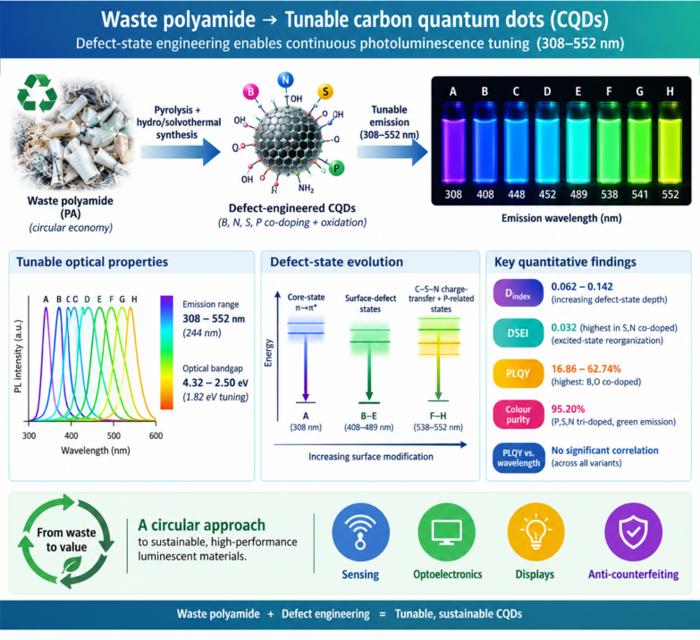
Waste polyamide-derived CQDs show continuous photoluminescence tuning from 308 to 552 nm through sequential defect-state engineering, with optical transition energies decreasing from 4.32 to 2.50 eV. @Christian Ebere Enyoh from Saitama University Carbon quantum dots (CQDs) are fluorescent carbon nanomaterials with potential applications in sensing, optoelectronics, displays, anti-counterfeiting, and environmental technologies. Their optical properties can be adjusted by modifying the carbon...
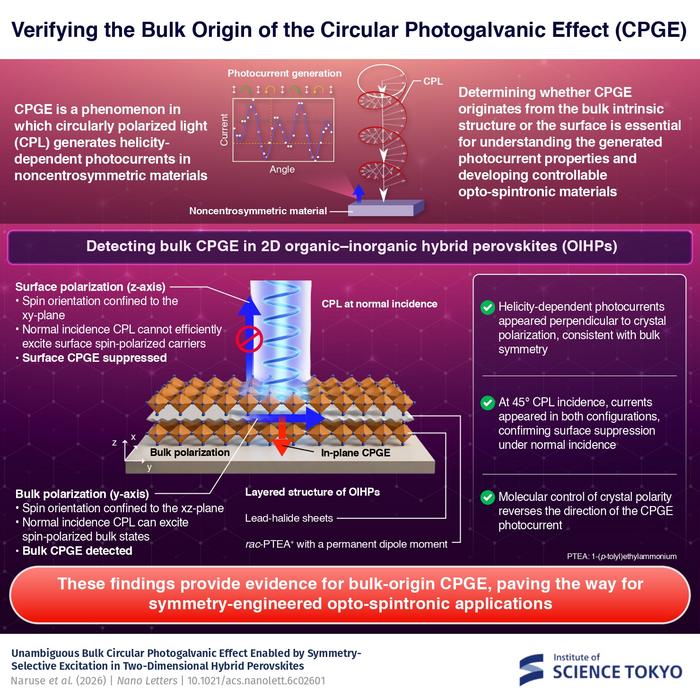
The researchers used circularly polarized light at normal incidence and found that helicity-dependent photocurrents appeared perpendicular to the crystal’s polarization but vanished when measured parallel to it, supporting a bulk origin of CPGE. @Institute of Science Tokyo The circular photogalvanic effect (CPGE), a phenomenon that generates helicity-dependent photocurrents in noncentrosymmetric materials, can originate purely from a crystal's internal structure without contribution from the...
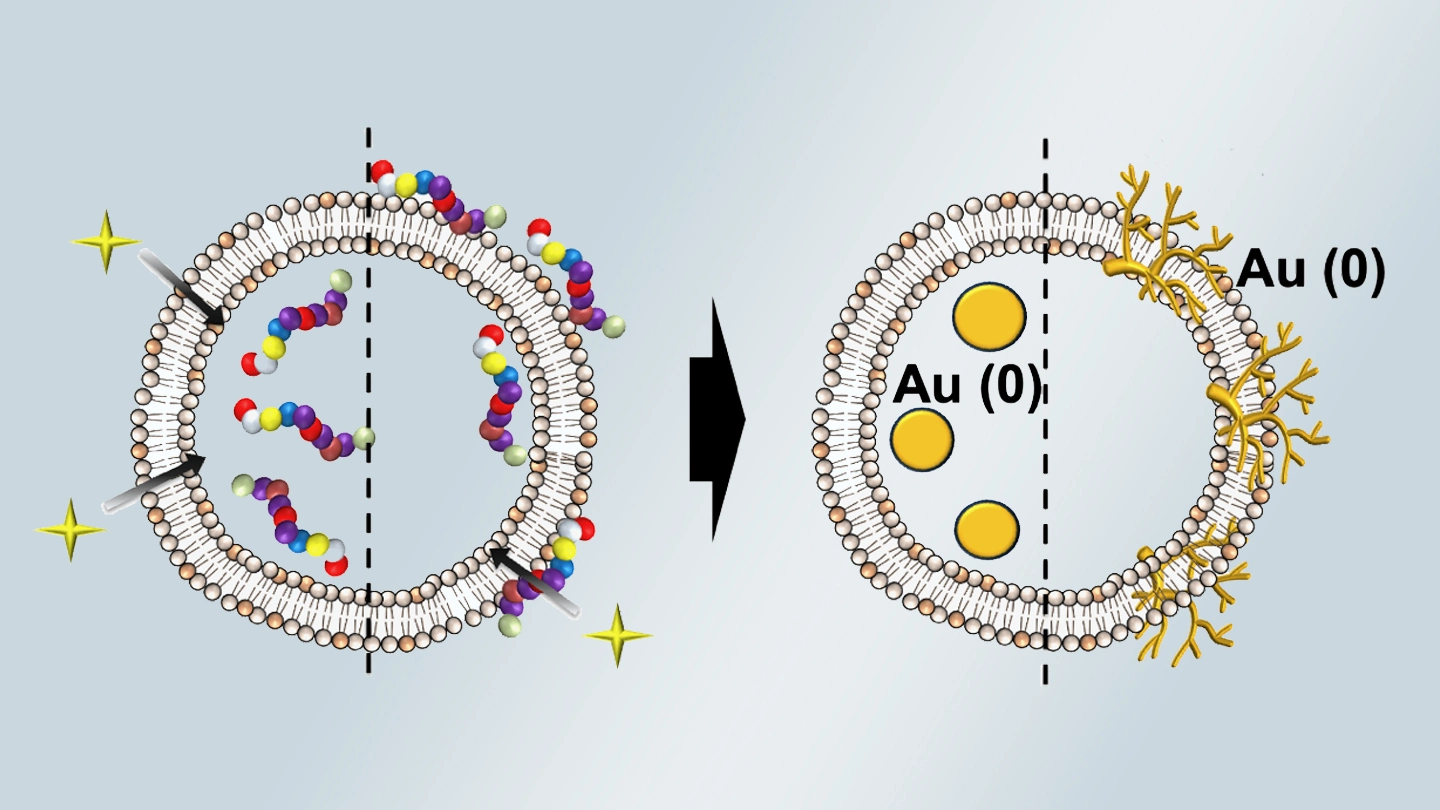
Summary of gold nanoparticle growth programming in liposome based on localization of biomineralization peptide The position of biomineralization peptides within liposomes can influence how gold nanoparticles grow, reports a research team from Institute of Science Tokyo. Peptides localized at the membrane interface promote branched structures, while those confined to the liposome interior favor spherical nanoparticles. The findings offer a new strategy for controlling nanoscale reaction...
