When Carnegie Mellon University doctoral candidates I-Hsuan Kao and Ryan Muzzio started working together a switch flicked on. Then off.
Working in the Department of Physics' Lab for Investigating Quantum Materials, Interfaces and Devices (LIQUID) Group, Kao, Muzzio and other research partners were able to show proof of concept that running an electrical current through a novel two-dimensional material could control the magnetic state of a neighboring magnetic material without the need of applying an external magnetic field.
The groundbreaking work, which was published in Nature Materials in June and has a related patent pending, has potential applications for data storage in consumer products such as digital cameras, smartphones and laptops.
"What we're doing here is utilizing ultrathin materials — often the thickness of few atoms — and stacking them on top of each other to create high-quality devices," said Ka, who was first author on the paper.
Simranjeet Singh, an assistant professor of physics and Jyoti Katoch, an assistant professor of physics, oversee the LIQUID Group, which investigates the intrinsic physical properties of two-dimensional quantum materials such as tungsten ditelluride (WTe2) and their electronic and spin-related properties.
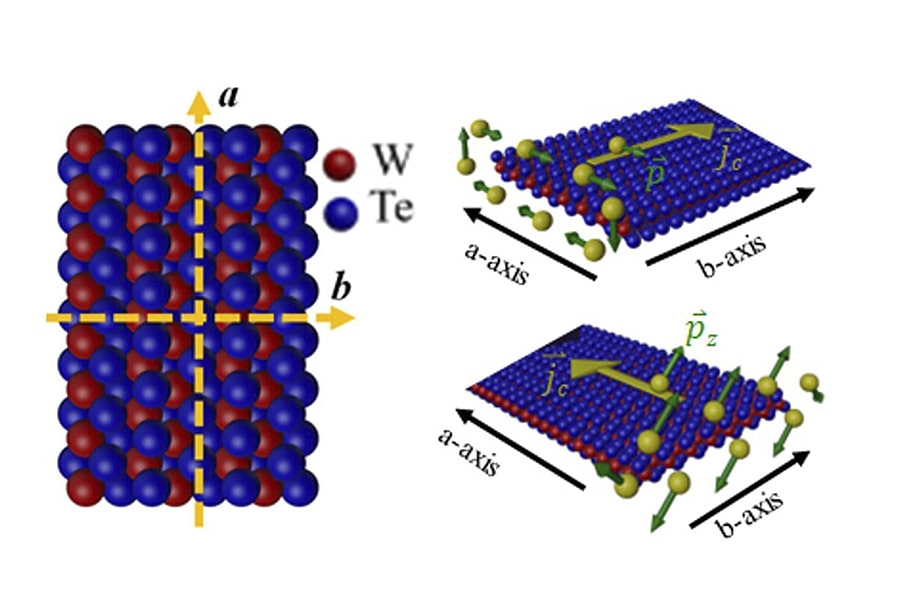
"Spins and magnetism are everywhere around us," Singh said. "Atoms configure in a particular way on an atomic lattice that in turn dictates material properties. For WTe2, it has a low-symmetry crystal structure that allows us to generate a special kind of spin current by applying an electric field."
The way atoms are configured in WTe2 allows for an out-of-plane oriented spin current that in turn can be used to control the magnetization state of a magnet. Singh said that in order to switch the magnetic state (up or down) of most magnetic materials using spin current studied so far, a magnetic field is applied horizontally, or in plane. Having a material that can switch magnetism without the need of an external magnetic field can lead to energy-efficient data storage and logic devices.
The work could be applied to magnetoresistive random-access memory (MRAM) devices, which have the potential of realizing high-speed and densely packed data storage bits while using less power.
"People can do this already, you can take a material, apply an electric field to generate in-plane oriented spin current and use it to switch the magnetization from an up state to a down state or vice-versa, but it requires an external magnetic field," Muzzio said. "What this boils down to is finding a material that has the intrinsic property that includes breaking symmetry."
Kao brought expertise on magnetism, while Muzzio understood how to build the devices as well as studies the behavior of electrons in material systems. To show that the behavior was reproducible, Kao and Muzzio created more than 20 devices over two years.
The simple devices are miniscule and allow a switch to either be turned in an up position or a down position, think of it like zeros and ones in binary, Kao said. While the devices could be 3-50 microns in length or width, the thickness is smaller than 1/200th of a human hair.
"We've just scratched the surface of what this material can do," Muzzio said. "There's so much more parameter space for us to explore and so many ways to utilize this material. This is just the beginning."
Reference
Deterministic switching of a perpendicularly polarized magnet using unconventional spin–orbit torques in WTe2
I-Hsuan Kao, Ryan Muzzio, Hantao Zhang, Menglin Zhu, Jacob Gobbo, Sean Yuan, Daniel Weber, Rahul Rao, Jiahan Li, James H. Edgar, Joshua E. Goldberger, Jiaqiang Yan, David G. Mandrus, Jinwoo Hwang, Ran Cheng, Jyoti Katoch & Simranjeet Singh
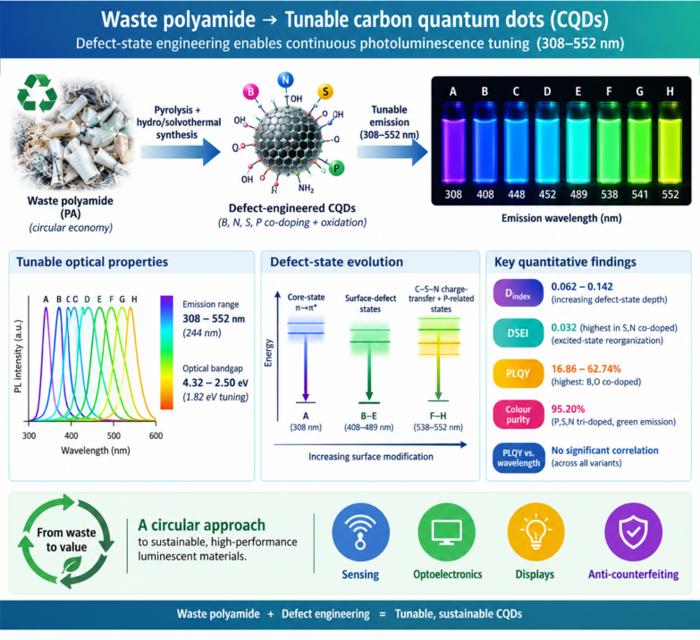
Waste polyamide-derived CQDs show continuous photoluminescence tuning from 308 to 552 nm through sequential defect-state engineering, with optical transition energies decreasing from 4.32 to 2.50 eV. @Christian Ebere Enyoh from Saitama University Carbon quantum dots (CQDs) are fluorescent carbon nanomaterials with potential applications in sensing, optoelectronics, displays, anti-counterfeiting, and environmental technologies. Their optical properties can be adjusted by modifying the carbon...
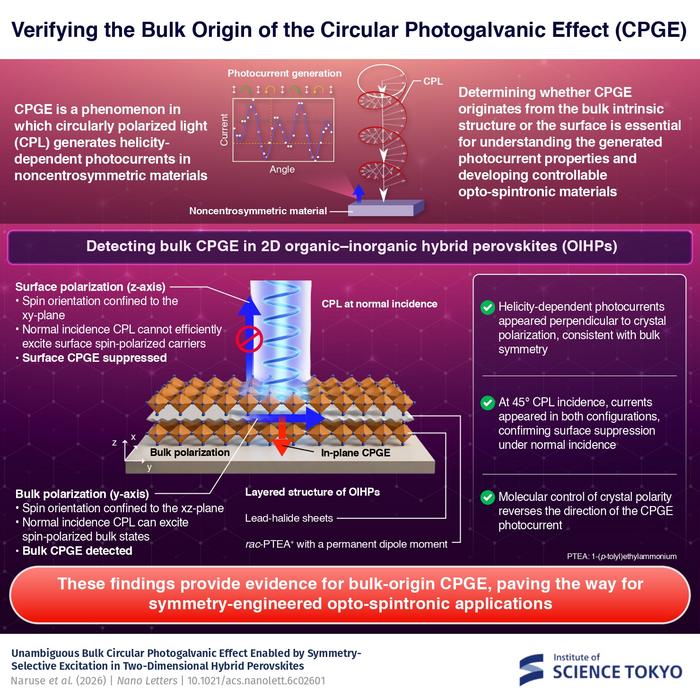
The researchers used circularly polarized light at normal incidence and found that helicity-dependent photocurrents appeared perpendicular to the crystal’s polarization but vanished when measured parallel to it, supporting a bulk origin of CPGE. @Institute of Science Tokyo The circular photogalvanic effect (CPGE), a phenomenon that generates helicity-dependent photocurrents in noncentrosymmetric materials, can originate purely from a crystal's internal structure without contribution from the...
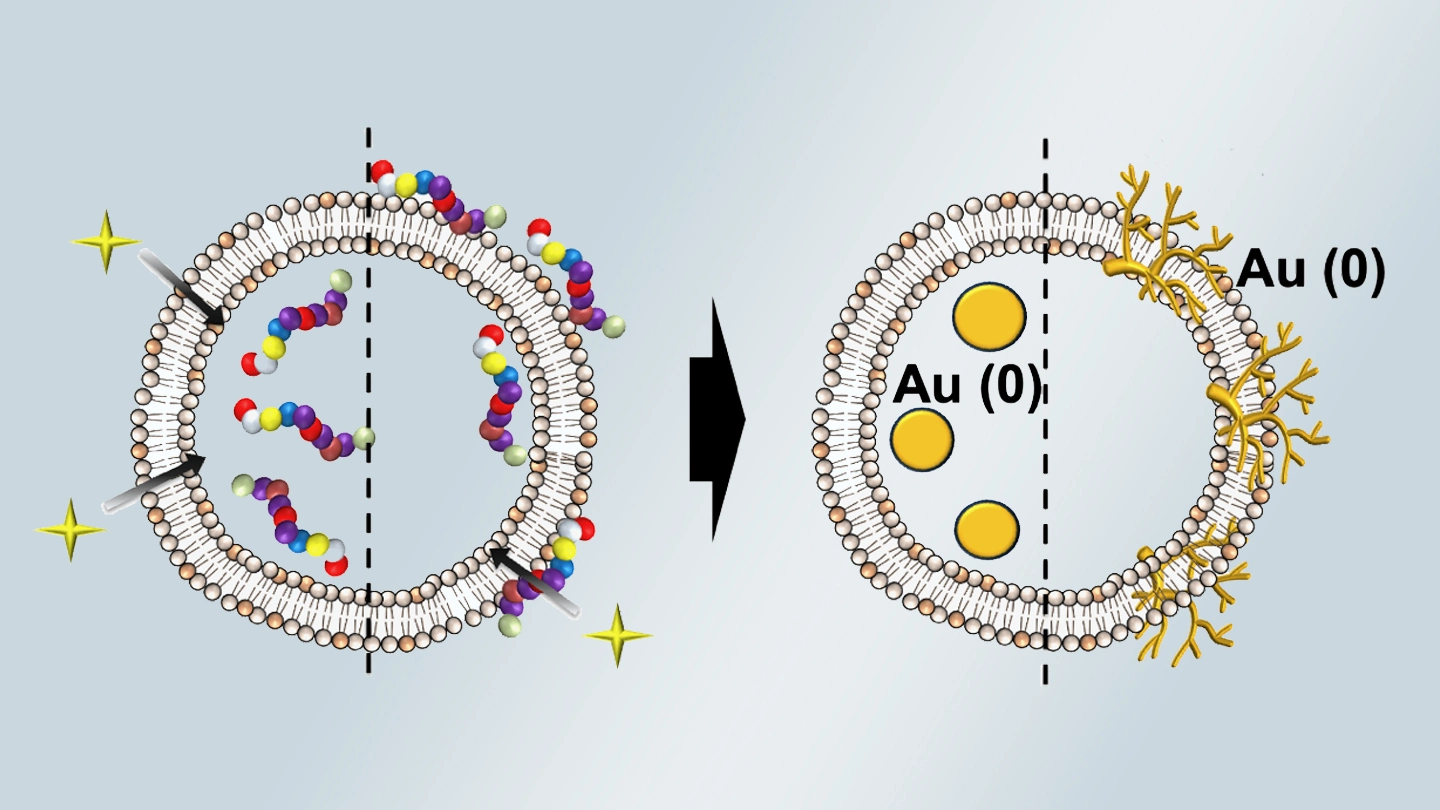
Summary of gold nanoparticle growth programming in liposome based on localization of biomineralization peptide The position of biomineralization peptides within liposomes can influence how gold nanoparticles grow, reports a research team from Institute of Science Tokyo. Peptides localized at the membrane interface promote branched structures, while those confined to the liposome interior favor spherical nanoparticles. The findings offer a new strategy for controlling nanoscale reaction...
