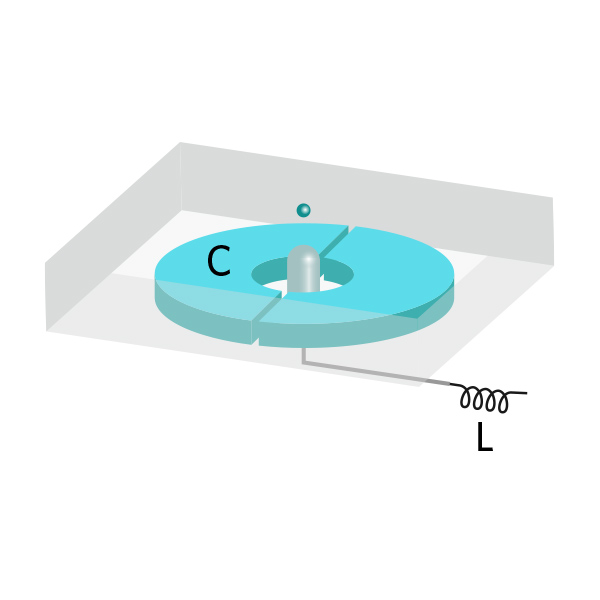
Future quantum computers could be based on electrons floating above liquid helium, according to a RIKEN physicist and collaborators.
Today’s computers are based on shuttling electrons around in silicon. Electrons in silicon could also form the basis of a completely different breed of computers—quantum computers. Numerous efforts are underway to realize quantum computers using electrons in various solid-state crystals, starting with silicon.
By exploiting the quantum nature of tiny objects, quantum computers promise to revolutionize computing by solving problems that are intractable using the most powerful supercomputers available today.
While efforts to create qubits using electrons in solid-state crystals have achieved significant success, increasing the number of qubits (the quantum equivalent of bits) is challenging because defects and impurities in solid-state crystals create unpredictable electrical potentials, making it difficult to produce many uniform qubits.
One way to overcome this problem would be to use electrons floating in a vacuum as qubits, since vacuum is defect free.
“Solid-state crystals will always have some defects, which means we cannot create a perfect environment for electrons,” says Erika Kawakami of the RIKEN Center for Quantum Computing. “That is problematic if we want to create a lot of uniform qubits. And so it’s better to have qubits in vacuum.”
In 1999, researchers theoretically proposed to realize qubits based on electrons floating on liquid helium for the first time. In this physical system, electrons float in vacuum slightly above the surface of liquid helium. This was a groundbreaking proposal, but it was limited to basic operations of quantum gates because quantum-computer research was still in its infancy.
Now, in a theoretical study, the team has shown how the quantum gates can be realized more concretely using electrons floating above liquid helium.
Central to their proposal is a hybrid qubit involving the vertically quantized charge state and the spin state of a floating electron. The charge state of the electron allows it to be easily manipulated over moderate distances using an electric field, while the spin state can be used to stably store data. The interaction between the spin and charge states of the electron enables data to be transferred between the two electron properties.
“We’ve proposed how to realize one-qubit and two-qubit gates using electrons on helium and estimated their fidelities,” says Kawakami. “We’ve also specified how we can scale up the number of qubits. That is something new.”
Their system uses an array of tiny ferromagnetic pillars to trap electrons above helium. It should be possible to squeeze more than 10 million qubits into an area the size of a postage stamp.
The team now intends to embrace the challenge of implementing their proposal experimentally.
Reference
Blueprint for quantum computing using electrons on helium
Erika Kawakami, Jiabao Chen, Mónica Benito, and Denis Konstantinov
https://journals.aps.org/prapplied/abstract/10.1103/PhysRevApplied.20.054022
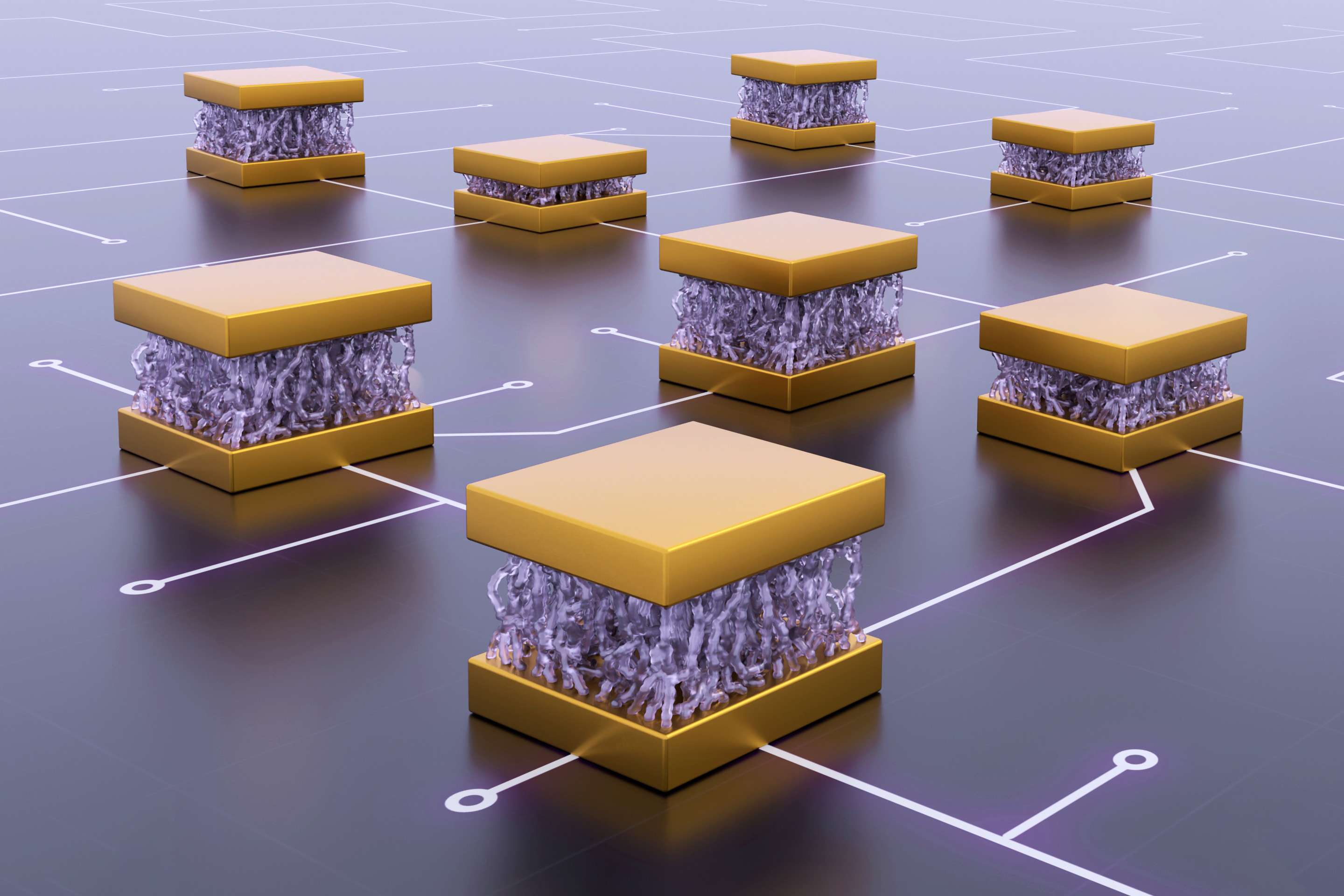
This illustration shows the nano-mechanical devices the researchers developed. Inspired by neurons, they can perform computing tasks with high energy efficiency. Image: Emily Theobald MIT researchers have created a new computing platform that could be used to develop intelligent and adaptive next-generation electronics that can simultaneously perform multiple functions, like computing and memory, all within one extremely compact, energy-efficient device. Such a platform opens opportunities...
Breakthrough from a team led by Jacob Covey, associate professor in the University of Chicago’s Pritzker School of Molecular Engineering and Department of Physics, turns helium-3’s low mass into a quantum resource
Courtesy of the National Science Foundation The NSF's Quantum Leap Challenge Institutes are taking on some of the hardest scientific hurdles in the global race to create powerful quantum-based technologies. Two UCLA computer scientists will help lead major national efforts to address some of quantum computing’s biggest challenges, serving as co-principal investigators for separate research institutes backed by five-year, $37.5 million grants from the National Science Foundation. The two...
