
As the integrated circuits that power our electronic devices get more powerful, they are also getting smaller. This trend of microelectronics has only accelerated in recent years as scientists try to fit increasingly more semiconducting components on a chip.
Microelectronics face a key challenge because of their small size. To avoid overheating, microelectronics need to consume only a fraction of the electricity of conventional electronics while still operating at peak performance.
Researchers at the U.S. Department of Energy’s (DOE) Argonne National Laboratory and the Pritzker School of Molecular Engineering at the University of Chicago have achieved a breakthrough that could allow for a new kind of microelectronic material to do just that. In a new study published in Advanced Materials, the team proposed a new kind of “redox gating” technique that can control the movement of electrons in and out of a semiconducting material.
“Redox” refers to a chemical reaction that causes a transfer of electrons. Microelectronic devices typically rely on an electric “field effect” to control the flow of electrons to operate. In the experiment, the scientists designed a device that could regulate the flow of electrons from one end to another by applying a voltage — essentially, a kind of pressure that pushes electricity — across a material that acted as a kind of electron gate. When the voltage reached a certain threshold, roughly half of a volt, the material would begin to inject electrons through the gate from a source redox material into a channel material.
By using the voltage to modify the flow of electrons, the semiconducting device could act like a transistor, switching between more conducting and more insulating states.
“The new redox gating strategy allows us to modulate the electron flow by an enormous amount even at low voltages, offering much greater power efficiency,” said Argonne materials scientist Dillon Fong, an author of the study. “This also prevents damage to the system. We see that these materials can be cycled repeatedly with almost no degradation in performance.”
“Controlling the electronic properties of a material also has significant advantages for scientists seeking emergent properties beyond conventional devices,” said Argonne materials scientist Wei Chen, one of the study’s co-corresponding authors.
“The subvolt regime, which is where this material operates, is of enormous interest to researchers looking to make circuits that act similarly to the human brain, which also operates with great energy efficiency,” he said.
The redox gating phenomenon could also be useful for creating new quantum materials whose phases could be manipulated at low power, said Argonne physicist Hua Zhou, another co-corresponding author of the study. Moreover, the redox gating technique may extend across versatile functional semiconductors and low-dimensional quantum materials composed of sustainable elements.
Work done at Argonne’s Advanced Photon Source, a DOE Office of Science user facility, helped characterize the redox gating behavior.
Additionally, Argonne’s Center for Nanoscale Materials, also a DOE Office of Science user facility, was used for materials synthesis, device fabrication, and electrical measurements of the device.
Reference
Redox Gating for Colossal Carrier Modulation and Unique Phase Control
Le Zhang, Changjiang Liu, Hui Cao, Andrew J. Erwin, Dillon D. Fong, Anand Bhattacharya, Luping Yu, Liliana Stan, Chongwen Zou, Matthew V. Tirrell, Hua Zhou, Wei Chen
Teledyne DALSA has launched the Rad-icon 2329HS X-ray detector, featuring a 27 Mp CMOS sensor, 10X faster frame rate and 3X higher sensitivity than the previous model. It was shown at the NDTMA conference.
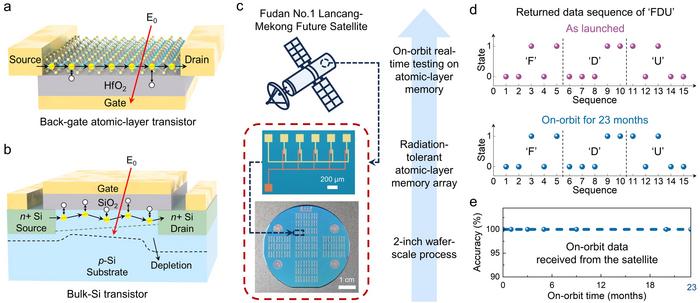
A monolayer MoS2 memory array fabricated at wafer scale on the Fudan No.1 satellite has returned stored data with 100% accuracy after 23 months in low Earth orbit, marking the first on-orbit real-time test of atomic-layer memory. Ground Co-60 gamma irradiation up to 20 Mrad left on/off current ratios stable across roughly eight orders of magnitude and preserved low-noise readout at picoampere levels.
GE HealthCare expanded global clinical and research collaborations to evaluate Photonova Spectra, its photon-counting CT system, across institutions in North America, Europe and Asia.
This week in nanotech
$18.9M raised
4 funding rounds · 31 deals tracked
New products
 DLS-1 Mass Spectrometer for Fusion Gas AnalysisHiden Analytical Featured
 Ti-WCMBN Nanomaterialia Featured
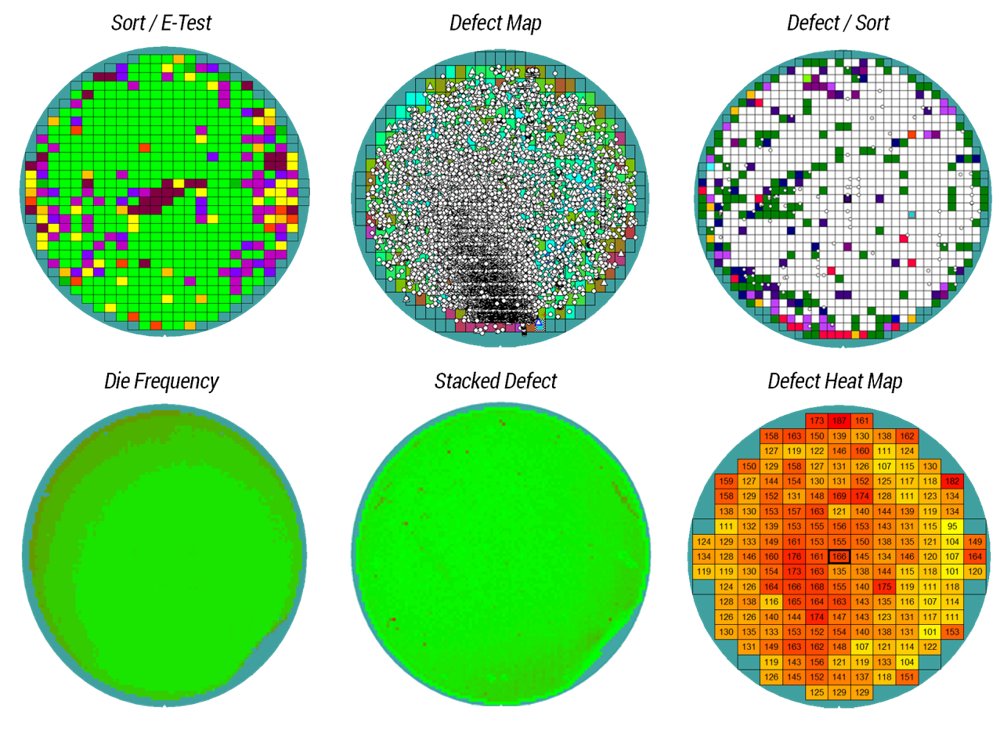 Discover Mapping SuiteOnto Innovation
Market insights
Last 30 days: Semiconductors & Electronics was the busiest vertical: 52 of 170 events (31%).
Money raised per month
Behind the deal
Who led Eindhoven University of Technology’s $1.1M Grant?
See the investors with Insights Pro →