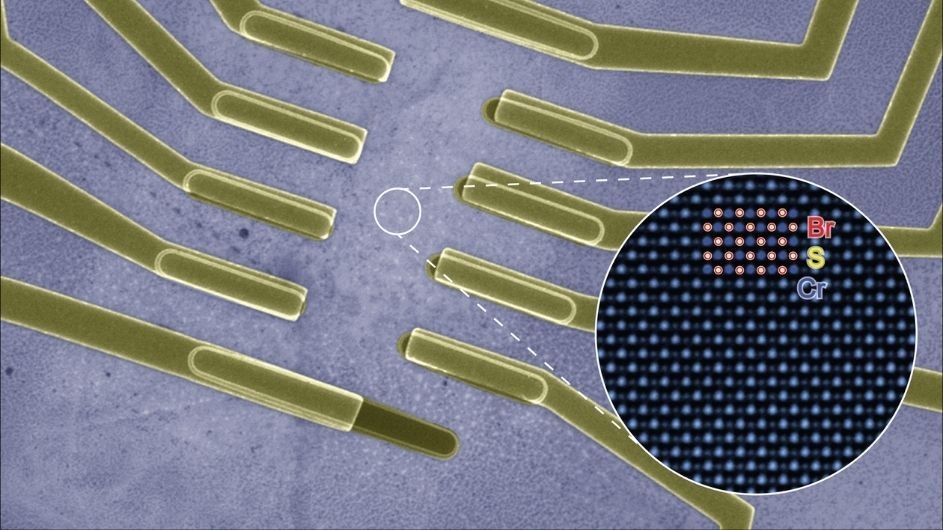
Information in computers is transmitted through semiconductors by the movement of electrons and stored in the direction of the electron spin in magnetic materials. To shrink devices while improving their performance—a goal of an emerging field called spin-electronics (“spintronics”)—researchers are searching for unique materials that combine both quantum properties. Writing in Nature Materials, a team of chemists and physicists at Columbia finds a strong link between electron transport and magnetism in a material called chromium sulfide bromide (CrSBr).
Created in the lab of Chemist Xavier Roy, CrSBr is a so-called van der Waals crystal that can be peeled into stackable, 2D layers that are just a few atoms thin. Unlike related materials that are quickly destroyed by oxygen and water, CrSBr crystals are stable at ambient conditions. These crystals also maintain their magnetic properties at the relatively high temperature of -280F, avoiding the need for expensive liquid helium cooled to a temperature of -450F.
“CrSBr is infinitely easier to work with than other 2D magnets, which lets us fabricate novel devices and test their properties,” said Evan Telford, a postdoc in the Roy lab who graduated with a PhD in physics from Columbia in 2020. Last year, colleagues Nathan Wilson and Xiaodong Xu at the University of Washington and Xiaoyang Zhu at Columbia found a link between magnetism and how CrSBr responds to light. In the current work, Telford led the effort to explore its electronic properties.
The team used an electric field to study CrSBr layers across different electron densities, magnetic fields, and temperatures—different parameters that can be adjusted to produce different effects in a material. As electronic properties in CrSBr changed, so did its magnetism.
“Semiconductors have tunable electronic properties. Magnets have tunable spin configurations. In CrSBr, these two knobs are combined,” said Roy. “That makes CrSBr attractive for both fundamental research and for potential spintronics application.”
Magnetism is a difficult property to measure directly, particularly as the size of the material shrinks, explained Telford, but it’s easy to measure how electrons move with a parameter called resistance. In CrSBr, resistance can serve as a proxy for otherwise unobservable magnetic states. “That’s very powerful,” said Roy, especially as researchers look to one day build chips out of such 2D magnets, which could be used for quantum computing and to store massive amounts of data in a small space.
The link between the material’s electronic and magnetic properties was due to defects in the layers—for the team, a lucky break, said Telford. “People usually want the ‘cleanest’ material possible. Our crystals had defects, but without those, we wouldn’t have observed this coupling,” he said.
From here, the Roy lab is experimenting with ways to grow peelable van der Waals crystals with deliberate defects, to improve the ability to fine-tune the material’s properties. They are also exploring whether different combinations of elements could function at higher temperatures while still retaining those valuable combined properties.
Reference
Coupling between magnetic order and charge transport in a two-dimensional magnetic semiconductor
Evan J. Telford, Avalon H. Dismukes, Raymond L. Dudley, Ren A. Wiscons, Kihong Lee, Daniel G. Chica, Michael E. Ziebel, Myung-Geun Han, Jessica Yu, Sara Shabani, Allen Scheie, Kenji Watanabe, Takashi Taniguchi, Di Xiao, Yimei Zhu, Abhay N. Pasupathy, Colin Nuckolls, Xiaoyang Zhu, Cory R. Dean & Xavier Roy
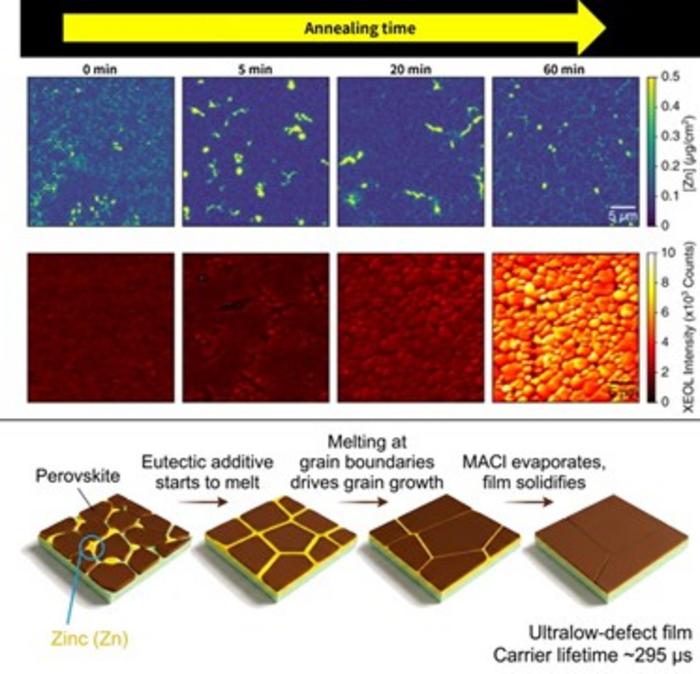
A eutectic mixture of methylammonium chloride and a zinc halide melts at about 100 degrees Celsius, forming a transient liquid layer at perovskite grain boundaries that lets crystals merge into larger, cleaner grains. The resulting films reached a carrier lifetime of roughly 295 microseconds and a surface recombination velocity of 0.3 cm/s, the lowest reported for lead halide perovskites.
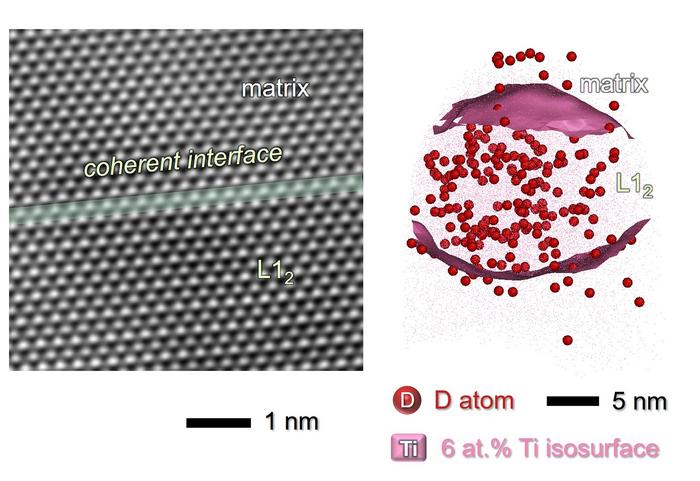
Researchers at the University of Sydney have directly observed hydrogen dissolved in the interstitial spaces between metal atoms in alloys, a world first. Using cryogenic atom probe tomography with deuterium tracers, electron microscopy and theoretical calculations, the team showed hydrogen occupies sites between atoms rather than only collecting at defects, and that local atomic arrangement and chemistry dictate where it prefers to reside.
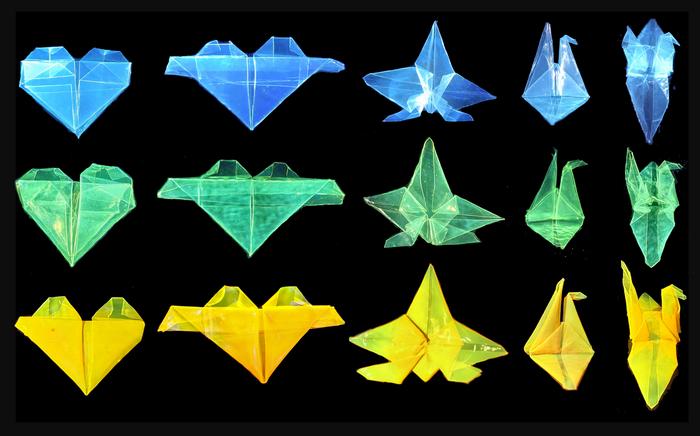
Researchers have developed carbon dots whose fluorescence shifts across the visible spectrum, from blue to red, depending on concentration, liquid environment and acidity. By tuning the particles' surfaces, the team produced versions that change color reversibly as pH shifts, then incorporated them into polymer powders, molded shapes and flexible films.
This week in nanotech
$10.2M raised
2 funding rounds · 18 deals tracked
New products
 Nion-compatible In Situ STEM Holders for Electrical BiasingHummingbird Scientific Featured
 DLS-1 Mass Spectrometer for Fusion Gas AnalysisHiden Analytical Featured
 GHK-CuPeoples Peps
Market insights
Last 30 days: Quantum Technologies was the busiest vertical: 52 of 174 events (30%).
Money raised per month