An international team of researchers has reported a new way to safeguard drones, surveillance cameras and other equipment against laser attacks, which can disable or destroy the equipment. The capability is known as optical limiting.
The work, published in the journal Nature Communications, also describes a superior manner of telecom switching without the use of electronics; instead, they use an all-optical method that could improve the speed and capacity of internet communications. That could remove a roadblock in moving from 4GLTE to 5G networks.
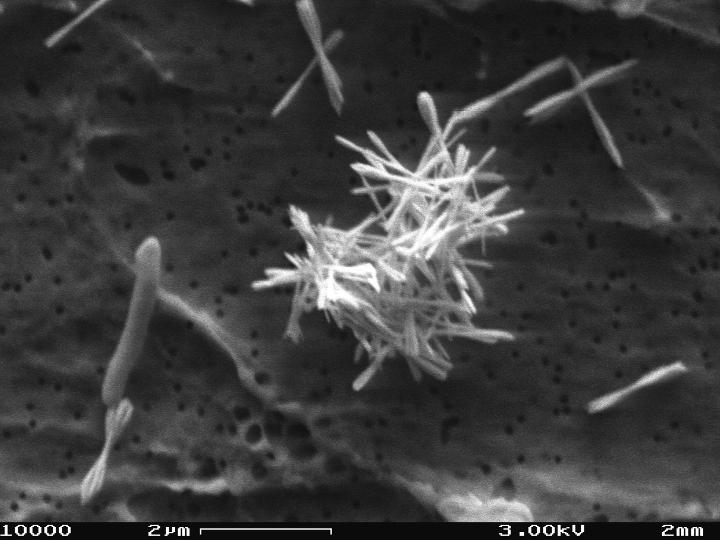
The team reported that a material created using tellurium nanorods - produced by naturally occurring bacteria - is an effective nonlinear optical material, capable of protecting electronic devices against high-intensity bursts of light, including those emitted by inexpensive household lasers targeted at aircraft, drones or other critical systems. The researchers describe the material and its performance as a material of choice for next-generation optoelectronic and photonic devices.
Seamus Curran, a physics professor at the University of Houston and one of the paper's authors, said while most optical materials are chemically synthesized, using a biologically-based nanomaterial proved less expensive and less toxic. "We found a cheaper, easier, simpler way to manufacture the material," he said. "We let Mother Nature do it."
The new findings grew out of earlier work by Curran and his team, working in collaboration with Werner J. Blau of Trinity College Dublin and Ron Oremland with the U.S. Geological Survey. Curran initially synthesized the nanocomposites to examine their potential in the photonics world. He holds a U.S. and international series of patents for that work.
The researchers noted that using bacteria to create the nanocrystals suggests an environmentally friendly route of synthesis, while generating impressive results. "Nonlinear optical measurements of this material reveal the strong saturable absorption and nonlinear optical extinctions induced by Mie scattering overbroad temporal and wavelength ranges," they wrote. "In both cases, Te [tellurium] particles exhibit superior optical nonlinearity compared to graphene."
Light at very high intensity, such as that emitted by a laser, can have unpredictable polarizing effects on certain materials, Curran said, and physicists have been searching for suitable nonlinear materials that can withstand the effects. One goal, he said, is a material that can effectively reduce the light intensity, allowing for a device to be developed that could prevent damage by that light.
The researchers used the nanocomposite, made up of biologically generated elemental tellurium nanocrystals and a polymer to build an electro-optic switch - an electrical device used to modulate beams of light - that is immune to damage from a laser, he said.
Oremland noted that the current work grew out of 30 years of basic research, stemming from their initial discovery of selenite-respiring bacteria and the fact that the bacteria form discrete packets of elemental selenium. "From there, it was a step down the Periodic Table to learn that the same could be done with tellurium oxyanions," he said. "The fact that tellurium had potential application in the realm of nanophotonics came as a serendipitous surprise."
Blau said the biologically generated tellurium nanorods are especially suitable for photonic device applications in the mid-infrared range. "This wavelength region is becoming a hot technological topic as it is useful for biomedical, environmental and security-related sensing, as well as laser processing and for opening up new windows for fiber optical and free-space communications."
Work will continue to expand the material's potential for use in all-optical telecom switches, which Curran said is critical in expanding broadband capacity. "We need a massive investment in optical fiber," he said. "We need greater bandwidth and switching speeds. We need all-optical switches to do that."
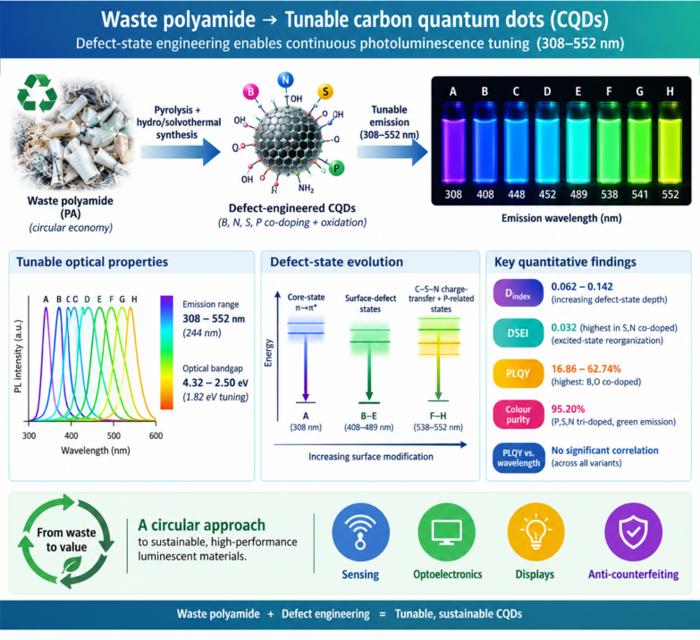
Waste polyamide-derived CQDs show continuous photoluminescence tuning from 308 to 552 nm through sequential defect-state engineering, with optical transition energies decreasing from 4.32 to 2.50 eV. @Christian Ebere Enyoh from Saitama University Carbon quantum dots (CQDs) are fluorescent carbon nanomaterials with potential applications in sensing, optoelectronics, displays, anti-counterfeiting, and environmental technologies. Their optical properties can be adjusted by modifying the carbon...
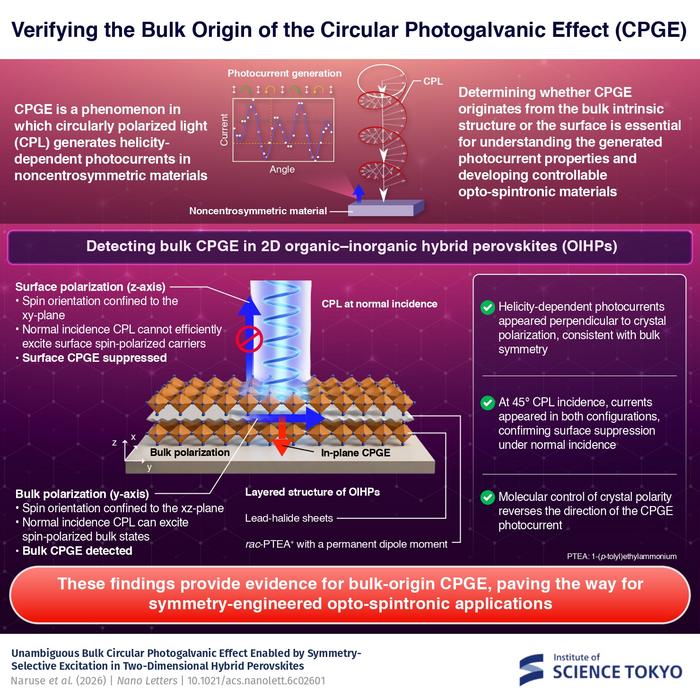
The researchers used circularly polarized light at normal incidence and found that helicity-dependent photocurrents appeared perpendicular to the crystal’s polarization but vanished when measured parallel to it, supporting a bulk origin of CPGE. @Institute of Science Tokyo The circular photogalvanic effect (CPGE), a phenomenon that generates helicity-dependent photocurrents in noncentrosymmetric materials, can originate purely from a crystal's internal structure without contribution from the...
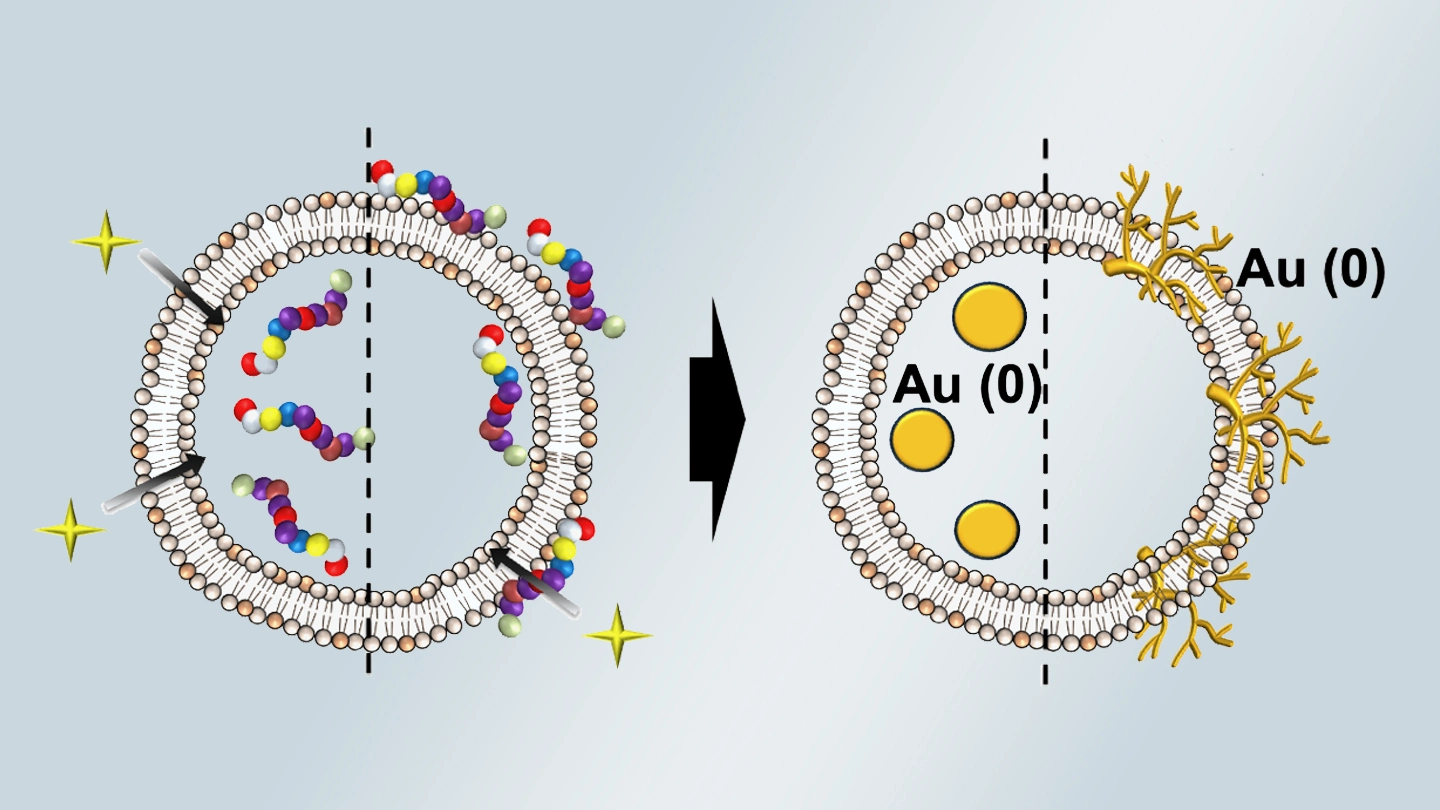
Summary of gold nanoparticle growth programming in liposome based on localization of biomineralization peptide The position of biomineralization peptides within liposomes can influence how gold nanoparticles grow, reports a research team from Institute of Science Tokyo. Peptides localized at the membrane interface promote branched structures, while those confined to the liposome interior favor spherical nanoparticles. The findings offer a new strategy for controlling nanoscale reaction...
