Scientists from the Semenov Institute of Chemical Physics of the Russian Academy of Sciences (ICP RAS) and the Moscow Institute of Physics and Technology (MIPT) have demonstrated that sensors based on binary metal oxide nanocomposites are sensitive enough to identify terrorist threats and detect environmental pollutants. The results of their study have been published in Sensors and Actuators B: Chemical.
Due to rapid industrial growth and the degradation of the environment, there is a growing need for the development of highly effective and selective sensors for pollutant detection. In addition, gas sensors could also be used to monitor potential terrorist threats.
"Choosing the right sensor composition can make a device at least ten times more effective and enable an exceptionally fast response, which is crucial for preventing terrorist attacks," says Prof. Leonid Trakhtenberg of the Department of Molecular and Chemical Physics at MIPT, who is the leader of the research team and the head of the Laboratory of Functional Nanocomposites at ICP RAS.
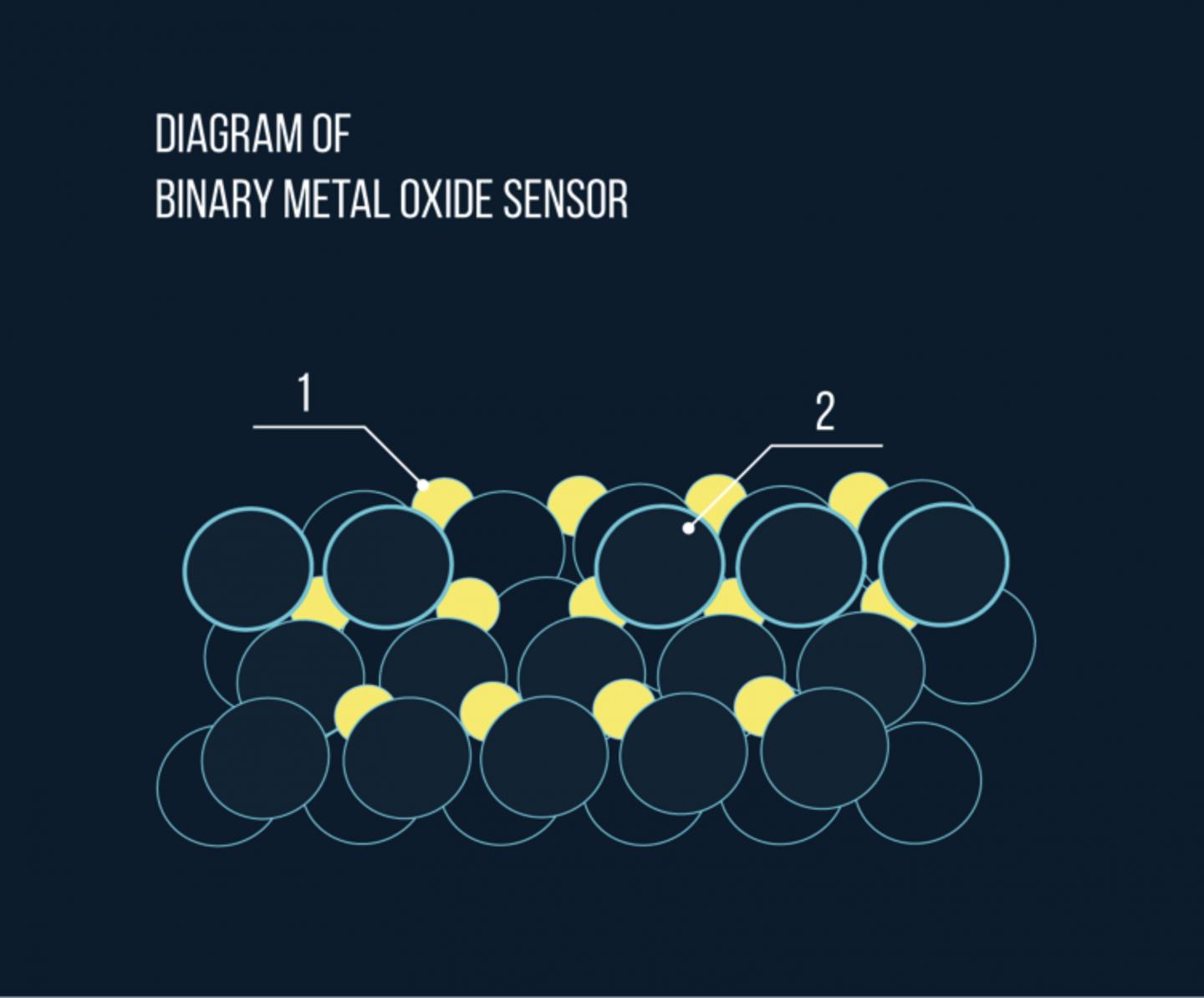
According to the research findings, the most promising detection systems are binary metal oxide sensors, in which one component provides a high density of conductive electrons and another is a strong catalyst.
A mixed system of that kind has the two necessary components for effective gas detection, viz., an electron donor and a substance "accommodating" the reaction. An additional factor contributing to faster sensor response is the formation of chemisorption centers, i.e., the chemically active spots on the nanocrystals that facilitate gas molecule adsorption.
"We are planning further research into the possibilities for sensor design presented by the multicomponent metal oxide nanocomposites incorporating nanofibers. The development of new effective sensor compositions will be based on a reasonably balanced approach involving both the experimental tests and the advancement of our theoretical understanding of the sensing mechanisms," comments Prof. Trakhtenberg.
A rather promising approach to the development of new gas detection systems is the use of "core-shell type" composite metal oxide nanofibers, where the "core" and the "shell" are composed of two different oxides.
The mechanisms of sensory phenomena in binary metal-oxide nanocomposites
G.N. Gerasimova, V.F. Gromova, O.J. Ilegbusib, , , L.I. Trakhtenberga, c
Received 13 June 2016, Revised 23 August 2016, Accepted 3 September 2016, Available online 4 September 2016
Moscow Institute of Physics and Technology
#Chemistry #MaterialScience #Sensors
