You may have seen it on CSI: The star examines hair from a crime scene and concludes its color or texture looks like the defendant's hair, or maybe his dog's. Case closed.
But looks can be deceiving, as well as vague and subjective. In real life, the FBI is now reviewing thousands of cases involving hair comparisons going back to the 1980s because traditional identifications--often based on looks alone--have been called into question.
Instead, what if investigators could precisely measure a hair's mechanical properties--its stiffness and stickiness? In fact, they can, according to recent experiments at the National Institute of Standards and Technology (NIST), which is developing science-based methods to help ensure rigorous forensic practices.
"Lots of forensics is based on the how the evidence looks," NIST engineer Frank DelRio says. "We are trying to add another dimension, how things feel. How an object feels--its mechanical response--depends on the material and the object's history."
DelRio is an expert in atomic force microscopy (AFM), a precision tool with a mechanical probe typically used in basic sciences for imaging but also to measure responses to force, or pulling. He usually measures industrial materials like silicon. But he also watches a lot of CSI and thought his expertise could help answer national calls to enhance the accuracy, reliability and statistical rigor of forensics.
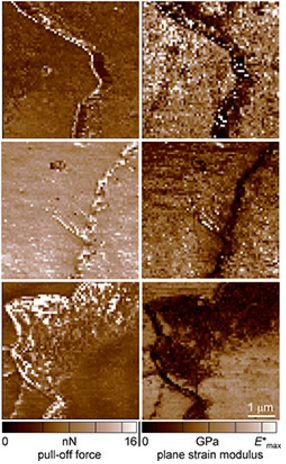
DelRio and NIST physicist Robert Cook recently used AFM to demonstrate quantitative methods for measuring--nondestructively and at the nanometer size scale--the mechanical properties of four types of evidence: hair, documents, fingerprints and explosives.
The researchers measured the stiffness and pull-off force (stickiness) for hair as a function of treatment, specifically conditioning and bleaching. They also measured these properties for test documents made to mimic forgeries marked with both ballpoint ink and printer ink, impression and pattern evidence such as how fingerprints change over time, and interactions of explosive particles and surfaces as a function of fabric type, rayon versus cotton.
The measurement results clearly distinguished various treatments of hair, types of ink, age of fingerprints and composition of fabrics, and related these data to the structure of the sample such as broken bonds in the hair and the smooth ballpoint ink versus the rough printer ink. Importantly, the measurements were rigorous--that is, precise enough to allow for tests and quantitative specifications of the statistical significance of the similarities or differences in properties. DelRio imagines that someday AFM might be used, for example, to measure old hair evidence and determine the probability that a criminal used a certain shampoo.
"This is all theoretical at this point," DelRio notes. "For this to be an effective practical tool, a lot of baseline measurements and in-depth studies would need to be done to develop a good sense of how these properties change over time."
In addition, DelRio notes that AFM calibration methods and standard samples or other methods for specifying accuracy would need to be developed to enable accurate comparison of measurements across laboratories. Also crucial would be the development of an experience base to build trust in AFM techniques, requiring widespread availability of instruments, training, protocols and standards for forensics labs, the paper notes.
uantitative Scanning Probe Microscopy for Nanomechanical Forensics. 2016. Experimental Mechanics
F.W. DelRio and R.F. Cook.
Posted online Oct. 31, 2016. DOI: 10.1007/s11340-016-0238-y
NIST
#MaterialScience
