Carbon is one of the most versatile elements: it forms the basis for an enormous number of chemical compounds, it has several allotropes of different dimensionality, and it exhibits many different bonding geometries.
For this reason, carbon materials have had a special place in materials research for a long time. Although the three-dimensional forms of carbon -- diamond and graphite -- are known since ancient times, it took until 1985 before the first low-dimensional carbon allotrope, the quasi-zero-dimensional fullerene, was discovered.
Soon after this, in 1991, the one-dimensional carbon nanotubes were brought to the attention of the scientific community, and in 2004 the two-dimensional carbon allotrope, graphene, became experimental reality. Different combinations of carbon allotropes such as fullerene-filled carbon nanotubes (carbon peapods) and graphite intercalated by fullerenes have been made already.
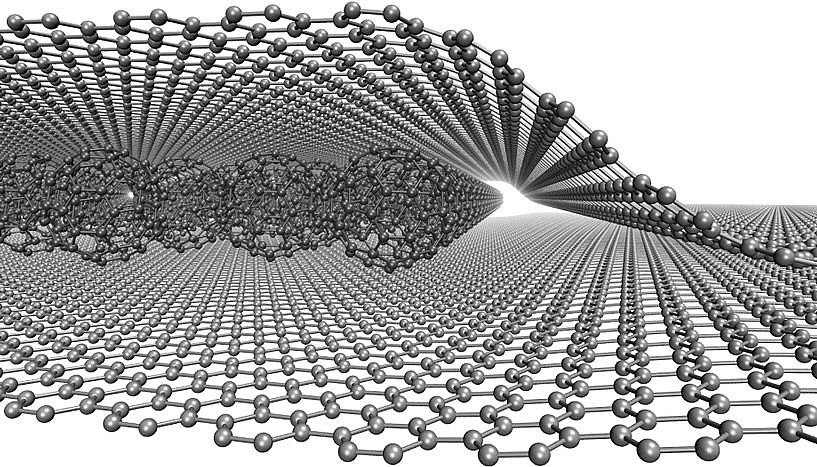
In the article published in Science Advances, the scientists at the University of Vienna demonstrate a hybrid carbon system, termed buckyball sandwich, in which a single layer of fullerenes is encapsulated between two graphene sheets (Illustration 1).
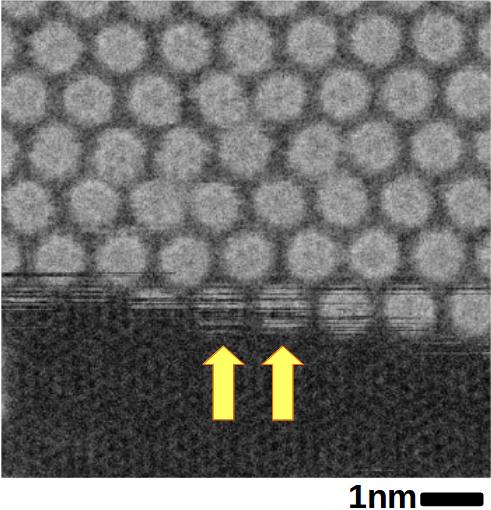
The analysis of the structure via atomically resolved scanning transmission electron microscopy provided insights into the dynamics of the molecules. At the edges of the fullerene layers, the scientists could observe the diffusion of individual fullerenes within the pocket of the graphene sandwich (Illustration 2): Due to the movement of the fullerenes, they are only partially visible in the image (recorded line by line, so that mobile fullerenes only appear on some of the lines).
Moreover, fullerenes were found to rotate inside the sandwich -- however this rotation was blocked when the fullerenes merged into larger objects due to extended electron irradiation.
With the fullerene-graphene system, the scientists have created a new material that fills a gap in the available combinations of hybrid carbon heterostructures. The graphene sandwich provides a nanoscale reaction chamber and a clean interface to the microscope vacuum, that allows the observation of molecular dynamics in the transmission electron microscope. Therefore the researchers expect that this work also opens many new avenues for studying the structure and dynamics of molecules similarly encapsulated in the 2D space between graphene sheets.
Buckyball sandwiches
Rasim Mirzayev, Kimmo Mustonen, Mohammad R. A. Monazam, Andreas Mittelberger, Timothy J. Pennycook, Clemens Mangler, Toma Susi, Jani Kotakoski and Jannik C. Meyer†
Science Advances 09 Jun 2017: Vol. 3, no. 6, e1700176
DOI: 10.1126/sciadv.1700176
V.-Prof. Dipl.-Phys. Dr. Jannik C. Meyer
Fakultät für Physik, Universität Wien
jannik.meyer@univie.ac.at
Dr. Kimmo Mustonen
Physik Nanostrukturierter Materialien, Universität Wien
kimmo.mustonen@univie.ac.at
Universität Wien
#Graphene #Nanostructures #MolecularSystems #Molecules
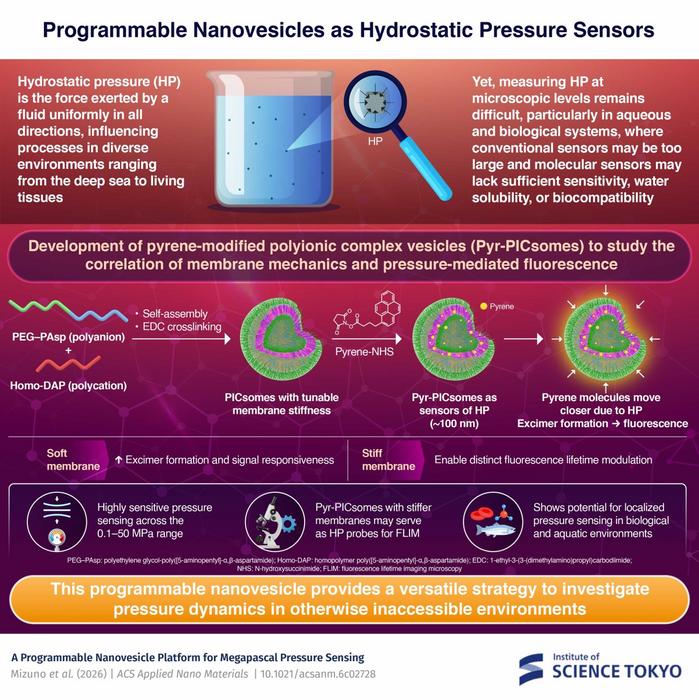
Pyrene-modified polyionic complex vesicles, or Pyr-PICsomes, convert hydrostatic pressure into measurable fluorescence. Crosslinking density tunes membrane stiffness, which governs sensing behavior: soft vesicles give strong excimer-to-monomer ratio changes from 0.1 to 50 MPa, while stiff membranes respond through fluorescence lifetime, suiting lifetime imaging.
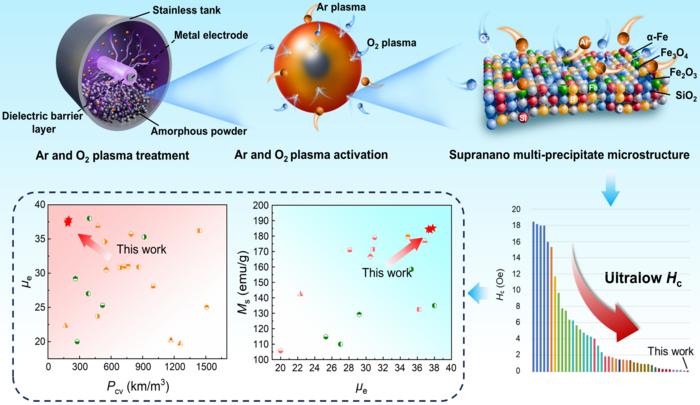
Ar/O₂ plasma treatment generates supranano α-Fe, Fe₃O₄, SiO₂ and Fe₂O₃ precipitates just 0.8–2.5 nm across amorphous powder surfaces, creating nucleation sites that ease magnetic-moment reversal. The resulting soft magnetic composite combines 0.13 Oe coercivity, 37.3 permeability, 185 emu g⁻¹ saturation magnetization and 191.18 kW m⁻³ core loss at 1 MHz and 20 mT. The surface route avoids bulk composition changes, aiding scale-up for high-frequency inductors and power chokes.
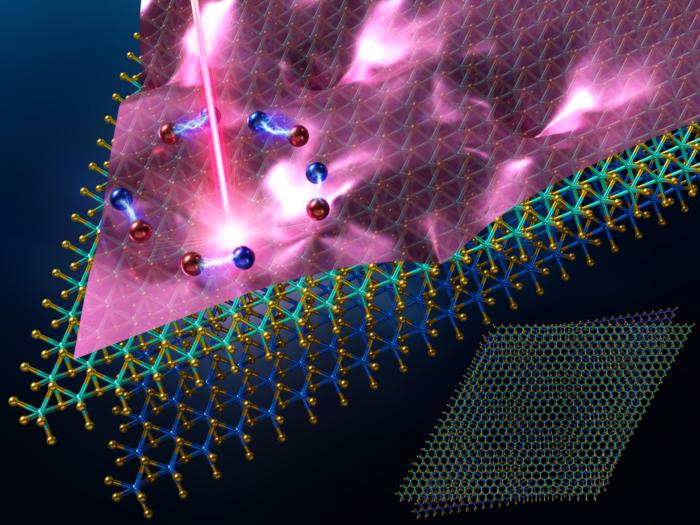
Researchers at MANA have introduced a theoretical framework that extracts hidden disorder from complex photoluminescence spectra in twisted MoSe2/WSe2 moiré heterostructures, bypassing unreliable peak-by-peak analysis. By tracking how simple descriptors like peak and average energy vary spatially, the work reveals a hierarchy of disorder, from micrometer-scale background variations to localized exciton-trapping defects.






