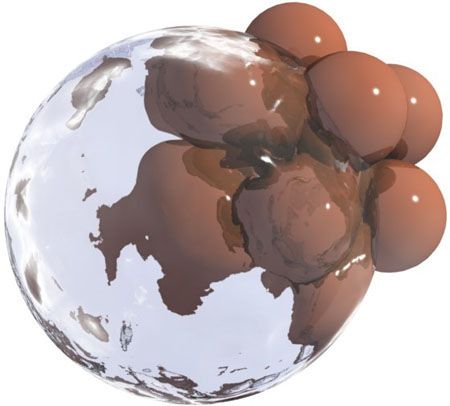
New model explains interactions between small copper clusters used as low-cost catalysts in the production of hydrogen by breaking down water molecules.
Copper nanoparticles dispersed in water or in the form of coatings have a range of promising applications, including lubrication, ink jet printing, as luminescent probes, exploiting their antimicrobial and antifungal activity, and in fuel cells. Another promising application is using copper as a catalyst to split water molecules and form molecular hydrogen in gaseous form. At the heart of the reaction, copper-water complexes are synthesised in ultra-cold helium nanodroplets as part of the hydrogen production process, according to a recent paper published in EPJ D. For its authors, Stefan Raggl, from the University of Innsbruck, Austria, and colleagues, splitting water like this is a good way of avoiding splitting hairs.
Previous work showed that at the molecular level, water oxidises copper nanoparticles until their surface is saturated with molecules carrying hydrogen (called hydroxyl groups). Theoretical work further showed that a monolayer of water, once adsorbed on the copper particles, spontaneously converts to a half-monolayer of hydroxide (OH) plus half a monolayer of water while releasing hydrogen gas.
In their study, Raggl and colleagues synthesised neutral copper-water complexes by successively doping helium nano-droplets -- which are kept at the ultra-cold temperature of 0.37 K in a state referred to as superfluid -- with copper atoms and water molecules. These droplets are then ionised by electrons. The authors show that the composition of the most prominent ions depends on the partial copper and water pressures in the cell where the reaction occurs. They observe ions containing several copper atoms and several dozen water molecules.
The authors recognise that they failed to directly observe the predicted hydrogen formation because their instrument is not designed to detect electrically neutral entities.
Helium nanodroplets doped with copper and water
S. Raggl, N. Gitzl, P. Martini, P. Scheier,O. Echt
DOI: 10.1140/epjd/e2018-90150-7
Springer
#RenewableEnergy #Catalysts
This week in nanotech
$108.5M raised
8 funding rounds · 46 deals tracked
New products
 DLS-1 Mass Spectrometer for Fusion Gas AnalysisHiden Analytical Featured
 Orion Sputtering Deposition SystemsAJA International Featured
 Aether®Lam Research
Market insights
Last 30 days: Quantum Technologies drew the most money: $3.17B.
Money raised per month
Behind the deal
Who invested in Vertical Semiconductor’s $73M Grant?
See the investors with Insights Pro →