Gold can do more than glitter - researchers create novel gold compound at the European XFEL

Gold is considered to be chemically extremely inert. Using the world's largest X-ray laser, the European XFEL, researchers have now been able to show that this precious metal becomes chemically more active under extreme conditions. They have been able to produce a completely new compound from gold and hydrogen: solid gold hydride.
An international research team including reseachers from DESY wanted to know how long it takes for hydrocarbons, compounds of carbon and hydrogen, to form diamonds under extremely high pressure and heat. In their experiments at the European XFEL, they used hydrocarbon samples with an embedded gold foil to absorb the X-rays and heat the weakly absorbing hydrocarbons. To their surprise, they did not only observe the formation of diamonds, but also discovered for the first time the formation of gold hydride, a chemical compound of gold and hydrogen, under extremely high temperatures and pressures. It had actually been assumed that gold hardly reacts with hydrogen. The discovery opens up new perspectives for chemistry under extreme sample conditions.
Gold is considered one of the most unreactive metals. However, under pressure conditions such as those found in the Earth's interior, something happens to the precious metal. Researchers at the High Energy Density (HED) experimental station at European XFEL compressed gold to over 40 gigapascals (GPa) using a diamond stamp cell and heated it to around 2,500 degrees Celsius with ultra-short flashes from the European XFEL X-ray laser. Under these conditions, the gold reacted with hydrogen which was released from hydrocarbons. A new type of gold-hydrogen compound was formed.
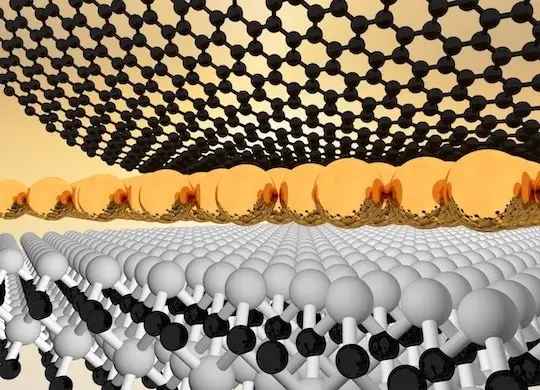
“We were able to demonstrate that the lattice of gold atoms above 40 GPa forms a hexagonal close-packed arrangement in which the hydrogen atoms ‘flow’ through the gaps,” explains Mungo Frost from the SLAC National Accelerator Laboratory.
What is particularly remarkable is that the hydrogen in the newly discovered compound moves very easily through the solid lattice of gold atoms. Scientists refer to this state as the superionic state which increases the conductivity of the gold hydride. This property was previously mainly observed in hydrogen-rich materials but is completely new in this form in gold-containing compounds.
On cooling, the gold hydride ‘decomposes’ back into normal gold which usually has a different face-centered cubic crystal structure. The researchers therefore assume that the gold hydride only decomposes under high temperature conditions. “The decisive factor for this discovery at European XFEL was the high-time resolution that we were able to achieve with the help of the ‘AGIPD’ detector developed at DESY,” says DESY researcher Cornelius Strohm, whose team is in charge of the platform for high-pressure experiments at the HED experimental station. It specialises in high-energy densities as part of the HIBEF (Helmholtz International Beamline for Extreme Fields) consortium. Heinz Graafsma, physicist at DESY and head of detector development, adds: “The AGIPD detectors were designed precisely to resolve the flashes of light from European XFEL individually at repetition rates of several million per second.”
“Our results show that even elements as unreactive as gold can exhibit completely new chemical properties under extreme pressure and temperature conditions,” says Ulf Zastrau, head of the HED experimental station at European XFEL, where the experiment was carried out. The team sees this as an indication that many more unexpected chemical compounds can be produced using extreme temperatures and pressures that cannot be produced using conventional chemistry.
This discovery not only represents a novelty for gold chemistry, but also has far-reaching implications for high-pressure experiments in which gold was previously used as a completely inert material. Future research should clarify whether similar effects also occur with other precious metals. Reference Synthesis of Gold Hydride at High Pressure and High Temperature
Mungo Frost, Kilian Abraham, Alexander F. Goncharov, R. Stewart McWilliams, Rachel J. Husband, Michal Andrzejewski, Karen Appel, Carsten Baehtz, Armin Bergermann, Danielle Brown, Elena Bykova, Anna Celeste, Eric Edmund, Nicholas J. Hartley, Konstantin Glazyrin, Heinz Graafsma, Nicolas Jaisle, Zuzana Konôpková, Torsten Laurus, Yu Lin, Bernhard Massani, Maximilian Schörner, Maximilian Schulze, Cornelius Strohm, Minxue Tang, Zena Younes, Gerd Steinle-Neumann, Ronald Redmer, Siegfried H. Glenzer