
As global energy demand increases, researchers, industries, governments, and stakeholders are working together to develop new ways of meeting that demand. This is especially important as we address the ongoing climate crisis and transition away from fossil fuels.
One very promising type of energy generation is solid-oxide fuel cells, or SOFCs. Unlike batteries, which release stored chemical energy as electricity, fuel cells convert chemical fuel directly into electricity and continue to do so as long as fuel is provided. A common type of fuel cell many are familiar with is the hydrogen fuel cells, which convert hydrogen gas into energy and water.
While SOFCs are promising due to their high efficiency and long lifespan, one major drawback is that they require operation at high temperatures of around 700-800℃. Therefore, utility of these devices would require costly heat-resistant materials.
Now, publishing in Nature Materials, researchers at Kyushu University report that they have succeeded in developing a new SOFC with an efficient operating temperature of 300℃. The team expects that their new findings will lead to the development of low-cost, low-temperature SOFCs and greatly accelerate the practical application of these devices.
The heart of an SOFC is the electrolyte, a ceramic layer that carries charged particles between two electrodes. In hydrogen fuel cells, the electrolyte transports hydrogen ions (a.k.a. protons) to generate energy. However, the fuel cell needs to operate at the extremally high temperatures to run efficiently.
“Bringing the working temperature down to 300℃ it would slash material costs and open the door to consumer-level systems,” explains Professor Yoshihiro Yamazaki from Kyushu University’s Platform of Inter-/Transdisciplinary Energy Research, who led the study. “However, no known ceramic could carry enough protons that fast at such ‘warm’ conditions. So, we set out to break that bottleneck.”
Electrolytes are composed of different combinations of atoms arranged in a crystal lattice structure. It’s between these atoms that a proton would travel. Researchers have explored different combinations of materials and chemical dopants—substances that can alter the material’s physical properties—to improve the speed at which protons travel through electrolytes.
“But this also comes with a challenge,” continues Yamazaki. “Adding chemical dopants can increase the number of mobile protons passing through an electrolyte, but it usually clogs the crystal lattice, slowing the protons down. We looked for oxide crystals that could host many protons and let them move freely—a balance that our new study finally struck.”
The team found that two compounds, barium stannate (BaSnO3) and barium titanate (BaTiO3), when doped with high concentrations of scandium (Sc), were able achieve the SOFC benchmark proton conductivity of more that 0.01 S/cm at 300℃, a conductivity level comparable to today’s common SOFC electrolytes at 600-700℃.
“Structural analysis and molecular dynamics simulations revealed that the Sc atoms link their surrounding oxygens to form a ‘ScO₆ highway,’ along which protons travel with an unusually low migration barrier. This pathway is both wide and softly vibrating, which prevents the proton-trapping that normally plagues heavily doped oxides,” explains Yamazaki. “Lattice-dynamics data further revealed that BaSnO₃ and BaTiO₃ are intrinsically ‘softer’ than conventional SOFC materials, letting them absorb far more Sc than previously assumed.”
The findings overturn the trade-off between dopant level and ion transport, offering a clear path for low-cost, intermediate-temperature SOFCs.
“Beyond fuel cells, the same principle can be applied to other technologies, such as low-temperature electrolyzes, hydrogen pumps, and reactors that convert CO₂ into valuable chemicals, thereby multiplying the impact of decarbonization. Our work transforms a long-standing scientific paradox into a practical solution, bringing affordable hydrogen power closer to everyday life,” concludes Yamazaki.
Reference
Mitigating proton trapping in cubic perovskite oxides via ScO6 octahedral networks
Kota Tsujikawa, Junji Hyodo, Susumu Fujii, Kazuki Takahashi, Yuto Tomita, Nai Shi, Yasukazu Murakami, Shusuke Kasamatsu & Yoshihiro Yamazaki
https://www.nature.com/articles/s41563-025-02311-w
Kyushu University

What are the limits of quantum physics? This is a question that has been researched around the world for decades. If we want to make the properties of the quantum world technically usable, we need to understand whether objects that are significantly larger than atoms and molecules can also exhibit quantum phenomena.For example, small glass spheres with a diameter of one hundred nanometres can be examined – still over a thousand times smaller than a grain of sand, but huge by quantum standards...
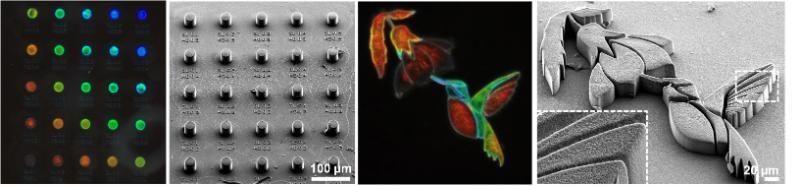
Half a billion years ago nature evolved a remarkable trick: generating vibrant, shimmering colours via intricate, microscopic structures in feathers, wings and shells that reflect light in precise ways. Now, researchers from Trinity have taken a major step forward in harnessing it for advanced materials science. A team, led by Professor Colm Delaney from Trinity’s School of Chemistry and AMBER, the Research Ireland Centre for Advanced Materials and BioEngineering Research, has developed a pio...

The new method, inspired by an imaging technique that has been around for 35 years, takes ultraprecise measurements of a molecule’s unique light-emission signature at the scale of a billionth of a second. It uses a single-photon avalanche diode (SPAD) camera made up of close to a million tiny sensors that can each detect aphoton. The data are analyzed to determine a molecule’s fluorescence lifetime – or the extremely short delay between an excitation laser pulse and the fluorescence emitted b...
