The research published in Nature Communications set out to answer a simple question - how do nanoparticles melt? Although this question has been a focus of researchers for the past century, it still is an open problem - initial theoretical models describing melting date from around 100 years, and even the most relevant models being some 50 years old.
Professor Richard Palmer, who led the team based at the University's College of Engineering said of the research: "Although melting behaviour was known to change on the nanoscale, the way in which nanoparticles melt was an open question. Given that the theoretical models are now rather old, there was a clear case for us to carry out our new imaging experiments to see if we could test and improve these theoretical models."
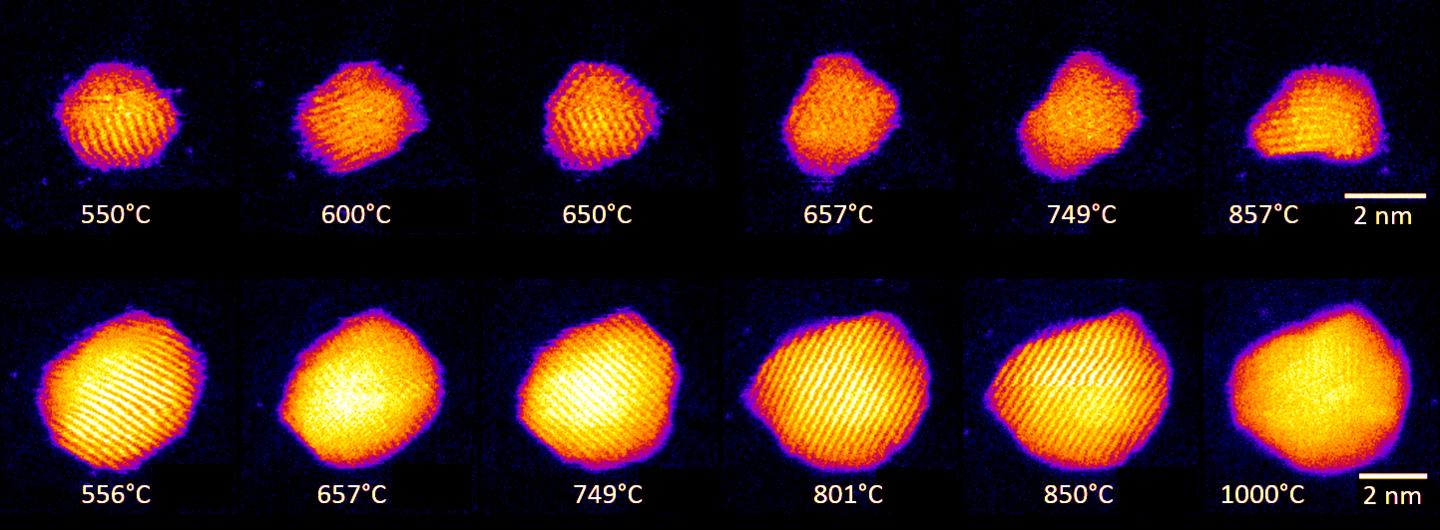
The research team used gold in their experiments as it acts as a model system for noble and other metals. The team arrived at their results by imaging gold nanoparticles, with diameters ranging from 2 to 5 nanometres, via aberration corrected scanning transmission electron microscope. Their observations were later supported by large-scale quantum mechanical simulations.
Professor Palmer said: "We were able to prove the dependence of the melting point of the nanoparticles on their size and for the first time see directly the formation of a liquid shell around a solid core in the nanoparticles over a wide region of elevated temperatures, in fact for hundreds of degrees.
"This helps us to describe accurately how nanoparticles melt and to predict their behaviour at elevated temperatures. This is a science breakthrough in a field we can all relate to - melting - and will also help those producing nanotech devices for a range of practical and everyday uses, including medicine, catalysis and electronics."
Atomic-resolution imaging of surface and core melting in individual size-selected Au nanoclusters on carbon
D. M. Foster, Th. Pavloudis, J. Kioseoglou & R. E. Palmer
Nature Communications 10, Article number: 2583 (2019)
DOI: https://doi.org/10.1038/s41467-019-10713-z
https://www.nature.com/articles/s41467-019-10713-z
Contact information:
Professor Richard Palmer
Senior Research Fellow in Engineering at Swansea University
r.e.palmer@swansea.ac.uk
Tel: +44 1792 604318
Swansea University
#GoldNanoparticles
This week in nanotech
$108.5M raised
8 funding rounds · 46 deals tracked
New products
 Ti-WCMBN Nanomaterialia Featured
 Nion-compatible In Situ STEM Holders for Electrical BiasingHummingbird Scientific Featured
 Aether®Lam Research
Market insights
Last 30 days: Quantum Technologies drew the most money: $3.17B.
Money raised per month