Pennsylvania State University (Penn State)
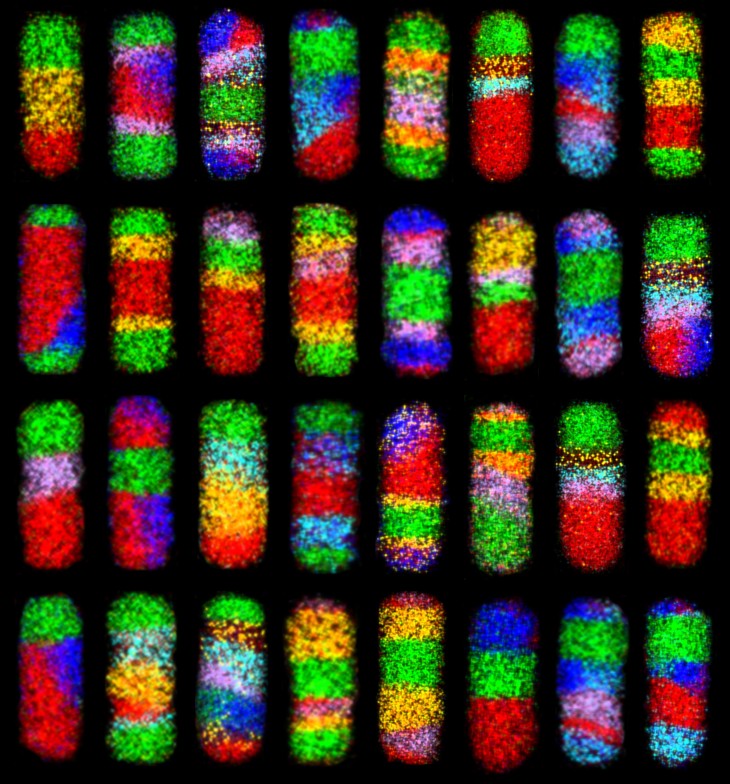
Using straightforward chemistry and a mix-and-match, modular strategy, researchers have developed a simple approach that could produce over 65,000 different types of complex nanoparticles, each containing up to six different materials and eight segments, with interfaces that could be exploited in electrical or optical applications. These rod-shaped nanoparticles are about 55 nanometers long and 20 nanometers wide--by comparison a human hair is about 100,000 nanometers thick--and many are considered to be among the most complex ever made.
A paper describing the research, by a team of Penn State chemists, appears January 24, 2020 in the journal Science.
"There is a lot of interest in the world of nanoscience in making nanoparticles that combine several different materials--semiconductors, catalysts, magnets, electronic materials," said Raymond E. Schaak, DuPont Professor of Materials Chemistry at Penn State and the leader of the research team. "You can think about having different semiconductors linked together to control how electrons move through a material, or arranging materials in different ways to modify their optical, catalytic, or magnetic properties. We can use computers and chemical knowledge to predict a lot of this, but the bottleneck has been in actually making the particles, especially at a large-enough scale so that you can actually use them."
The team starts with simple nanorods composed of copper and sulfur. They then sequentially replace some of the copper with other metals using a process called "cation exchange." By altering the reaction conditions, they can control where in the nanorod the copper is replaced--at one end of the rod, at both ends simultaneously, or in the middle. They can then repeat the process with other metals, which can also be placed at precise locations within the nanorods. By performing up to seven sequential reactions with several different metals, they can create a veritable rainbow of particles--over 65,000 different combinations of metal sulfide materials are possible.
"The real beauty of our method is its simplicity," said Benjamin C. Steimle, a graduate student at Penn State and the first author of the paper. "It used to take months or years to make even one type of nanoparticle that contains several different materials. Two years ago we were really excited that we could make 47 different metal sulfide nanoparticles using an earlier version of this approach. Now that we've made some significant new advances and learned more about these systems, we can go way beyond what anyone has been able to do before. We are now able to produce nanoparticles with previously unimaginable complexity simply by controlling temperature and concentration, all using standard laboratory glassware and principles covered in an Introductory Chemistry course."
"The other really exciting aspect of this work is that it is rational and scalable," said Schaak. "Because we understand how everything works, we can identify a highly complex nanoparticle, plan out a way to make it, and then go into the laboratory and actually make it quite easily. And, these particles can be made in quantities that are useful. In principle, we can now make what we want and as much as we want. There are still limitations, of course--we can't wait until we are able to do this with even more types of materials--but even with what we have now, it changes how we think about what is possible to make."
Rational construction of a scalable heterostructured nanorod megalibrary
Benjamin C. Steimle, Julie L. Fenton, Raymond E. Schaak
Science, 2020; 367 (6476): 418
Contact information:
Raymond E. Schaak
Penn State Professor of Materials Chemistry
res20@psu.edu or schaak@chem.psu.edu
Phone: 814-865-8600
Schaak Group - Synthetic Inorganic Nanochemistry

Silver nanoparticles with diameters of ~10 nm deliver the best performance as electrocatalysts. The silver particles are sprayed onto the electrode together with a conductive carbon powder. The ideal mixture consists of 20 per cent by mass silver and 80 per cent by mass carbon powder. This image was taken using a transmission electron microscope (TEM). © HZB Via electrolysis, CO₂ can be reduced to CO, a raw material for further chemical products such as fuels. Within the GreenQuest Project,...

A flexible metal–organic framework developed by researchers from Institute of Science Tokyo enables the structural determination of large "beyond rule of 5" molecules from microgram-scale samples. Using APF-40 as a crystalline sponge, the researchers determined the structures of 12 pharmaceutical-related molecules, including the 899 Da drug molecule doramectin and trace ivermectin derivatives. The method could aid drug discovery, natural products research, and the characterization of rare...
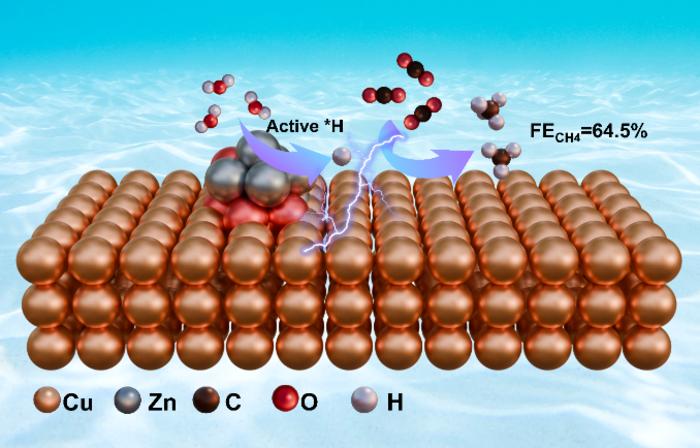
image: CuZn800@C was constructed via solvothermal method and utilizes the high-temperature volatility of zinc to prepare through calcination at different temperatures, which displays a high methane Faradaic efficiency of 64.5% and a remarkable partial current density of -551.3 mA/cm2 at -1.7 V vs. RHE, along with excellent stability. Zn and Cu form a tandem reaction system. Zn sites promote water splitting to provide protons, while Cu sites reduce the energy barrier for *CO hydrogenation....






