To measure very small magnetic fields, researchers often use superconducting quantum interference devices, or SQUIDs. In medicine, their uses include monitoring brain or heart activity, for example, while in the earth sciences researchers use SQUIDs to characterize the composition of rocks or detect groundwater flows. The devices also have a broad range of uses in other applied fields and basic research.
The team led by Professor Christian Schönenberger of the University of Basel’s Department of Physics and the Swiss Nanoscience Institute has now succeeded in creating one of the smallest SQUIDs ever built. The researchers described their achievement in the scientific journal Nano Letters.
A superconducting ring with weak links
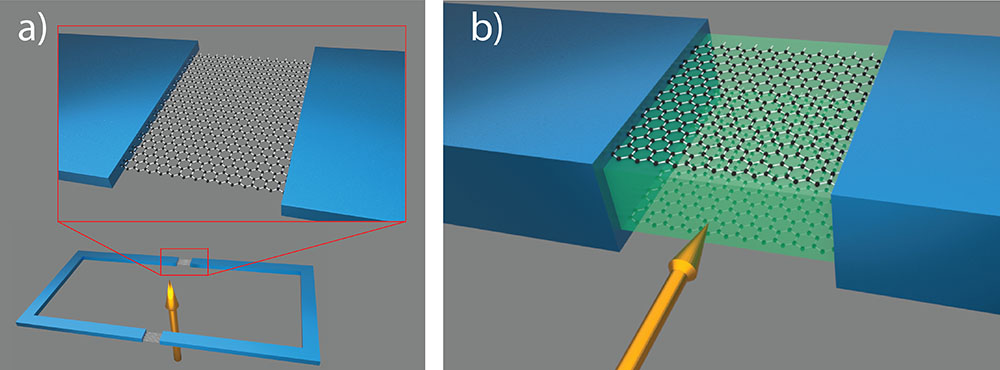
A typical SQUID consists of a superconducting ring interrupted at two points by an extremely thin film with normal conducting or insulating properties. These points, known as weak links, must be so thin that the electron pairs responsible for superconductivity are able to tunnel through them. Researchers recently also began using nanomaterials such as nanotubes, nanowires or graphene to fashion the weak links connecting the two superconductors.
As a result of their configuration, SQUIDs have a critical current threshold above which the resistance-free superconductor becomes a conductor with ordinary resistance. This critical threshold is determined by the magnetic flux passing through the ring. By measuring this critical current precisely, the researchers can draw conclusions about the strength of the magnetic field.
SQUIDs with six layers
“Our novel SQUID consists of a complex, six-layer stack of individual two-dimensional materials,” explains lead author David Indolese. Inside it are two graphene monolayers separated by a very thin layer of insulating boron nitride. “If two superconducting contacts are connected to this sandwich, it behaves like a SQUID – meaning it can be used to detect extremely weak magnetic fields.”
In this setup, the graphene layers are the weak links, although in contrast to a regular SQUID they are not positioned next to each other, but one on top of the other, aligned horizontally. “As a result, our SQUID has a very small surface area, limited only by the constraints of nanofabrication technology,” explains Dr. Paritosh Karnatak from Schönenberger’s team.
The tiny device for measuring magnetic fields is only around 10 nanometers high – roughly a thousandth of the thickness of a human hair. The instrument can trigger supercurrents that flow in minuscule spaces. Moreover, its sensitivity can be adjusted by changing the distance between the graphene layers. With the help of electrical fields, the researchers are also able to increase the signal strength, further enhancing the measurement accuracy.
Analyzing topological insulators
The Basel research team’s primary goal in developing the novel SQUIDs was to analyze the edge currents of topological insulators. Topological insulators are currently a focus of countless research groups all over the world. On the inside, they behave like insulators, while on the outside – or along the edges – they conduct current almost losslessly, making them possible candidates for a broad range of applications in the field of electronics.
“With the new SQUID, we can determine whether these lossless supercurrents are due to a material’s topological properties, and thereby tell them apart from non-topological materials. This is very important for the study of topological insulators,” remarked Schönenberger of the project. In future, SQUIDs could also be used as low-noise amplifiers for high-frequency electrical signals, or for instance to detect local brainwaves (magnetoencephalography), as their compact design means a large number of the devices can be connected in series.
The paper is the outcome of close collaboration among groups at the University of Basel, the University of Budapest and the National Institute for Material Science in Tsukuba (Japan).
Reference:
Compact SQUID realized in a double layer graphene heterostructure
David I. Indolese, Paritosh Karnatak, Artem Kononov, Raphaëlle Delagrange, Roy Haller, Lujun Wang, Péter Makk, Kenji Watanabe, Takashi Taniguchi, and Christian Schönenberger
Nano Letters (2020), doi: 10.1021/acs.nanolett.0c02412
Contact:
Prof. Dr. Christian Schönenberger,
University of Basel, Department of Physics
+41 61 207 36 90,
christian.schoenenberger@unibas.ch
AIST and HORIBA, Ltd. have jointly established the HORIBA Institute for Particle Analysis in AIST TSUKUBA (HIPAA) under the National Metrology Institute of Japan, AIST. HIPAA has conducted operations since February 1, 2021.
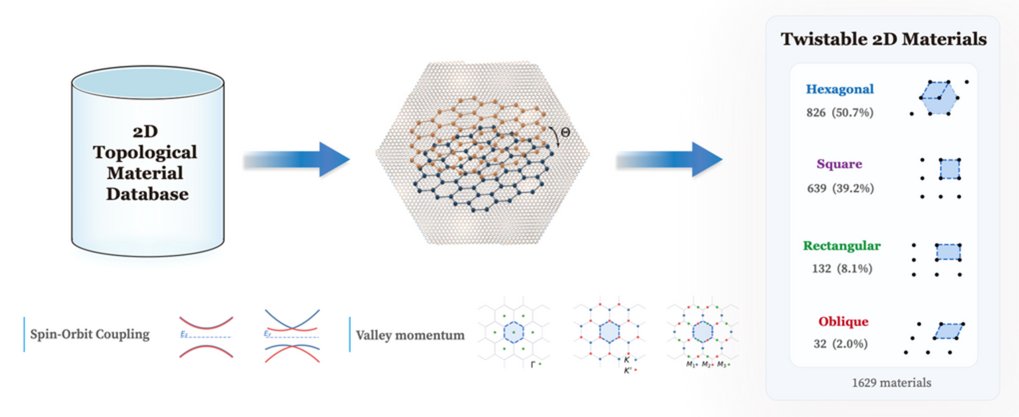
Two new studies catalog nearly 9,000 two-dimensional materials and identify 61 semimetals and 1,568 insulators suited to twistronics, the stacking and rotating of atomically thin layers to engineer narrow electronic bands. The work maps topological electronic structures, predicts promising twisted bilayers such as tin diselenide and hafnium disulfide, and confirms several candidates can be grown in bulk and exfoliated into working devices, giving researchers a systematic route to designer…
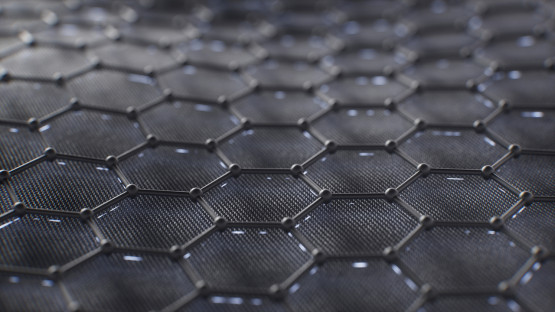
Cornell researchers found that applying voltage to a four-layer graphene stack slides the layers between atomic stacking arrangements, reversibly switching the material between nonmagnetic and magnetic states. The effect, reported in Nature Nanotechnology, exploits weak van der Waals bonds rather than breaking chemical bonds, and the resulting state persists after voltage is removed.