
WASHINGTON, D.C. – Today, the U.S. Department of Energy (DOE) announced $60.7 million in funding to advance the development of quantum computing and networking.
“We are on the threshold of a new era in Quantum Information Science and quantum computing and networking, with potentially great promise for science and society,” said Under Secretary of Science Paul Dabbar. “These projects will help ensure U.S. leadership in these important new areas of science and technology.”
Funding of $47 million will be provided for three five-year projects aimed at accelerating progress in quantum computing. Projects will focus on the development of algorithms as well as the creation of a suite of traditional software tools and techniques— including programming languages, compilers, and debugging approaches—specifically designed for quantum computing.
Funding of $13.7 million will be provided for five four-year projects aimed at developing wide-area quantum networks, with the goal of greatly boosting the range of quantum-based communications. The goal is to develop long-distance quantum communication using existing fiber optic connections. New science and technology, such as quantum repeaters, will be needed to extend the current very limited range of such quantum networks.
All projects are multi-institutional partnerships and involve a total of nine DOE laboratories, ten universities, and one non-profit.
Fiscal Year 2019 funding for the two initiatives totals $15 million, with outyear funding contingent on congressional appropriations.
Projects were selected by competitive peer review under two separate funding announcements sponsored by the Office of Advanced Scientific Computing Research within the Department’s Office of Science.
Lists of the projects can be found here under the heading, “What’s New.”
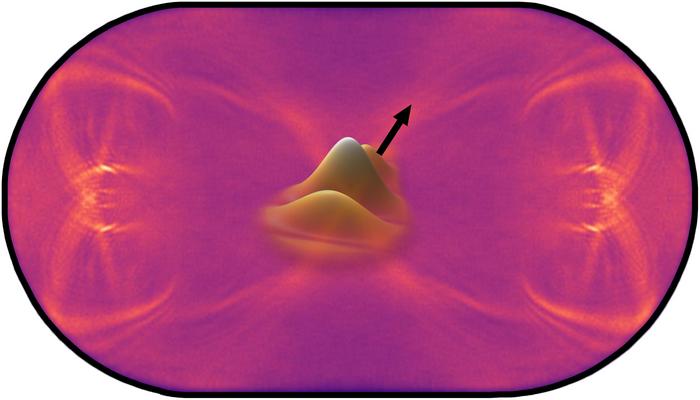
A quantum "wave packet" (in the middle) launched from the same kind of starting point behaves differently. Even after bouncing around for a very long time, faint filament-like patterns (bright glow) are still visible, a tattoo tracing back to its early history. This lingering imprint is the "quantum birthmark" described in the study. Credit: Joonas Keski-Rahkonen, Tampere University Even the most chaotic quantum systems keep a permanent mark of their own past – a "quantum birthmark" – that...
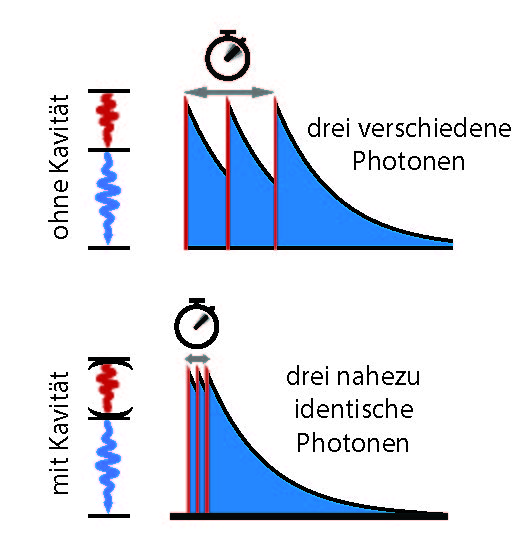
Illustration (University of Basel, Timon Baltisberger): Biexziton decay can generate photons of very high quality if the system is specifically controlled using an optical cavity. Under these conditions, 90 per cent of the photons are indistinguishable. Working in close collaboration, researchers from Paderborn University, the University of Basel and Ruhr University Bochum have made a significant breakthrough in the field of quantum communication. In their recently published paper in the...
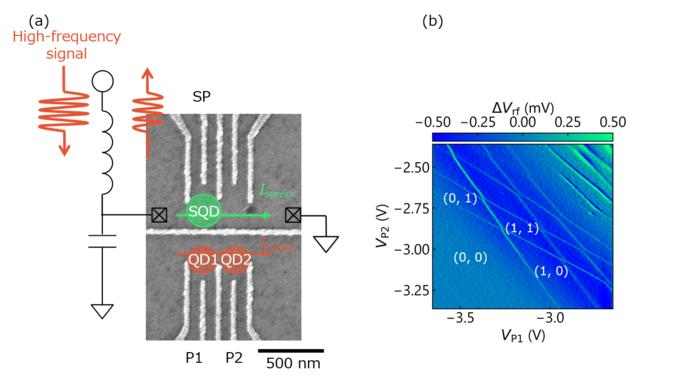
(a) The structure of the gate electrodes on the ZnO device used in the experiment in this paper. (b) The charge stability diagram indicating the formation of ZnO double quantum dot in few-electron regime. Researchers at Tohoku University, in collaboration with the National Institute for Materials Science (NIMS) and the University of Tokyo, have taken an important step toward semiconductor quantum computing using zinc oxide (ZnO). The team successfully demonstrated charge sensing,...
