Deutsches Elektronen-Synchrotron (DESY)
Liquid crystals have become an integral part of our everyday lives. They're not just responsible for the brilliant colours we see on our mobile phones, televisions and computers, but they also play a very important role in many other optical technologies, as they change light interacting with them in a special way. Now a team of researchers led by Deutsches Elektronen-Synchrotron DESY and Hamburg University of Technology (TU Hamburg) is reporting a discovery that expands the potential of liquid crystals with regard to applications in the field of bio- and nanoelectronics, as well as to new membrane technologies for battery design and water purification.
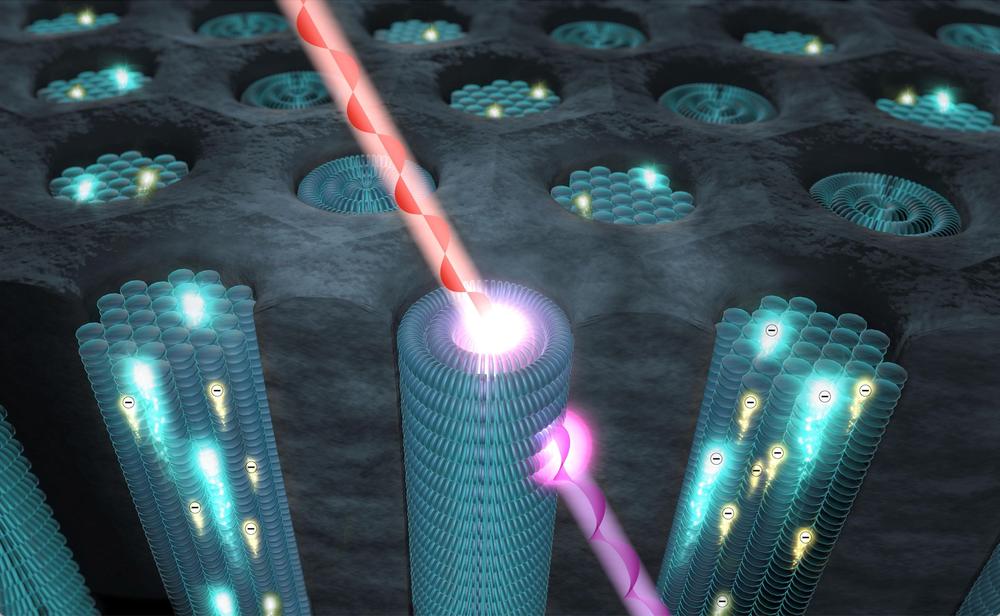
As the researchers report in the highly respected journal "ACS Nano", so-called ionic liquid crystals, which consist, similarly to table salt, of positive and negative ions, can be made to self-assemble into beautifully aligned nanorings or nanowires by filling them into tiny cylindrical nanochannels that are only around 1/250 of the diameter of a hair thick. This process can be precisely controlled by the temperature and by the properties of the nanocontainer walls, which can be either water-repellent or water-attracting. The resulting artificially created ion channels are similar in structure to those found in many biological systems, such as biomembranes. With both electron and ion flow occurring in these nanochannels in the liquid crystals, new avenues for iono-electronic applications are being explored, revealing fascinating possibilities. “This self-assembly is a nice example of scalable multiscale material systems that follow different architectural principles at different length scales, especially at the nano- and mesoscale, to create very special properties at the macroscale," says Zhuoqing Li, PhD student at TU Hamburg and DESY and first author of the corresponding publication.
"The discovery was only possible thanks to a combination of state-of-the-art laser-optical and X-ray experiments, including high-brilliant X-ray sources at DESY in Hamburg and ESRF in Grenoble," says Patrick Huber, head of the Institute of Materials and X-ray Physics at TUHH and the leader of the "High-resolution X-ray Analytics" working group at DESY, also the PhD thesis advisor of Zhuoqing Li.
The customised synthesis of the elementary building blocks of the liquid crystals was also of particular importance in order to decipher the self-assembly behaviour of the nanowires and to make it controllable, according to Sabine Laschat, who heads the working group at the University of Stuttgart. Aileen Raab, PhD student in Laschat's group synthesized the liquid crystals.
The results of this groundbreaking study mark a significant milestone in the fundamental understanding of the self-assembly of liquid-crystalline and more generally hierarchically structured materials at the nanoscale. Due to their unique properties, ionic liquid crystals not only offer the possibility of targeted control of ion transport and ion exchange, but also show extremely interesting opto-electrical properties with regard to changing the polarization of light, which are also of great interest for the development of new photonic technologies.
“The newly discovered systems could find applications in water treatment and as separator materials in electric battery and supercapacitor design,” says Andreas Schönhals (Bundesanstalt für Materialforschung und -prüfung, BAM, Berlin), who supervised the PhD thesis of Mohamed A. Kolmangadi dealing besides others, with the mobility of ions in these systems on a molecular scale.
“During our studies, we also noticed that the liquid-crystalline self-assembly is extremely dependent on the air humidity and thus on the water content. For this reason, these systems are also to be investigated as part of the TU Hamburg's "BlueMat: Water-Driven Materials" research initiative, as stated by Patrick Huber.
Reference
Self-Assembly of Ionic Superdiscs in Nanopores
Zhuoqing Li, Aileen Raab, Mohamed Aejaz Kolmangadi, Mark Busch, Marco Grunwald, Felix Demel, Florian Bertram, Andriy V. Kityk, Andreas Schönhals, Sabine Laschat, and Patrick Huber
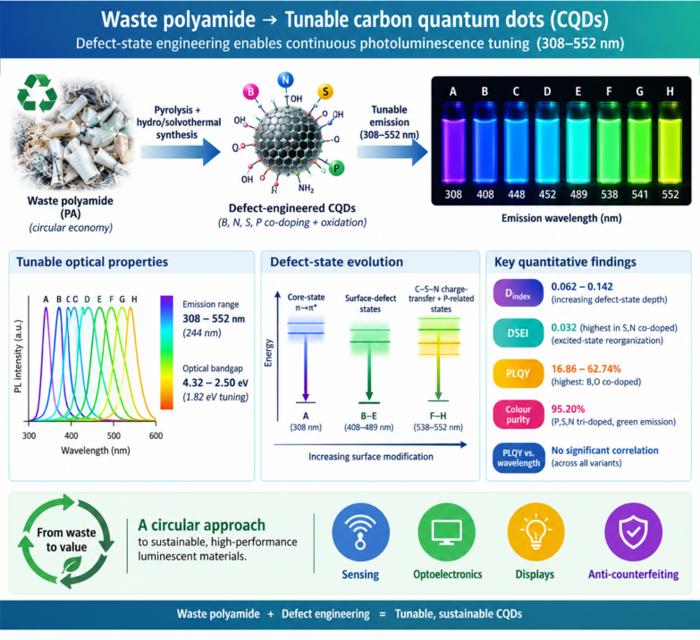
Waste polyamide-derived CQDs show continuous photoluminescence tuning from 308 to 552 nm through sequential defect-state engineering, with optical transition energies decreasing from 4.32 to 2.50 eV. @Christian Ebere Enyoh from Saitama University Carbon quantum dots (CQDs) are fluorescent carbon nanomaterials with potential applications in sensing, optoelectronics, displays, anti-counterfeiting, and environmental technologies. Their optical properties can be adjusted by modifying the carbon...
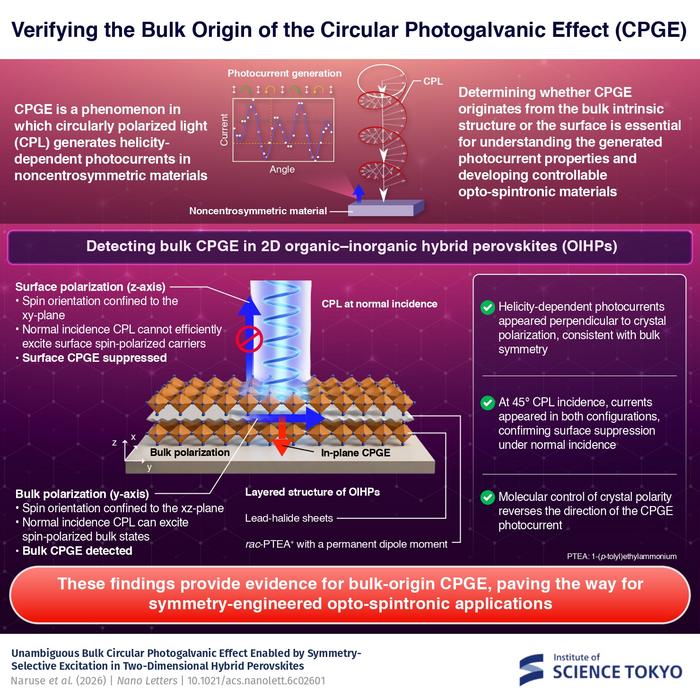
The researchers used circularly polarized light at normal incidence and found that helicity-dependent photocurrents appeared perpendicular to the crystal’s polarization but vanished when measured parallel to it, supporting a bulk origin of CPGE. @Institute of Science Tokyo The circular photogalvanic effect (CPGE), a phenomenon that generates helicity-dependent photocurrents in noncentrosymmetric materials, can originate purely from a crystal's internal structure without contribution from the...
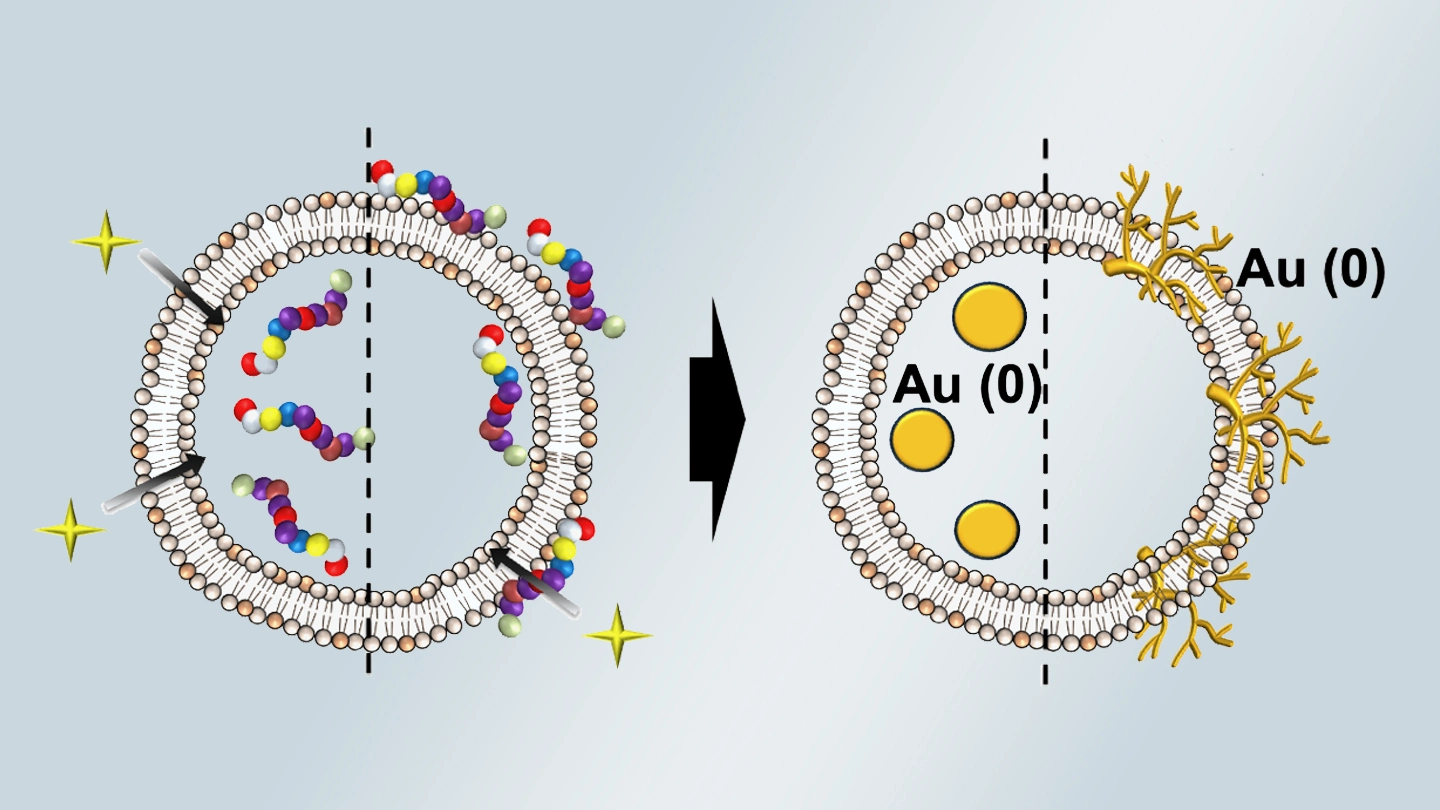
Summary of gold nanoparticle growth programming in liposome based on localization of biomineralization peptide The position of biomineralization peptides within liposomes can influence how gold nanoparticles grow, reports a research team from Institute of Science Tokyo. Peptides localized at the membrane interface promote branched structures, while those confined to the liposome interior favor spherical nanoparticles. The findings offer a new strategy for controlling nanoscale reaction...
