
There is a conundrum around rare earth elements (REE). They play a key role in clean energy, vital to the production of lightweight, efficient batteries and essential components in wind turbines. Conversely, conventional extraction of these elements raises environmental concerns ranging from habitat destruction to water and air pollution to the high amount of energy needed to extract and process these elements.
To solve this quandary, Penn State researchers found inspiration under the sea: mussel stickiness. By mimicking this natural glue, the researchers developed a new mussel-inspired nanocellulose coating (MINC) that has demonstrated what they call a “remarkable, even surprising” ability to recover REEs from secondary sources such as industrial wastewater without using a high amount of energy.
They published the work on July 31 in ACS Applied Materials and Interfaces. It will feature on the journal’s front cover in September.
Mussels have a remarkable ability to adhere to surfaces underwater thanks to the adhesive properties of catechol-based molecules found in mussel proteins. The MINC mirrors this by consisting of ultra-tiny hairy cellulose nanocrystals with uniquely sticky properties. The MINC is applied to a substrate via a technique called dopamine-mediated ad-layer formation. A chemical reaction enables the MINC to form a thin layer of molecules on a surface, making it capable of sticking to a broad range of substrates.
“The MINC approach offers a sustainable and eco-friendly alternative to conventional extraction methods, minimizing the environmental footprint and contributing to the long-term availability of critical elements,” said lead author Amir Sheikhi, assistant professor of chemical engineering and of biomedical engineering, by courtesy.
The researchers focused on applying MINC to extract a particular REE, neodymium. The U.S. Department of Energy listed neodymium as a critical material due to supply shortages and its high impact on emerging sustainable technologies such as electric car batteries and magnets used in powering systems for electric vehicles and wind turbines. However, the “rare” part of rare earth elements is especially true with neodymium, as the lack of ready-to-extract supply of this critical element forces extraction of it from secondary sources such as industrial wastewater recycling. This can be both inefficient and energy intensive, according to Sheikhi.
“The limited global supply of neodymium and the environmental impact of current extraction methods necessitate the development of eco-friendly and sustainable approaches for REE recovery,” Sheikhi said, explaining that conventional extraction techniques use significant amounts of toxic chemicals, such as kerosene, to purify the target element. “Prior rare earth extraction methods have utilized adsorbents such as alginate gels, phosphorus sol-gel materials, nanotubes and porous carbon, but these techniques demonstrate limited efficiency.”
The MINC coating is to neodymium what a magnet is to iron, pulling the REE out of water, even when the element is only present in amounts as limited as parts per million.
"The challenge in extracting neodymium lies in achieving efficient and selective removal of it at low concentrations,” Sheikhi said. “The MINC presented in this study offers improved selectivity and capacity for neodymium removal, overcoming limitations of previous methods.”
This selectivity allows MINC to avoid recovering undesired elements like sodium and calcium, which Sheikhi said would waste time and energy if they had to be filtered to further refine the neodymium.
“The public and society will benefit from this work through the potential for increased availability of neodymium, a crucial element for not just developing clean energy technologies, but also for creating new medical and electronic devices,” Sheikhi said, noting that he plans to investigate how the MINC method may work to extract other REEs. “By providing a sustainable and efficient method for neodymium recovery, this research contributes to the advancement of these technologies and helps address supply shortage concerns, and in turn will increase the possibility of translating this technology to other REE recovery efforts in the future.”
Reference
Mussel-Inspired Nanocellulose Coating for Selective Neodymium Recovery
Shang-Lin Yeh, Dawson Alexander, Naveen Narasimhalu, Roya Koshani, and Amir Sheikhi
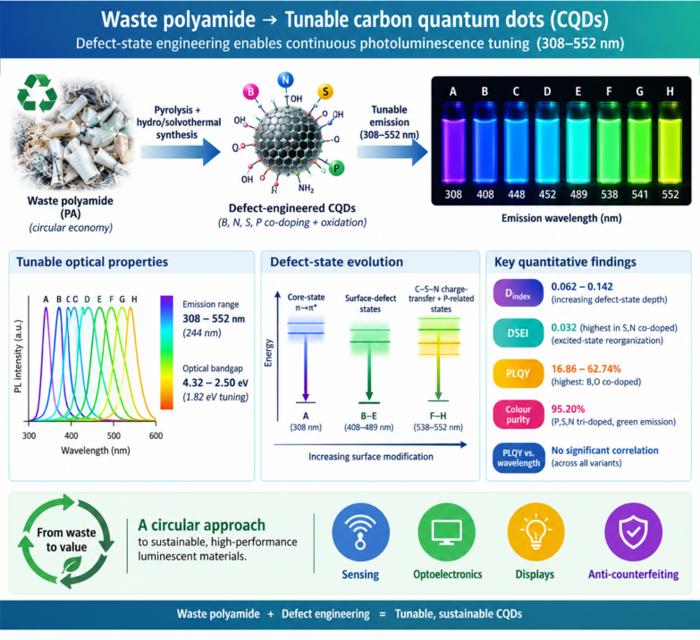
Waste polyamide-derived CQDs show continuous photoluminescence tuning from 308 to 552 nm through sequential defect-state engineering, with optical transition energies decreasing from 4.32 to 2.50 eV. @Christian Ebere Enyoh from Saitama University Carbon quantum dots (CQDs) are fluorescent carbon nanomaterials with potential applications in sensing, optoelectronics, displays, anti-counterfeiting, and environmental technologies. Their optical properties can be adjusted by modifying the carbon...
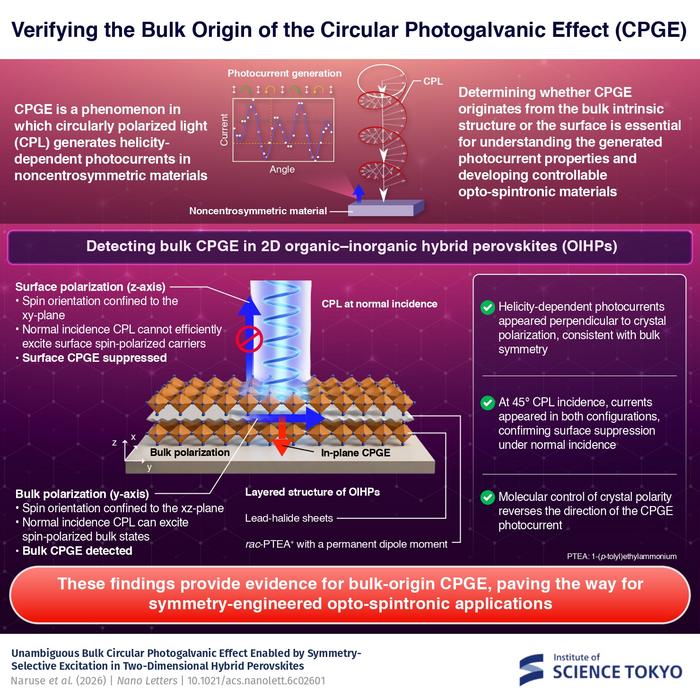
The researchers used circularly polarized light at normal incidence and found that helicity-dependent photocurrents appeared perpendicular to the crystal’s polarization but vanished when measured parallel to it, supporting a bulk origin of CPGE. @Institute of Science Tokyo The circular photogalvanic effect (CPGE), a phenomenon that generates helicity-dependent photocurrents in noncentrosymmetric materials, can originate purely from a crystal's internal structure without contribution from the...
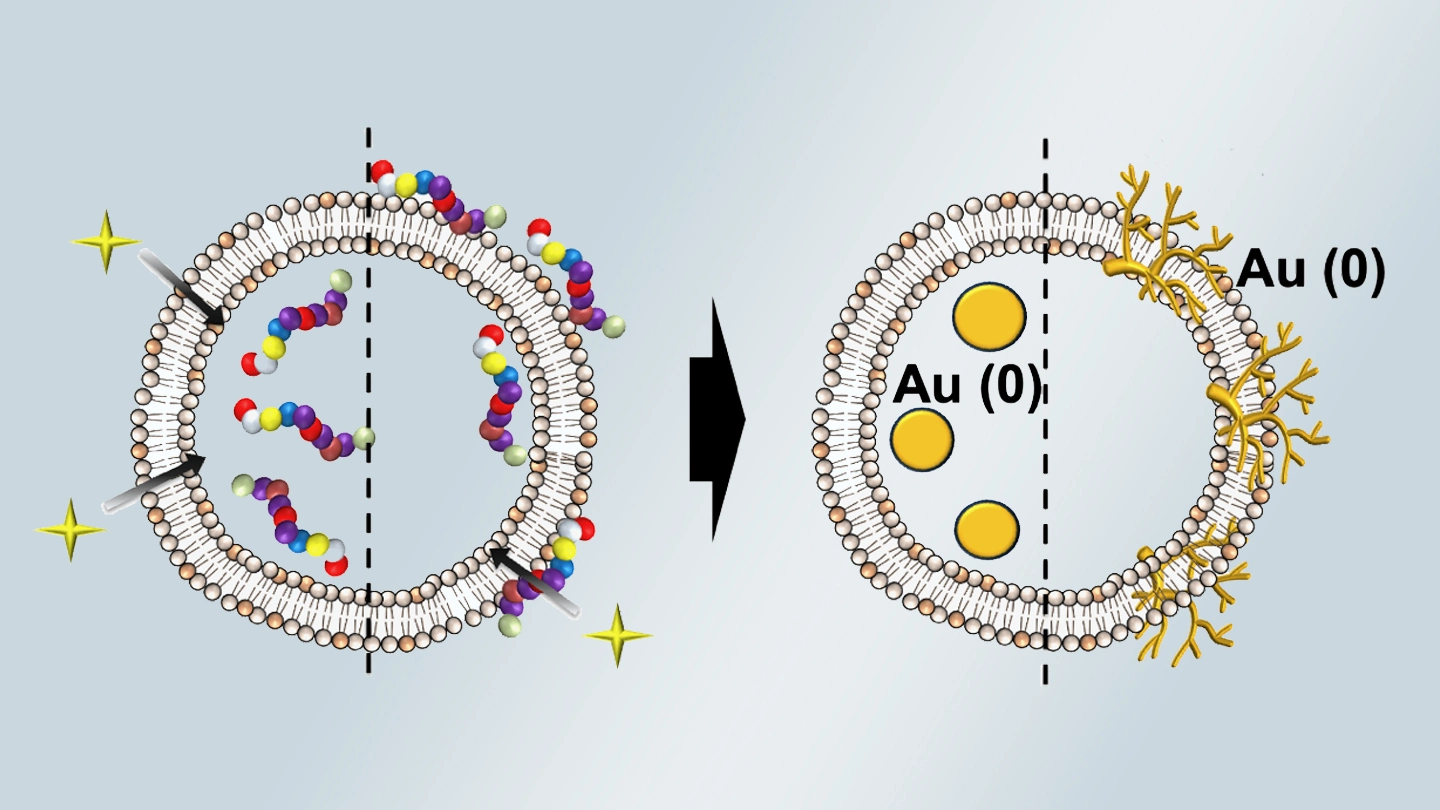
Summary of gold nanoparticle growth programming in liposome based on localization of biomineralization peptide The position of biomineralization peptides within liposomes can influence how gold nanoparticles grow, reports a research team from Institute of Science Tokyo. Peptides localized at the membrane interface promote branched structures, while those confined to the liposome interior favor spherical nanoparticles. The findings offer a new strategy for controlling nanoscale reaction...
