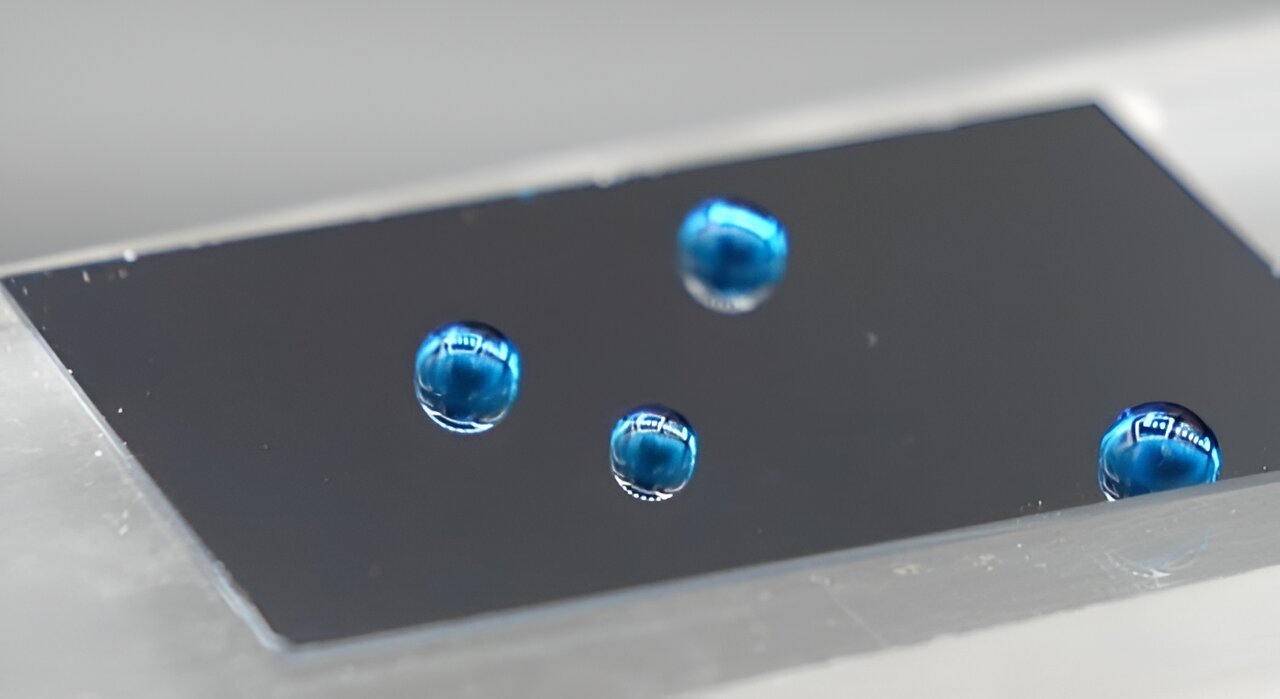
University of Sydney researchers have observed oil molecules retaining their 'liquid-like' properties when they are chemically attached as an extremely thin layer to solid surfaces, opening new possibilities for designing sustainable materials with non-stick characteristics.
The findings are published in the leading chemistry journal Angewandte Chemie, led by Dr Isaac Gresham with co-authors Professor Chiara Neto and honours student Seamus Lilley from the School of Chemistry and Sydney Nano, Dr Kaloian Koynov from the Max Planck Institute for Polymer Research and Dr Andrew Nelson from the Australian Centre for Neutron Scattering.
The ‘liquid-like’ coatings the team studied, known as slippery covalently-attached liquid surfaces (SCALS), are produced from silicones or polyethylene glycol – both of which break down into harmless byproducts in the environment.
SCALS are anti-adhesive without relying on problematic perfluorinated polymers (PFAS), known as ‘forever chemicals’ that are usually used for their low adhesion properties.
“These liquid-like layers are extremely slippery to most contaminants: they shed liquid droplets effortlessly, which is great to increase the efficiency of heat transfer and for collecting water, they prevent the buildup of scale, and resist the adhesion of ice and bacteria, bringing us one step closer to a self-cleaning world,” said Professor Neto, who leads the Nano-Interfaces Laboratory at the University of Sydney.
“We can correlate the exceptional performance of these layers with their nanostructure – meaning we now know what we’re aiming for when we design slippery surfaces, enabling us to make them even more effective and provide viable alternatives to fluorinated coatings.”
The slippery nano-thin layers, between two and five billionths of a metre thick or 10,000 times thinner than a human hair, are made up of oil molecules that are only a hundred atoms long.
“A water droplet glides with no friction over a thick oil film, but if you completely remove the oil film, say by using soap, most water droplets will stick to solid surfaces,” Professor Neto said.
“How thin can the oil layer be on a solid surface before it is no longer ‘liquid-like’? At the nanoscale, the definition of a liquid becomes somewhat slippery.”
To unravel the secrets of their ultra-thin liquid coatings, the team used two techniques to ‘see’ the surface layers.
The first technique is single-molecule force spectroscopy, which measures the length of individual molecules and the force required to stretch or compress them.
The second is neutron reflectometry, which allows scientists to measure the length and grafting density of molecules.
“We found that if the liquid molecules were too short and sparsely grafted on the solid surface, they did not adequately cover the underlying solid surface and remained sticky,” Professor Neto said.
“On the other hand, if molecules were too long or grafted too densely, they did not have enough flexibility to act like a liquid.
“For SCALS to be effective, they needed to be in a Goldilocks zone, where they are neither too short nor too long, nor packed too loose or too tight.”
To show definitively that the exceptional properties of these layers are due to their ‘liquid-like’ state, the team measured the speed that a small probe molecule diffused inside the layer.
Molecules can diffuse through liquids, but not through solids. Professor Neto said the fastest molecular diffusion was observed in the Goldilocks zone, where the oil molecules are just the right length and grafted with moderate density.
Reference
Nanostructure Explains the Behavior of Slippery Covalently Attached Liquid Surfaces
Isaac Gresham, Seamus Lilley, Andrew Nelson, Kaloian Koynov, Chiara Neto
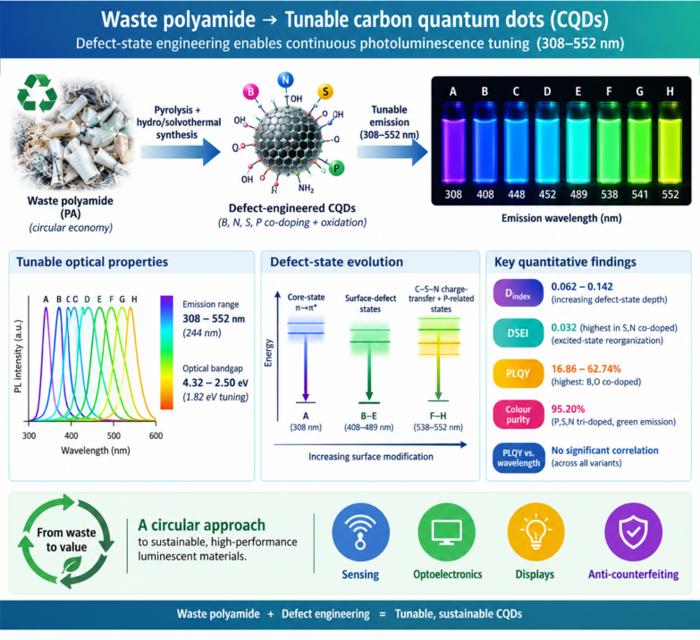
Waste polyamide-derived CQDs show continuous photoluminescence tuning from 308 to 552 nm through sequential defect-state engineering, with optical transition energies decreasing from 4.32 to 2.50 eV. @Christian Ebere Enyoh from Saitama University Carbon quantum dots (CQDs) are fluorescent carbon nanomaterials with potential applications in sensing, optoelectronics, displays, anti-counterfeiting, and environmental technologies. Their optical properties can be adjusted by modifying the carbon...
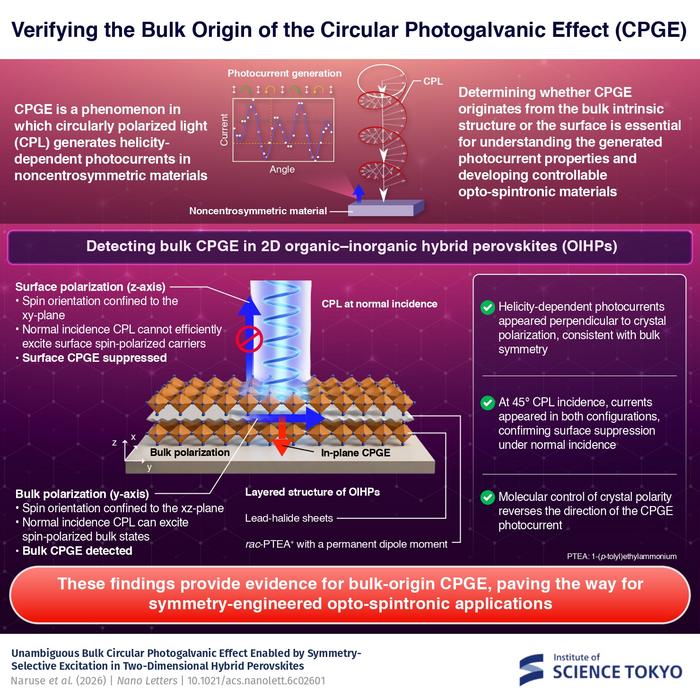
The researchers used circularly polarized light at normal incidence and found that helicity-dependent photocurrents appeared perpendicular to the crystal’s polarization but vanished when measured parallel to it, supporting a bulk origin of CPGE. @Institute of Science Tokyo The circular photogalvanic effect (CPGE), a phenomenon that generates helicity-dependent photocurrents in noncentrosymmetric materials, can originate purely from a crystal's internal structure without contribution from the...
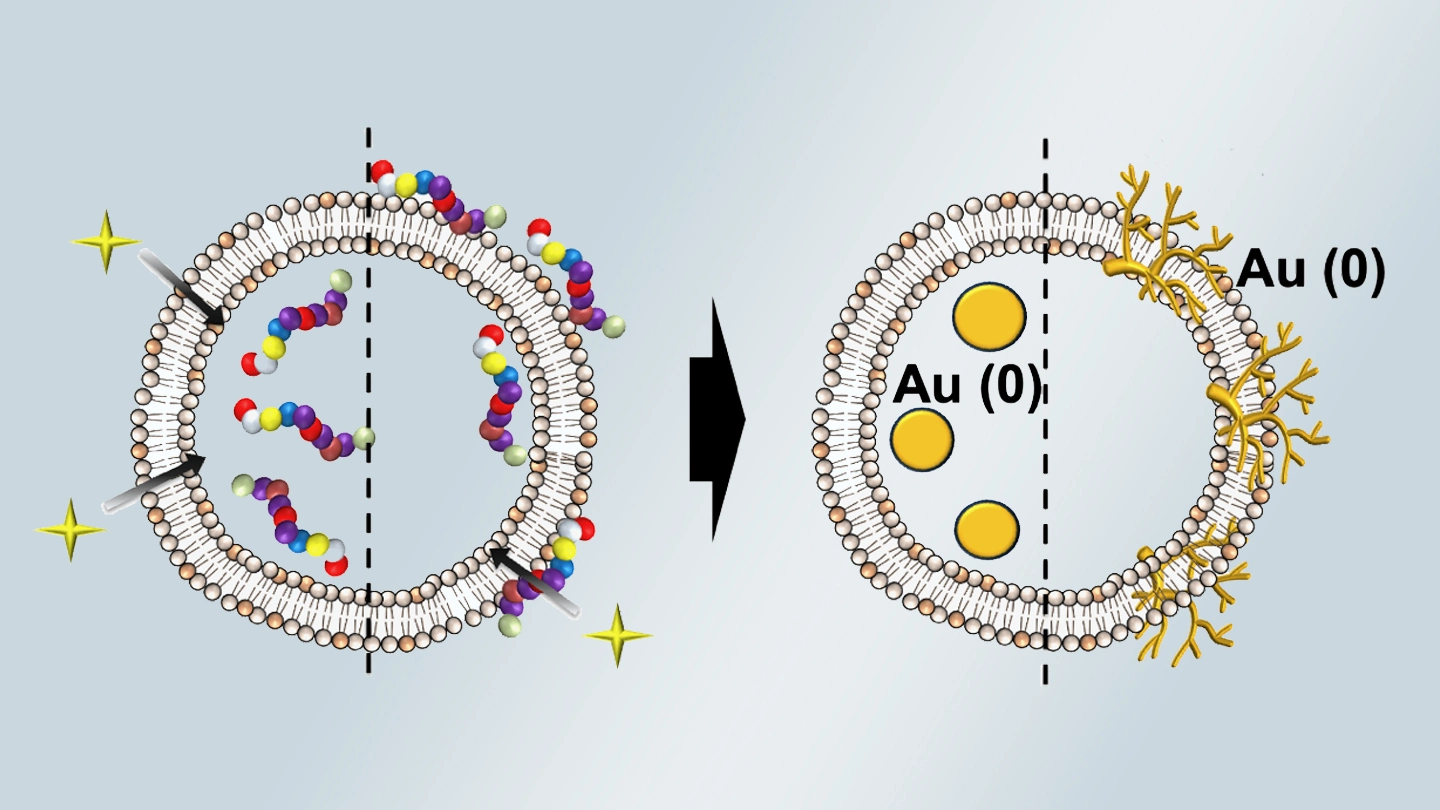
Summary of gold nanoparticle growth programming in liposome based on localization of biomineralization peptide The position of biomineralization peptides within liposomes can influence how gold nanoparticles grow, reports a research team from Institute of Science Tokyo. Peptides localized at the membrane interface promote branched structures, while those confined to the liposome interior favor spherical nanoparticles. The findings offer a new strategy for controlling nanoscale reaction...
