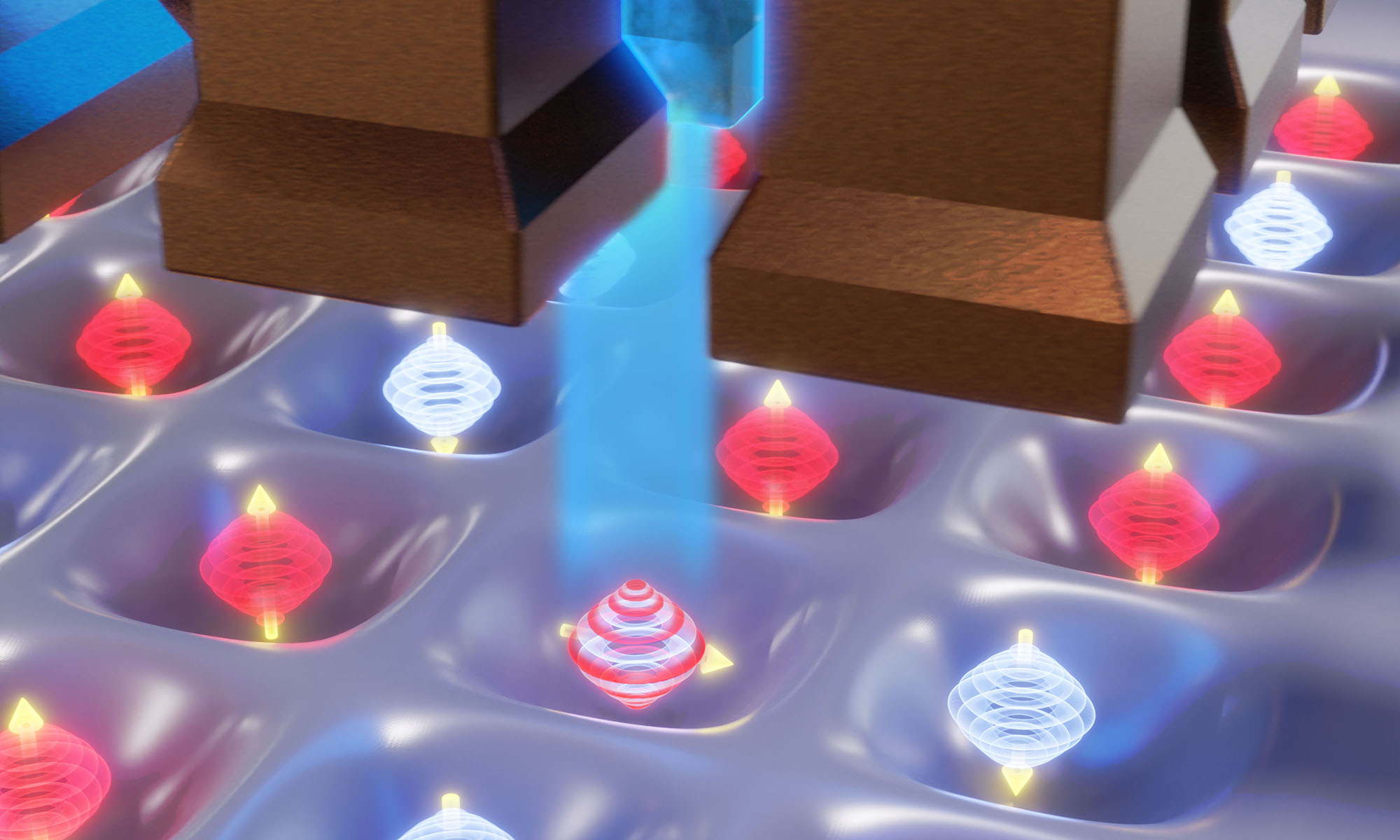
Quantum science has the potential to revolutionize modern technology with more efficient computers, communication, and sensing devices. Challenges remain in achieving these technological goals, however, including how to precisely manipulate information in quantum systems.
In a paper published in Nature Physics, a group of researchers from the University of Rochester, including John Nichol, an associate professor of physics, outlines a new method for controlling electron spin in silicon quantum dots—tiny, nanoscale semiconductors with remarkable properties—as a way to manipulate information in a quantum system.
“The results of the study provide a promising new mechanism for coherent control of qubits based on electron spin in semiconductor quantum dots, which could pave the way for the development of a practical silicon-based quantum computer,” Nichol says.
Using quantum dots as qubits
A regular computer consists of billions of transistors, called bits. Quantum computers, on the other hand, are based on quantum bits, also known as qubits. Unlike ordinary transistors, which can be either “0” (off) or “1” (on), qubits are governed by the laws of quantum mechanics and can be both “0” and “1” at the same time.
Scientists have long considered using silicon quantum dots as qubits; controlling the spin of electrons in quantum dots would offer a way to manipulate the transfer of quantum information. Every electron in a quantum dot has intrinsic magnetism, like a tiny bar magnet. Scientists call this “electron spin”—the magnetic moment associated with each electron—because each electron is a negatively charged particle that behaves as though it were rapidly spinning, and it is this effective motion that gives rise to the magnetism.
Electron spin is a promising candidate for transferring, storing, and processing information in quantum computing because it offers long coherence times and high gate fidelities and is compatible with advanced semiconductor manufacturing techniques. The coherence time of a qubit is the time before the quantum information is lost due to interactions with a noisy environment; long coherence means a longer time to perform computations. High gate fidelity means that the quantum operation researchers are trying to perform is performed exactly as they want.
One major challenge in using silicon quantum dots as qubits, however, is controlling electron spin.
Controlling electron spin
The standard method for controlling electron spin is electron spin resonance (ESR), which involves applying oscillating radiofrequency magnetic fields to the qubits. However, this method has several limitations, including the need to generate and precisely control the oscillating magnetic fields in cryogenic environments, where most electron spin qubits are operated. Typically, to generate oscillating magnetic fields, researchers send a current through a wire, and this generates heat, which can disturb cryogenic environments.
Nichol and his colleagues outline a new method for controlling electron spin in silicon quantum dots that does not rely on oscillating electromagnetic fields. The method is based on a phenomenon called “spin-valley coupling,” which occurs when electrons in silicon quantum dots transition between different spin and valley states. While the spin state of an electron refers to its magnetic properties, the valley state refers to a different property related to the electron’s spatial profile.
The researchers apply a voltage pulse to harness the spin-valley coupling effect and manipulate the spin and valley states, controlling the electron spin.
“This method of coherent control, by spin-valley coupling, allows for universal control over qubits, and can be performed without the need of oscillating magnetic fields, which is a limitation of ESR,” Nichol says. “This allows us a new pathway for using silicon quantum dots to manipulate information in quantum computers.”
Reference
Coherent spin–valley oscillations in silicon
Xinxin Cai, Elliot J. Connors, Lisa F. Edge & John M. Nichol
https://www.nature.com/articles/s41567-022-01870-y
University of Rochester
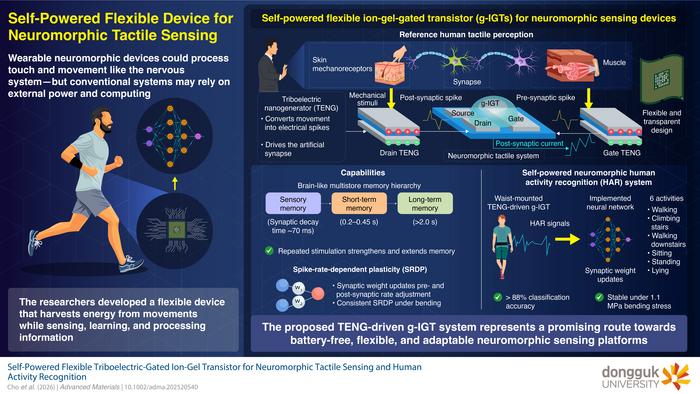
The proposed TENG-driven g-IGT is a flexible, self-powered neuromorphic device capable of reproducing multiple memory states and spike-rate-dependent learning Neuromorphic devices, which are designed to emulate aspects of biological neural networks, are promising candidates for developing low-power and intelligent sensing technologies, including wearable applications. Among the device architectures explored for neuromorphic computing, graphene-channel ion-gel-gated transistors (g-IGTs) are...

Rice University researchers have shown that sub-nanometer wrinkles in graphene generate flexoelectric charge separation, reshaping local electrical behavior through curvature alone. Extreme bending produces polarization far stronger than in larger systems and may enable geometry-controlled electronics without chemical doping. Published in Advanced Materials.

Researchers at NC State have extended twistronics beyond van der Waals materials into strongly bonded crystalline oxides. By stacking sodium niobate membranes with twist angles controlled down to 0.1 degrees, and confirming results via synchrotron X-ray diffraction, the team found interlayer bonds distort the atomic lattice, shifting phase structure and domain configuration. The technique works at near-millimeter scale, far larger than typical twistronic devices, marking a real step toward pract
