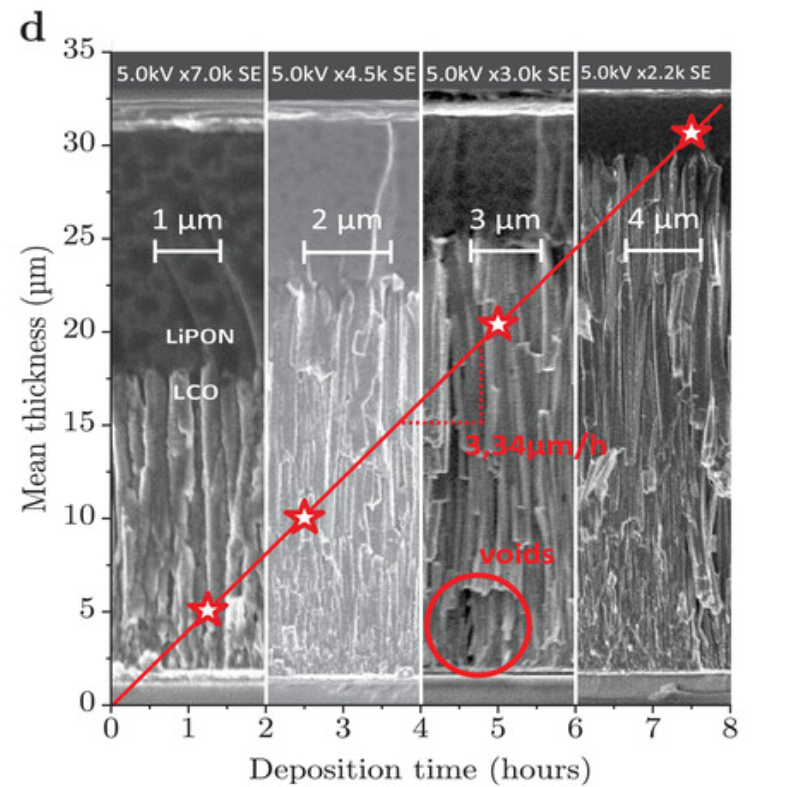
On-chip batteries will play a key role in our increasingly connected, electrified, and sustainable world. As wireless sensor technologies improve and the Internet of Things expands, the need for tiny, high-energy-density solid-state integrated batteries for a rapidly-growing number of use cases is urgent. CEA-Leti is pushing back the frontiers of on-device energy storage with innovative battery performance optimization tools.
Thin-film fabrication and advanced characterization vital to improving performance
In this research, CEA-Leti fabricated innovative thin-film batteries on the institute's TINY platform. Standard microfabrication techniques and a 200 mm wafer integration process flow were used to produce sub-square-millimeter microbatteries with a specific areal capacity five times that of today's commercially-available products. The batteries also exhibited exceptional power density and virtually no capacity fading over hundreds of cycles. These remarkable attributes are ideal for the longer battery life and small form factor needed for IoT devices.
Towards viable and more sustainable alternatives to lithium metal
Lithium metal, used in battery anodes, represents one of the major environmental hurdles to the adoption of the technology. Here, we focused on an anode-free model system utilizing a transition-metal dioxide (LiCoO2), an inorganic lithium phosphorus oxynitride (LiPON) glass electrolyte, and a titanium current collector. We were able to demonstrate full-stack cyclability, making this a viable alternative to lithium metal. In addition, the maximal discharge capacity was measured at 1.5 mAh.cm-2, unprecedented for thin film batteries. Plus, when this anode-free model was coupled with a 100% active cathode, the battery demonstrated a volumetric capacity of up to 1,400 Wh/l. We also investigated different cathode thicknesses: There was a linear correlation between thickness and delivered capacity for high current densities of up to 2 mA/cm². Diffusion limitations only emerged when the state of charge (SOC) fell below 50%, with thicker electrode designs proving advantageous as long as the battery charge remains above this threshold. Overall, this model appears to be very promising for a wide variety of on-chip energy storage needs.
Modeling the future of microbatteries
A comprehensive physical model, which aligns closely with our experimental results, was developed based on this research. It also factors in performance variations depending on design and architecture, making it a useful and relevant tool for the optimization of microbatteries for a variety of use cases, including medical devices.
Reference
Minimal Architecture Lithium Batteries: Toward High Energy Density Storage Solutions
Jacopo Celè, Sylvain Franger, Yann Lamy, Sami Oukassi
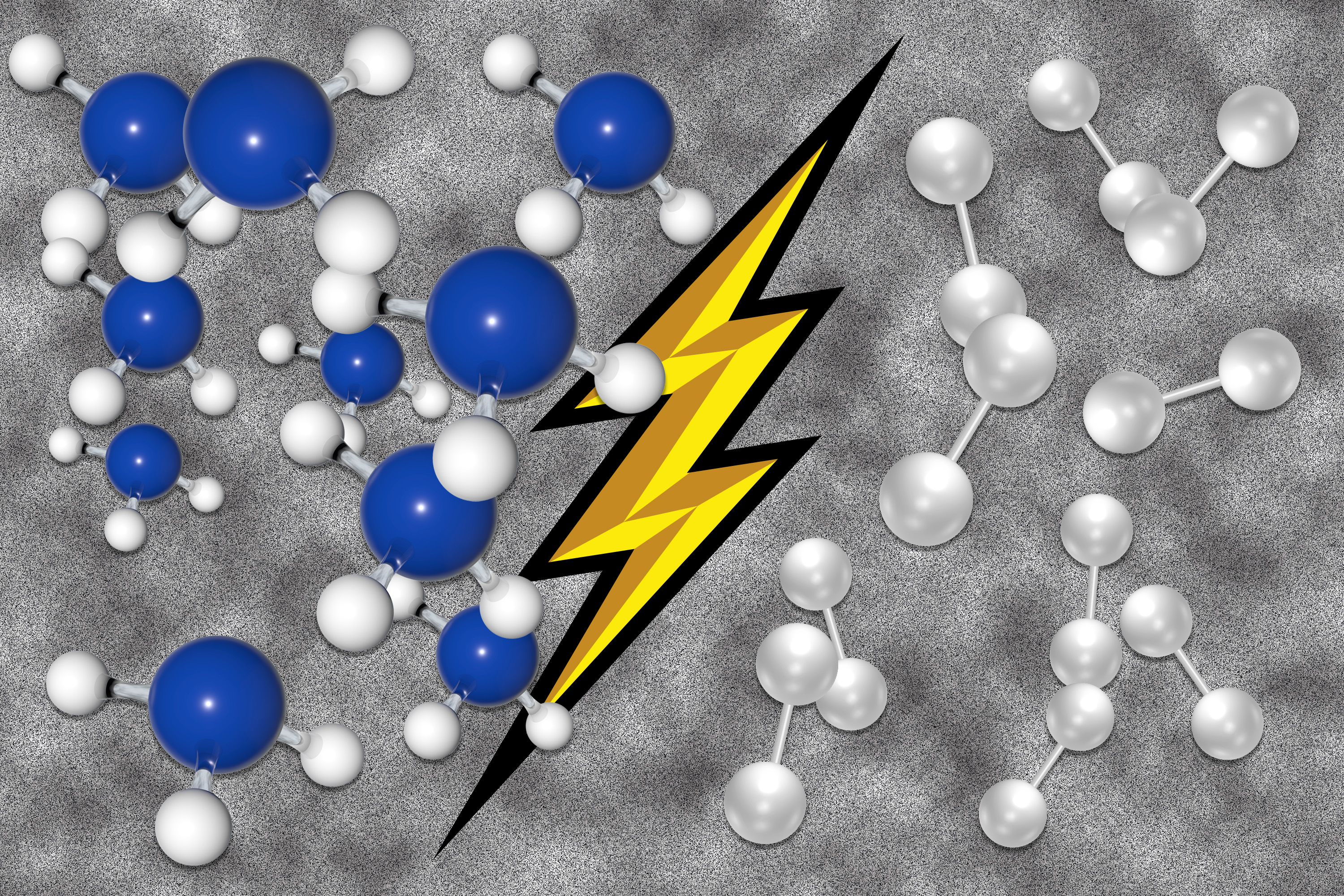
MIT researchers have developed a new way to extract pure hydrogen gas from ammonia and other hydrogen carrier molecules. Their strategy, which uses electricity to speed up the extraction, reduces the temperature and energy required to recover hydrogen from these molecules. As a liquid that is easily stored and transported, ammonia (NH3) is an attractive carrier for hydrogen, which is used in fuel cells, semiconductor manufacturing, chemical processing, and other applications. However,...
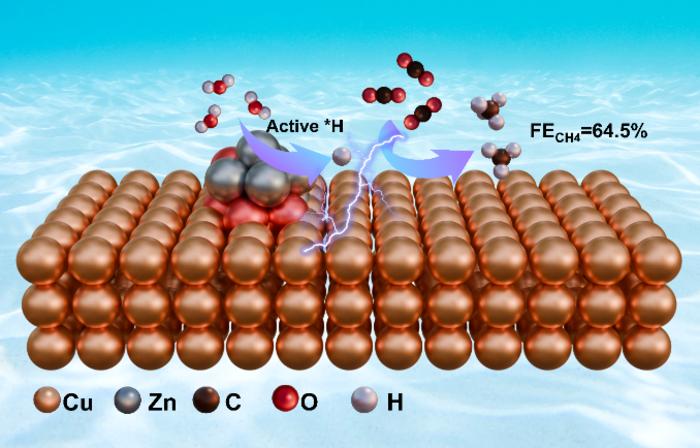
image: CuZn800@C was constructed via solvothermal method and utilizes the high-temperature volatility of zinc to prepare through calcination at different temperatures, which displays a high methane Faradaic efficiency of 64.5% and a remarkable partial current density of -551.3 mA/cm2 at -1.7 V vs. RHE, along with excellent stability. Zn and Cu form a tandem reaction system. Zn sites promote water splitting to provide protons, while Cu sites reduce the energy barrier for *CO hydrogenation....
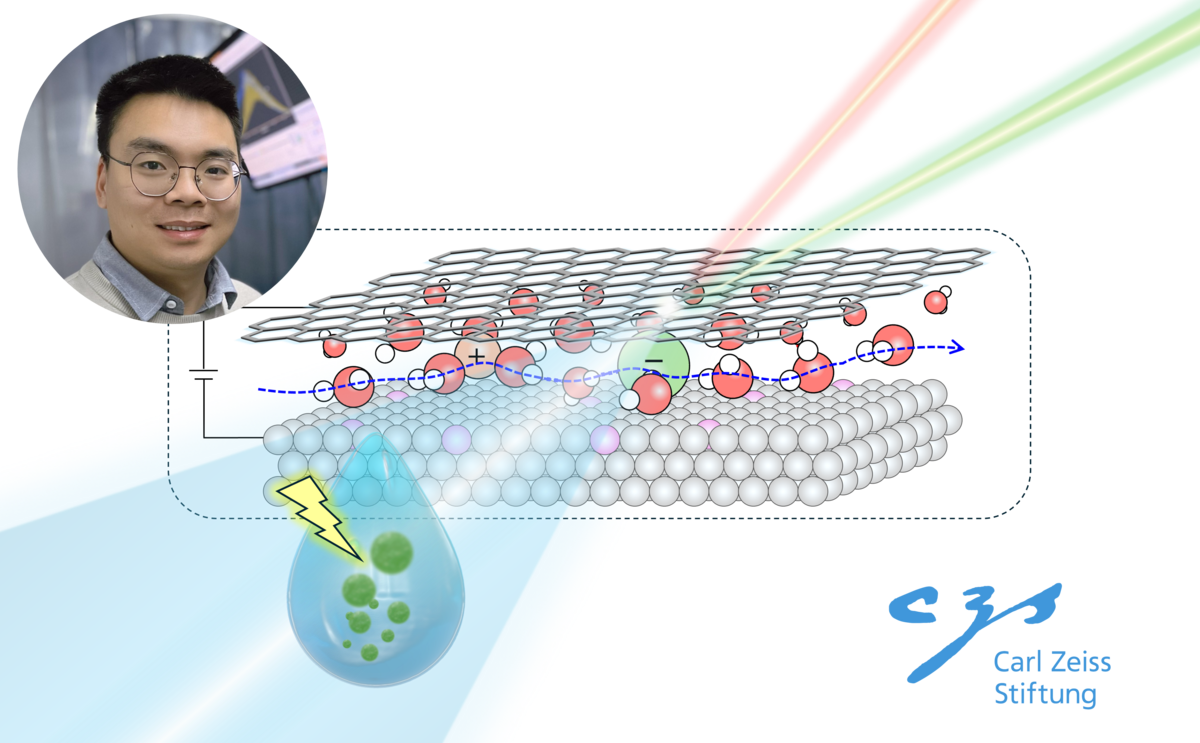
Electrochemical water splitting powered by renewable electricity is a promising pathway to sustainable hydrogen production, but its efficiency and scalability remain limited by costly catalysts and slow reaction kinetics. With €1.5 million in funding from the Carl-Zeiss-Stiftung for five years, Dr. Yongkang Wang and his team will pursue a new approach by visualizing and controlling water at the molecular level, using nanoscale confinement to shape its structure and dynamics at catalytic...
