
Researchers have developed a new design for computer memory that could both greatly improve performance and reduce the energy demands of internet and communications technologies, which are predicted to consume nearly a third of global electricity within the next ten years.
The researchers, led by the University of Cambridge, developed a device that processes data in a similar way as the synapses in the human brain. The devices are based on hafnium oxide, a material already used in the semiconductor industry, and tiny self-assembled barriers, which can be raised or lowered to allow electrons to pass.
This method of changing the electrical resistance in computer memory devices, and allowing information processing and memory to exist in the same place, could lead to the development of computer memory devices with far greater density, higher performance and lower energy consumption. The results are reported in the journal Science Advances.
Our data-hungry world has led to a ballooning of energy demands, making it ever more difficult to reduce carbon emissions. Within the next few years, artificial intelligence, internet usage, algorithms and other data-driven technologies are expected to consume more than 30% of global electricity.
“To a large extent, this explosion in energy demands is due to shortcomings of current computer memory technologies,” said first author Dr Markus Hellenbrand, from Cambridge’s Department of Materials Science and Metallurgy. “In conventional computing, there’s memory on one side and processing on the other, and data is shuffled back between the two, which takes both energy and time.”
One potential solution to the problem of inefficient computer memory is a new type of technology known as resistive switching memory. Conventional memory devices are capable of two states: one or zero. A functioning resistive switching memory device however, would be capable of a continuous range of states – computer memory devices based on this principle would be capable of far greater density and speed.
“A typical USB stick based on continuous range would be able to hold between ten and 100 times more information, for example,” said Hellenbrand.
Hellenbrand and his colleagues developed a prototype device based on hafnium oxide, an insulating material that is already used in the semiconductor industry. The issue with using this material for resistive switching memory applications is known as the uniformity problem. At the atomic level, hafnium oxide has no structure, with the hafnium and oxygen atoms randomly mixed, making it challenging to use for memory applications.
However, the researchers found that by adding barium to thin films of hafnium oxide, some unusual structures started to form, perpendicular to the hafnium oxide plane, in the composite material.
These vertical barium-rich ‘bridges’ are highly structured, and allow electrons to pass through, while the surrounding hafnium oxide remains unstructured. At the point where these bridges meet the device contacts, an energy barrier was created, which electrons can cross. The researchers were able to control the height of this barrier, which in turn changes the electrical resistance of the composite material.
“This allows multiple states to exist in the material, unlike conventional memory which has only two states,” said Hellenbrand.
Unlike other composite materials, which require expensive high-temperature manufacturing methods, these hafnium oxide composites self-assemble at low temperatures. The composite material showed high levels of performance and uniformity, making them highly promising for next-generation memory applications.
A patent on the technology has been filed by Cambridge Enterprise, the University’s commercialisation arm.
“What’s really exciting about these materials is they can work like a synapse in the brain: they can store and process information in the same place, like our brains can, making them highly promising for the rapidly growing AI and machine learning fields,” said Hellenbrand.
The researchers are now working with industry to carry out larger feasibility studies on the materials, in order to understand more clearly how the high-performance structures form. Since hafnium oxide is a material already used in the semiconductor industry, the researchers say it would not be difficult to integrate into existing manufacturing processes.
Reference
Thin-film design of amorphous hafnium oxide nanocomposites enabling strong interfacial resistive switching uniformity
Markus Hellenbrand, Babak Bakhit, Hongyi Dou, Ming Xiao, Megan O. Hill, Zhuotong Sun, Adnan Mehonic, Aiping Chen, Quanxi Jia, Haiyan Wang, Judith L. MacManus-Driscoll
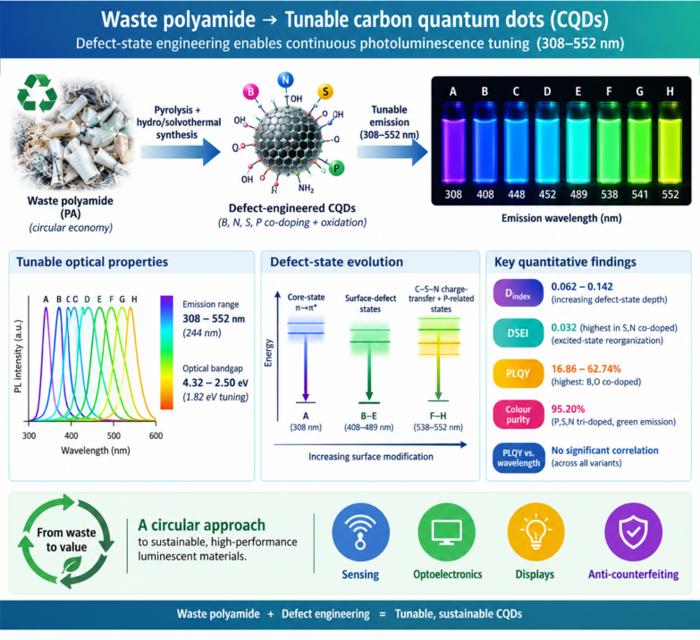
Waste polyamide-derived CQDs show continuous photoluminescence tuning from 308 to 552 nm through sequential defect-state engineering, with optical transition energies decreasing from 4.32 to 2.50 eV. @Christian Ebere Enyoh from Saitama University Carbon quantum dots (CQDs) are fluorescent carbon nanomaterials with potential applications in sensing, optoelectronics, displays, anti-counterfeiting, and environmental technologies. Their optical properties can be adjusted by modifying the carbon...

The researchers used circularly polarized light at normal incidence and found that helicity-dependent photocurrents appeared perpendicular to the crystal’s polarization but vanished when measured parallel to it, supporting a bulk origin of CPGE. @Institute of Science Tokyo The circular photogalvanic effect (CPGE), a phenomenon that generates helicity-dependent photocurrents in noncentrosymmetric materials, can originate purely from a crystal's internal structure without contribution from the...
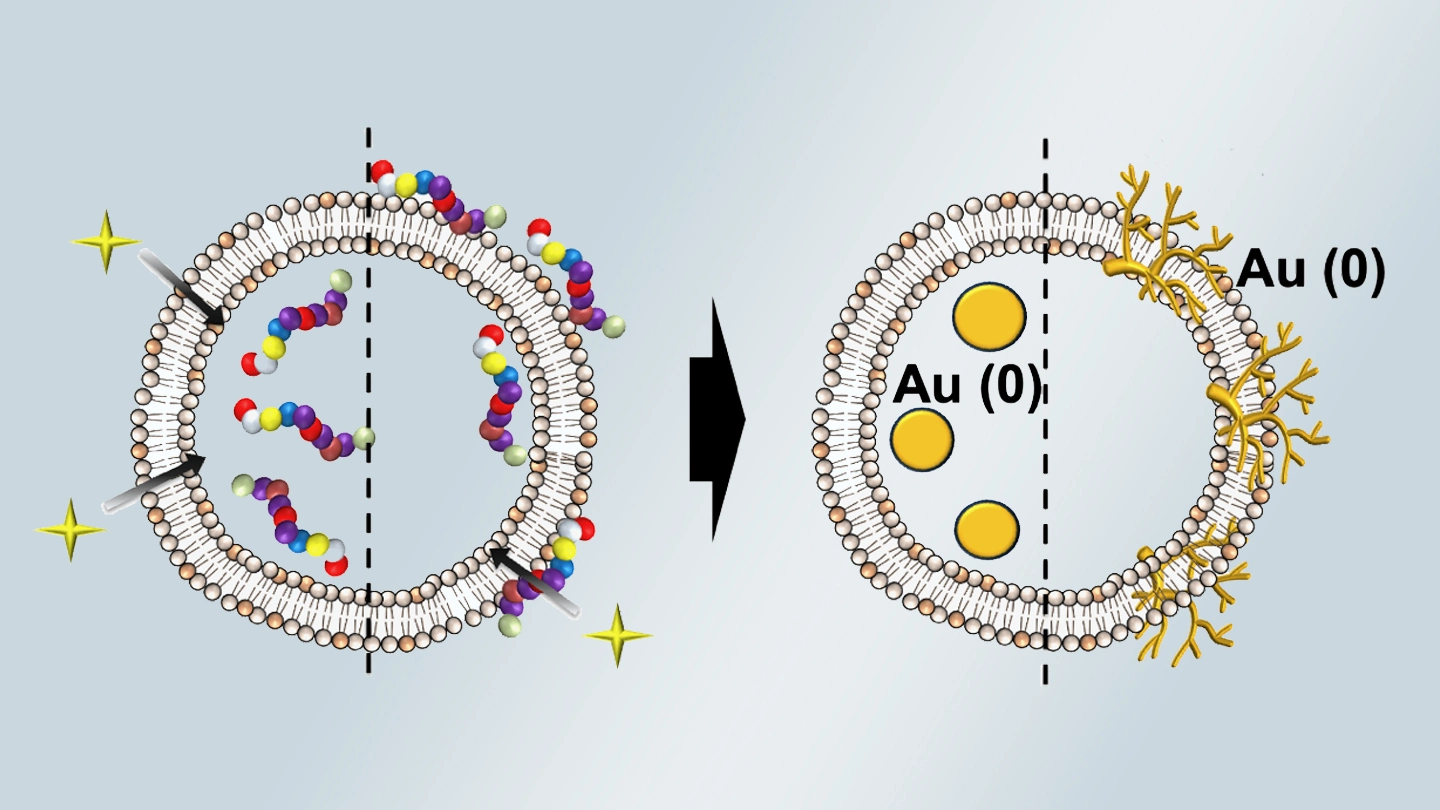
Summary of gold nanoparticle growth programming in liposome based on localization of biomineralization peptide The position of biomineralization peptides within liposomes can influence how gold nanoparticles grow, reports a research team from Institute of Science Tokyo. Peptides localized at the membrane interface promote branched structures, while those confined to the liposome interior favor spherical nanoparticles. The findings offer a new strategy for controlling nanoscale reaction...
