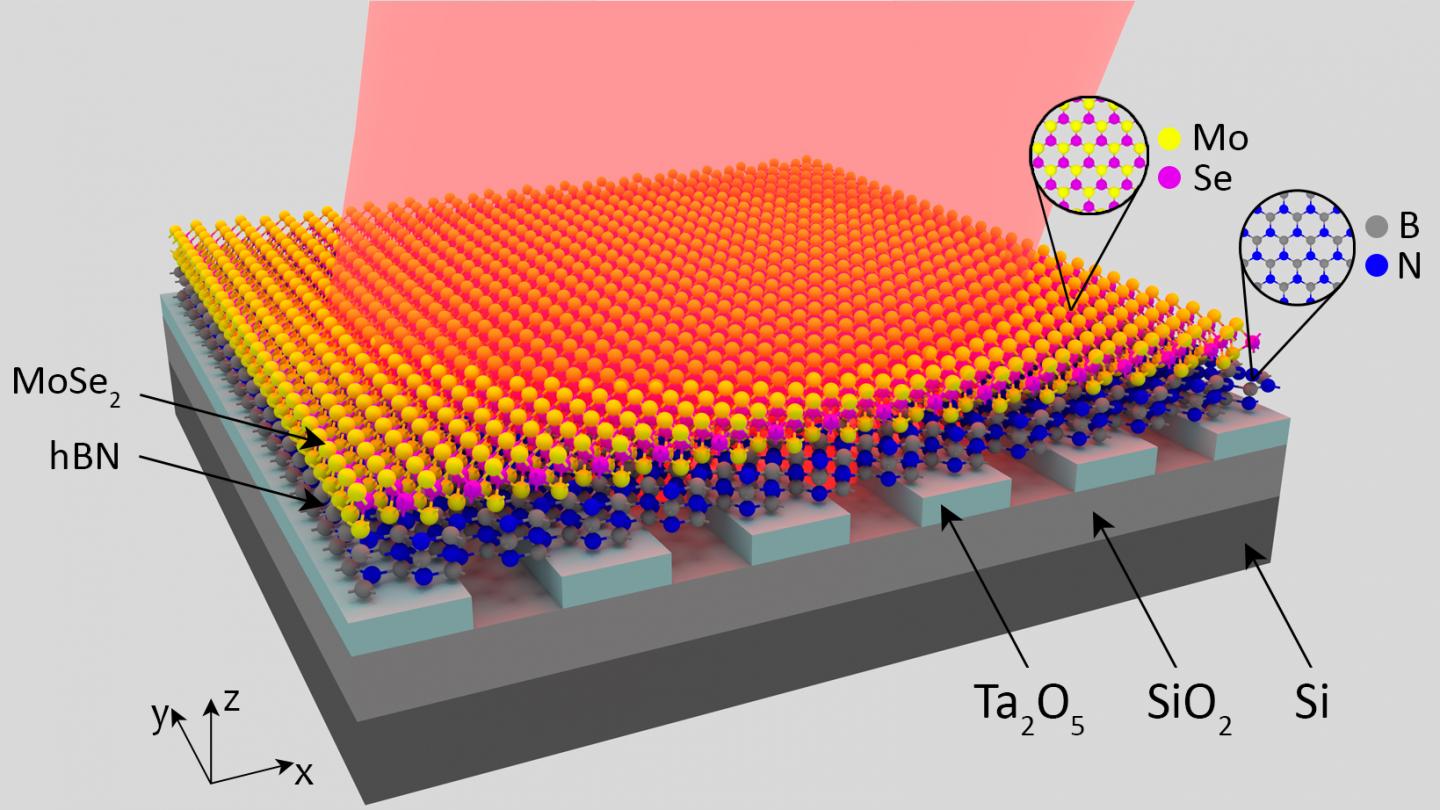
Leading research groups in the field of nanophotonics are working toward developing optical transistors - key components for future optical computers. These devices will process information with photons instead of electrons, thus reducing the heat and increasing the operation speed. However, photons do not interact with each other well, which creates a big problem for microelectronics engineers. A group of researchers from ITMO University, together with colleagues, have come up with a new solution to this problem by creating a planar system where photons couple to other particles, which enables them to interact with each other. The principle demonstrated in their experiment can provide a platform for developing future optical transistors. The results of their work are published in Light: Science & Applications.
It is widely known that transistors, key elements of the modern digital world, function thanks to the controlled motion of electrons. This approach has been used for decades, but it has several drawbacks. First, electronic devices tend to heat up when they perform a task, which means that part of the energy is wasted as heat and not used for actual work. To fight this heating, we need to equip our devices with coolers, thus wasting even more energy. Second, electronic devices have a limited processing speed. Some of these issues can be solved by using photons, light particles, instead of electrons. Devices that use photons for information encoding would produce less heat, require less energy, and work faster.
That is exactly why scientists all over the world conduct research in the field of optical computers. However, the main problem is that photons, unlike electrons, do not interact with each other. Researchers from over the world suggest different methods to "train" photons to interact with each other. The idea of one of these methods is to couple photons with other particles. A group of researchers from ITMO's Department of Physics and Engineering, together with colleagues, have demonstrated a new efficient implementation, where photons couple to excitons in single-layer semiconductors. Excitons form in semiconductors when electrons are excited leaving behind empty valence bonds (or electron holes, as physicists call them). Both the electron and its hole can interact with each other creating a new particle - an exciton, which in turn can interact with other excitons.
"If we strongly couple excitons to light particles, we will get polaritons," explains Vasily Kravtsov, a leading research fellow at ITMO University and one of the paper's co-authors. "These are partly light, meaning that they can be used to transfer information very fast; but at the same time they can interact with each other very well."
It seems like polaritons are a straightforward solution, and now all we need to do is to create a polariton-based transistor. However, it is not that easy: we need to design a system where these particles could exist long enough while still maintaining their high interaction strength. In the labs of ITMO's Department of Physics and Engineering, polaritons are created with the help of a laser, a waveguide, and an extremely thin molybdenum diselenide semiconductor layer.
A three-atom-thick semiconductor layer is placed on a nanophotonic waveguide, with a precise net of very fine grooves engraved on its surface. After that, it is lit up with a red laser to create excitons in the semiconductor. These excitons couple with light particles creating polaritons, which are "trapped" in the system.
Polaritons obtained in this way not only exist for relatively long periods of time, but also have extra high nonlinearity, meaning that they actively interact with each other.
"It brings us closer to creating an optical transistor, as we now have a planar platform less than 100 nanometers thick, which could be integrated on a chip. As the nonlinearity is rather high, we would not need a powerful laser - a small red light source will suffice, which could also be integrated onto the chip," elaborates Vasily Kravtsov.
At the moment, the study continues, as the researchers have to demonstrate the efficiency of their system at room temperatures.
Nonlinear polaritons in a monolayer semiconductor coupled to optical bound states in the continuum
Vasily Kravtsov, Ekaterina Khestanova, Fedor A. Benimetskiy, Tatiana Ivanova, Anton K. Samusev, Ivan S. Sinev, Dmitry Pidgayko, Alexey M. Mozharov, Ivan S. Mukhin, Maksim S. Lozhkin, Yuri V. Kapitonov, Andrey S. Brichkin, Vladimir D. Kulakovskii, Ivan A. Shelykh, Alexander I. Tartakovskii, Paul M. Walker, Maurice S. Skolnick, Dmitry N. Krizhanovskii & Ivan V. Iorsh
Light: Science & Applications volume 9, Article number: 56 (2020)
DOI: 10.1038/s41377-020-0286-z
Contact information:
Vasily Kravtsov
ITMO research fellow at Dept. of Physics
vasily.kravtsov@metalab.ifmo.ru
ITMO (Information Technologies, Mechanics and Optics) University
Learn more about the Nanotechnology World Association (NWA):
Who we are | Founding Members | Board of Directors | Memberships |
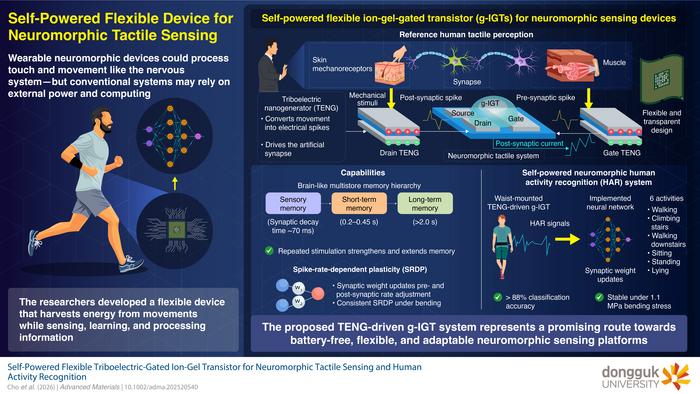
The proposed TENG-driven g-IGT is a flexible, self-powered neuromorphic device capable of reproducing multiple memory states and spike-rate-dependent learning Neuromorphic devices, which are designed to emulate aspects of biological neural networks, are promising candidates for developing low-power and intelligent sensing technologies, including wearable applications. Among the device architectures explored for neuromorphic computing, graphene-channel ion-gel-gated transistors (g-IGTs) are...

Rice University researchers have shown that sub-nanometer wrinkles in graphene generate flexoelectric charge separation, reshaping local electrical behavior through curvature alone. Extreme bending produces polarization far stronger than in larger systems and may enable geometry-controlled electronics without chemical doping. Published in Advanced Materials.
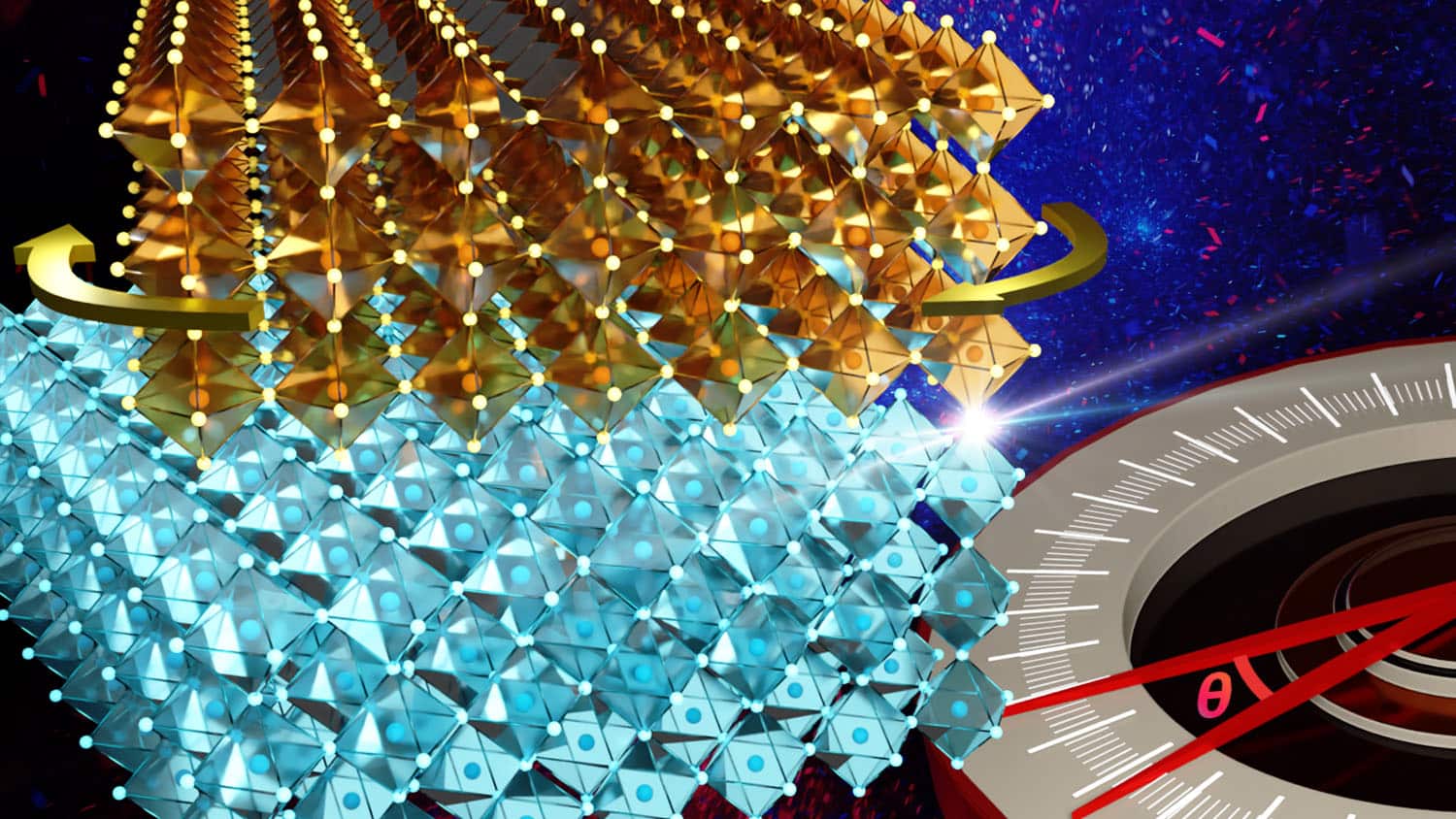
Researchers at NC State have extended twistronics beyond van der Waals materials into strongly bonded crystalline oxides. By stacking sodium niobate membranes with twist angles controlled down to 0.1 degrees, and confirming results via synchrotron X-ray diffraction, the team found interlayer bonds distort the atomic lattice, shifting phase structure and domain configuration. The technique works at near-millimeter scale, far larger than typical twistronic devices, marking a real step toward pract
