Pohang University of Science and Technology (POSTECH)
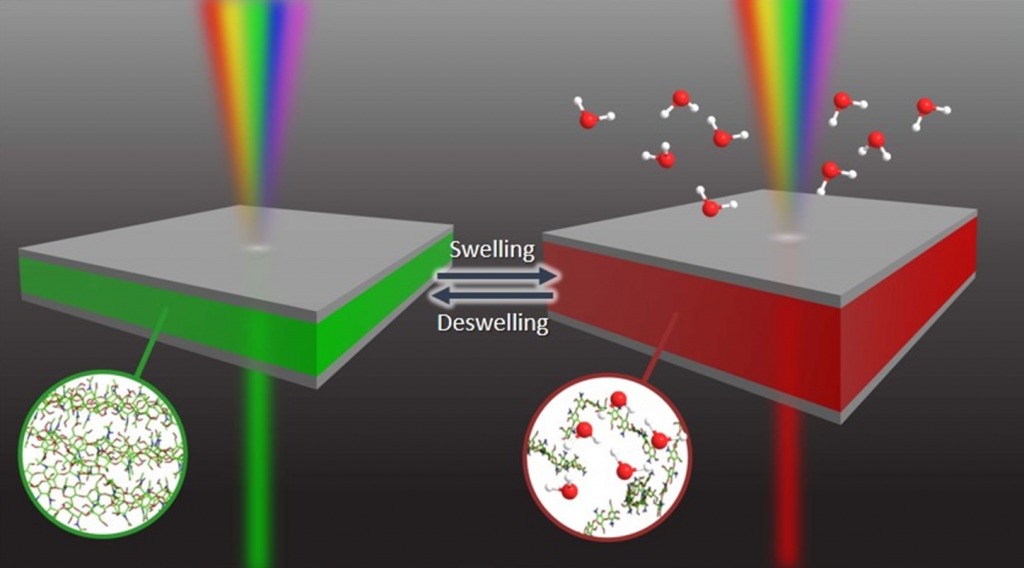
Smart windows that automatically change colors depending on the intensity of sunlight are gaining attention as they can reduce energy bills by blocking off sun's visible rays during summer. But what about windows that change colors depending on the humidity outside during the monsoon season or on hot days of summer?
Recently, a Korean research team has developed the source technology for smart windows that change colors according to the amount of moisture, without needing electricity.
The joint research team comprised of Professor Junsuk Rho of departments of mechanical and chemical engineering, Jaehyuck Jang and Aizhan Ismukhanova of chemical engineering department at POSTECH, and Professor Inkyu Park of KAIST's department of mechanical engineering. Together, they successfully developed a variable color filter using a metal-hydrogel-metal resonator structure using chitosan-based hydrogel, and combined it with solar cells to make a self-powering humidity sensor. These research findings were published as a cover story in the latest edition of Advanced Optical Materials, a journal specializing in nanoscience and optics.
Sensors using light are already widely used in our daily lives in measuring the ECG, air quality, or distance. The basic principle is to use light to detect changes in the surroundings and to convert them into digital signals.
Fabri-Pero interference* is one of the resonance phenomena that can be applied in optical sensors and can be materialized in the form of multilayer thin films of metal-dielectric-metal. It is known that the resonance wavelength of transmitted light can be controlled according to the thickness and refractive index of the dielectric layer. However, the existing metal-dielectric-metal resonators had a big disadvantage in not being able to control the wavelengths of transmitted light once they are manufactured, making it difficult to use them in variable sensors.
The research team found that when the chitosan hydrogel is made into the metal-hydrogel-metal structure, the resonance wavelength of light transmitted changes in real time depending on the humidity of the environment. This is because the chitosan hydrogel repeats expansion and contraction as the humidity changes around it.
Using this mechanism, the team developed a humidity sensor that can convert light's energy into electricity by combining a solar battery with a water variable wavelength filter made of metal-hydrogel-metal structured metamaterial that changes resonance wavelength depending on the external humidity.
The design principle is to overlap the filter's resonance wavelength with the wavelength where the absorption of the solar cells changes rapidly. This filter is designed to change the amount of light absorption of solar cells depending on the amount of moisture, and to lead to electric changes that ultimately detect the surrounding humidity.
Unlike the conventional optical humidity sensors, these newly developed ones work regardless of the type of light, whether it be natural, LED or indoor. Also, not only does it function without external power, but it can also predict humidity according to the filter's color.
Professor Junsuk Rho who led the research commented, "This technology is a sensing technology that can be used in places like nuclear power reactors where people and electricity cannot reach." He added, "It will create even greater synergy if combined with IoT technology such as humidity sensors that activate or smart windows that change colors according to the level of external humidity."
Self‐powered humidity sensor using chitosan‐bsed plasmonic metal–hydrogel–metal filters
Jaehyuck Jang, Kyungnam Kang, Niloufar Raeis‐Hosseini, Aizhan Ismukhanova, Heonyeong Jeong, Chunghwan Jung, Byeongsu Kim, Jung‐Yong Lee, Inkyu Park, and Junsuk Rho
Advanced Optical Materials (May 4, 2020) Volume 8, Issue 9
Contact information:
Assistant professor, department of mechanical engineering, KAIST
inkyu@kaist.ac.kr
Phone: +82-42-350-3240
MIcro and Nano Transducers (MINT) Laboratory
Assistant professor, departments of mechanical and chemical engineering, POSTECH
jsrho@postech.ac.kr
Phone: +82-54-279-2187
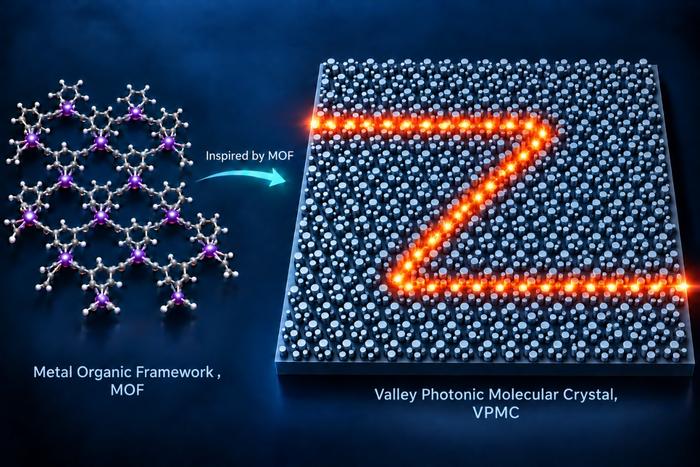
Inspired by Metal-Organic Framework based topological insulators, researchers at Tsinghua University proposed valley photonic molecular crystal (VPMC) and investigated the impact of molecular rotation on the valley-topological properties of VPMC. Credit: Tsinghua University/Xue Feng A research team led by Yidong Huang at Tsinghua University, including Xue Feng and Yongzhuo Li, has developed valley photonic molecular crystals (VPMCs) on a silicon platform. Combining theoretical modeling,...
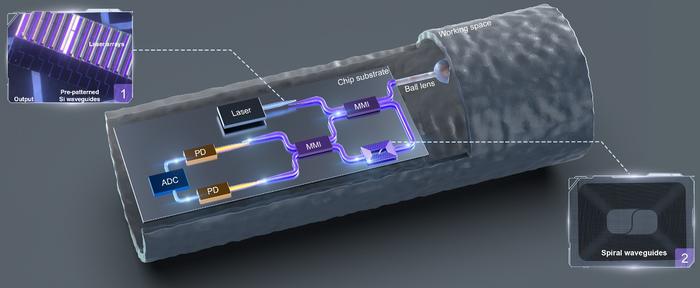
The system integrates a III-V semiconductor light source, SiN-based interferometers, Si-Ge photodetectors (PDs), and an integrated ball-lens microprobe, thereby combining the distinct advantages of multiple photonic integration platforms. The insets illustrate complementary technologies that can be incorporated to realize a miniaturized, fully integrated OCT system. Abbreviations: ADC, analog-to-digital converter. Inset 1: Foundry-scalable embedded III-V lasers on silicon-on-insulator (SOI)...

From left to right: Three photons with different quantum states enter an interferometer with three beam splitters. At each beam splitter, they can take different paths at the same time in superposition. The researchers then measured how often the three photons ended up together at the same output. Counterintuitively, it is possible to make the photons more similar to each other and at the same make them less likely to “bunch” together. AI-generated illustration, by Leonardo Novo. We usually...
