Northwestern University
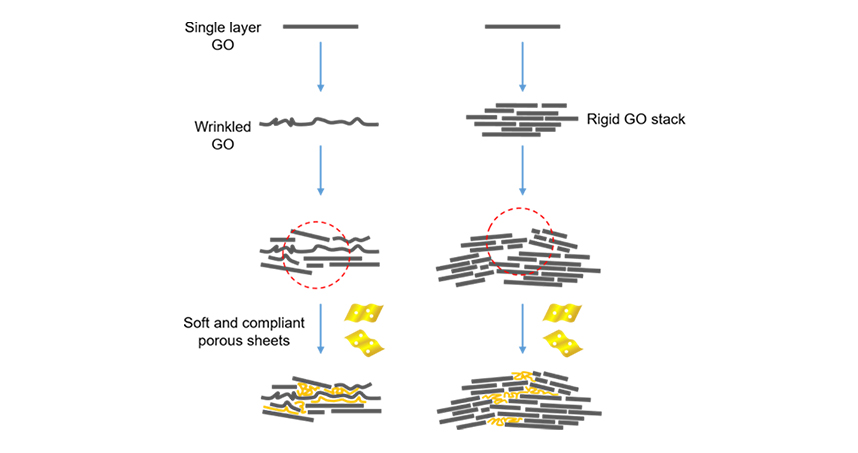
Want to make a super strong material from nano-scale building blocks? Start with the highest quality building blocks, right?
Wrong -- at least when working with "flakes" of graphene oxide (GO).
A new study from Northwestern University researchers shows that better GO "paper" can be made by mixing strong, solid GO flakes with weak, porous GO flakes. The finding will aid the production of higher quality GO materials, and it sheds light on a general problem in materials engineering: how to build a nano-scale material into a macroscopic material without losing its desirable properties.
"To put it in human terms, collaboration is very important," said Jiaxing Huang, Northwestern Engineering professor of materials science and engineering, who led the study. "Excellent players can still make a bad team if they don't work well together. Here, we add some seemingly weaker players and they strengthen the whole team."
The research was a four-way collaboration. In addition to Huang's, three other groups participated, led by Horacio Espinosa, professor of mechanical engineering at the McCormick School of Engineering; SonBinh Nguyen, professor of chemistry at Northwestern; and Tae Hee Han, a former postdoc researcher at the University who's now a professor of organic and nano engineering at Hanyang University, South Korea.
High-tech paper
GO is a derivative of graphite that can be used to make the two-dimensional, super material graphene. Since GO is easier to make, scientists study it as a model material. It generally comes as a dispersion of tiny flakes in water. From one end to the other, each flake is smaller than the width of a human hair and only one nanometer thick.
When a solution of GO flakes is poured onto a filter and the water removed, a thin "paper" is formed, usually a few inches in diameter with a thickness less than or equal to 40 micrometers. Intermolecular forces hold the flakes together, nothing more.
Strength from weakness
Scientists can make strong GO in single layers but layering the flakes into a paper form doesn't work too well. While testing the effect of holes on the strength of GO flakes, Huang and his collaborators discovered a solution.
Using a mixture of ammonia and hydrogen peroxide, the researchers chemically "etched" holes in the GO flakes. Flakes left soaking for one to three hours were drastically weaker than un-etched flakes. After five hours of soaking, flakes became so weak they couldn't be measured.
Then, the team found something surprising: Paper made from the weakened flakes was stronger than expected. At the single layer level, one-hour-etched porous flakes, for example, were 70 percent weaker than solid flakes, but paper made from those flakes was only 10 percent weaker than paper made from solid flakes.
Things got even more interesting when the team mixed solid and porous flakes together, Huang said. Instead of weakening the paper made solely from solid flakes, the addition of 10 or 25 percent of the weakest flakes strengthened it by about 95 and 70 percent, respectively.
Effective connection
If GO sheets can be likened to aluminum foil, Huang said, making a GO paper is just like stacking the foil up to make a thick aluminum slab. If you start with large sheets of aluminum foil, chances are good that many will wrinkle, impeding tight packing between sheets. On the other hand, smaller sheets don't wrinkle as easily. They pack together well but create tight stacks that don't integrate well with other tight stacks, creating voids within GO paper where it can easily break.
"Weak flakes warp to fill in those voids, which improves the distribution of forces throughout the material," Huang said. "It's a reminder that the strength of individual units is only part of the equation; effective connection and stress distribution is equally important."
This finding will be directly applicable to other two-dimensional materials, like graphene, Huang said, and will also lead to the design of higher quality GO products. He hopes to test it out on GO fibers next.
Stiffening of graphene oxide films by soft porous sheets
Lily Mao, Hun Park, Rafael A. Soler-Crespo, Horacio D. Espinosa, Tae Hee Han, SonBinh T. Nguyen, Jiaxing Huang
Nature Communications, 2019; 10 (1)
DOI: 10.1038/s41467-019-11609-8
Contact information:
Jiaxing Huang
Professor of materials science and engineering at Northwestern University
jiaxing-huang@northwestern.edu
Horacio D. Espinosa
Professor of mechanical engineering at Northwestern University
espinosa@northwestern.edu
Phone: 847-467-5989
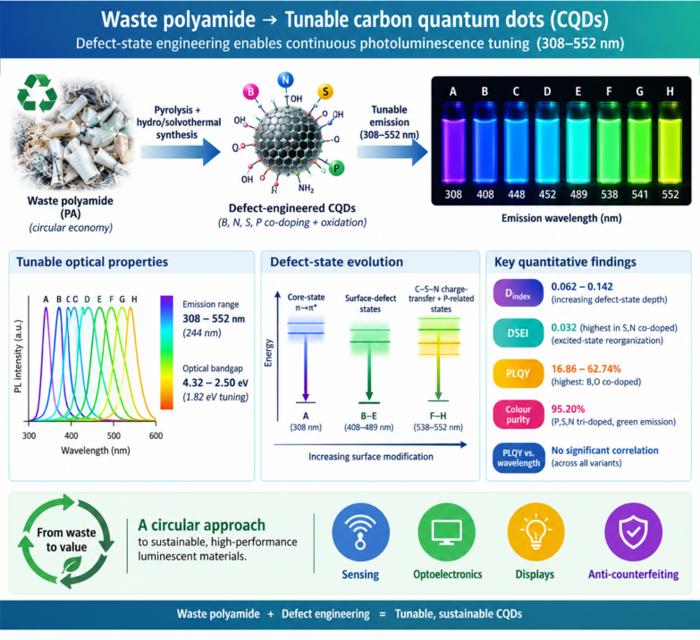
Waste polyamide-derived CQDs show continuous photoluminescence tuning from 308 to 552 nm through sequential defect-state engineering, with optical transition energies decreasing from 4.32 to 2.50 eV. @Christian Ebere Enyoh from Saitama University Carbon quantum dots (CQDs) are fluorescent carbon nanomaterials with potential applications in sensing, optoelectronics, displays, anti-counterfeiting, and environmental technologies. Their optical properties can be adjusted by modifying the carbon...
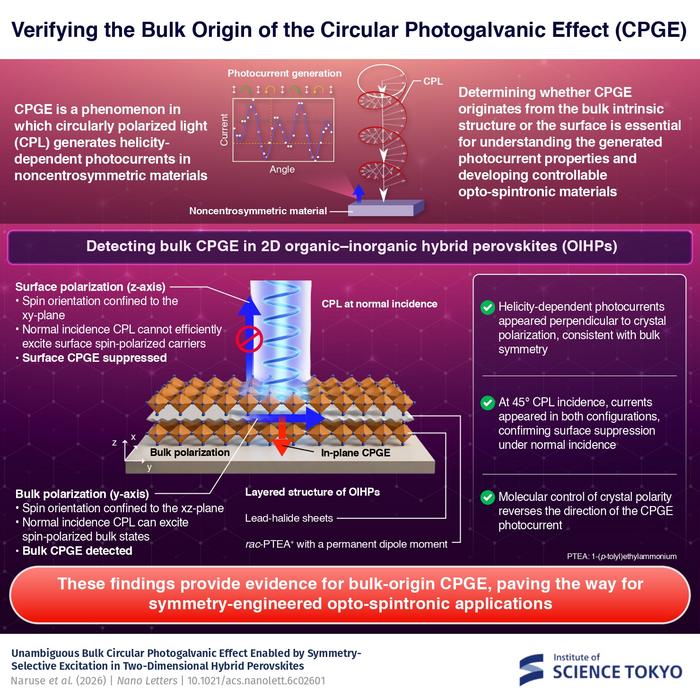
The researchers used circularly polarized light at normal incidence and found that helicity-dependent photocurrents appeared perpendicular to the crystal’s polarization but vanished when measured parallel to it, supporting a bulk origin of CPGE. @Institute of Science Tokyo The circular photogalvanic effect (CPGE), a phenomenon that generates helicity-dependent photocurrents in noncentrosymmetric materials, can originate purely from a crystal's internal structure without contribution from the...
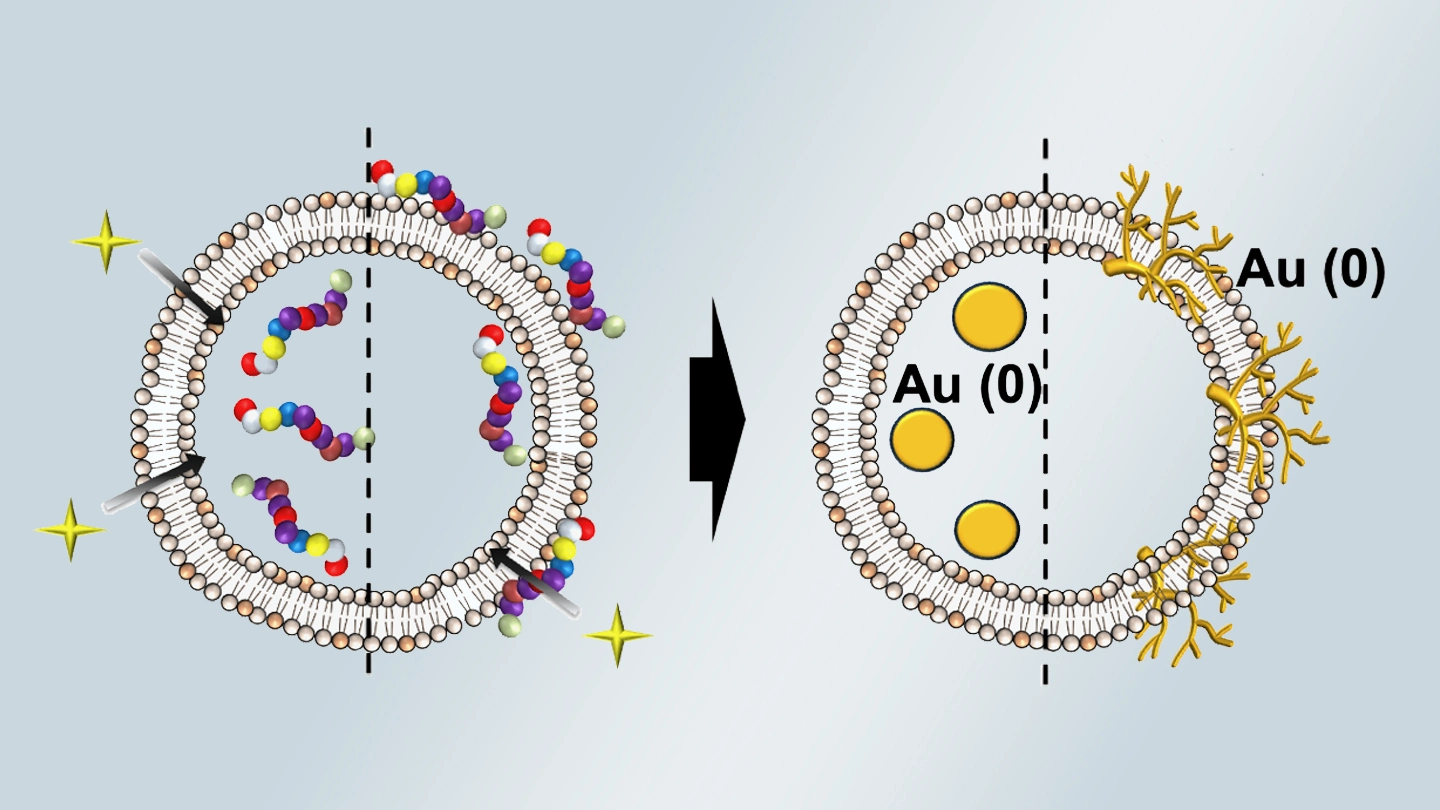
Summary of gold nanoparticle growth programming in liposome based on localization of biomineralization peptide The position of biomineralization peptides within liposomes can influence how gold nanoparticles grow, reports a research team from Institute of Science Tokyo. Peptides localized at the membrane interface promote branched structures, while those confined to the liposome interior favor spherical nanoparticles. The findings offer a new strategy for controlling nanoscale reaction...
