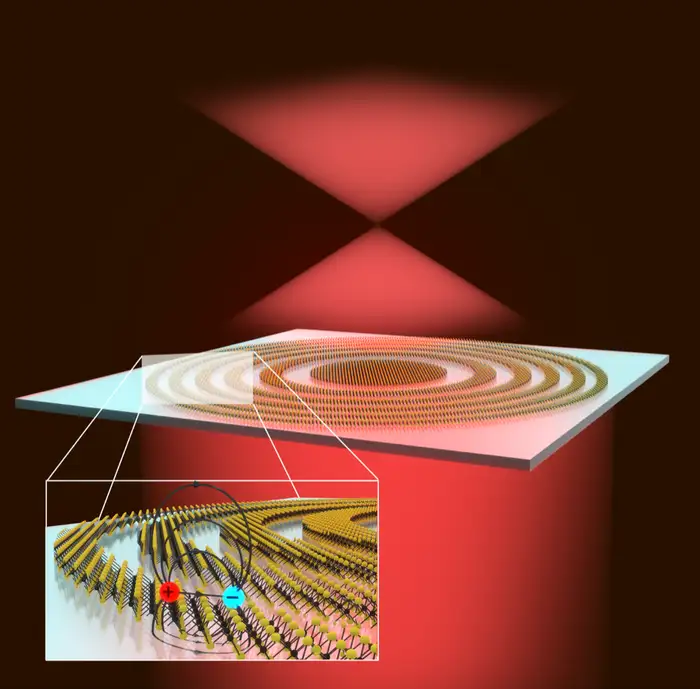
Lenses are used to bend and focus light. Normal lenses rely on their curved shape to achieve this effect, but physicists from the University of Amsterdam and Stanford University have made a flat lens of only three atoms thick which relies on quantum effects. This type of lens could be used in future augmented reality glasses.
When you imagine a lens, you probably picture a piece of curved glass. This type of lens works because light is refracted (bent) when it enters the glass, and again when it exits, allowing us to make things appear larger or closer than they actually are. We have used curved lenses for more than two millennia, allowing us to study the movements of distant planets and stars, to reveal tiny microorganisms, and to improve our vision.
Ludovico Guarneri, Thomas Bauer, and Jorik van de Groep of the University of Amsterdam, together with colleagues from Stanford University in California, took a different approach. Using a single layer of a unique material called tungsten disulphide (WS2 for short), they constructed a flat lens that is half a millimetre wide, but just 0.0000006 millimetres, or 0.6 nanometres, thick. This makes it the thinnest lens on Earth!
Rather than relying on a curved shape, the lens is made of concentric rings of WS2 with gaps in between. This is called a ‘Fresnel lens’ or ‘zone plate lens’, and it focuses light using diffraction rather than refraction. The size of, and distance between the rings (compared to the wavelength of the light hitting it) determines the lens’s focal length. The design used here focuses red light 1 mm from the lens.
Quantum enhancement
A unique feature of this lens is that its focussing efficiency relies on quantum effects within WS2. These effects allow the material to efficiently absorb and re-emit light at specific wavelengths, giving the lens the built-in ability to work better for these wavelengths.
This quantum enhancement works as follows. First, WS2 absorbs light by sending an electron to a higher energy level. Due to the ultra-thin structure of the material, the negatively charged electron and the positively charged ‘hole’ it leaves behind in the atomic lattice stay bound together by the electrostatic attraction between them, forming what is known as an ‘exciton’. These excitons quickly disappear again by the electron and hole merging together and sending out light. This re-emitted light contributes to the lens’s efficiency.
The scientists detected a clear peak in lens efficiency for the specific wavelengths of light sent out by the excitons. While the effect is already observed at room temperature, the lenses are even more efficient when cooled down. This is because excitons do their work better at lower temperatures.
Augmented reality
Another one of the lens’s unique features is that, while some of the light passing through it makes a bright focal point, most light passes through unaffected. While this may sound like a disadvantage, it actually opens new doors for use in technology of the future. “The lens can be used in applications where the view through the lens should not be disturbed, but a small part of the light can be tapped to collect information. This makes it perfect for wearable glasses such as for augmented reality,” explains Jorik van de Groep, one of the authors of the paper.
The researchers are now setting their sights on designing and testing more complex and multifunctional optical coatings whose function (such as focussing light) can be adjusted electrically. “Excitons are very sensitive to the charge density in the material, and therefore we can change the refractive index of the material by applying a voltage,” says Van de Groep. The future of excitonic materials is bright!
Reference
Temperature-Dependent Excitonic Light Manipulation with Atomically Thin Optical Elements
Ludovica Guarneri, Qitong Li, Thomas Bauer, Jung-Hwan Song, Ashley P. Saunders, Fang Liu, Mark L. Brongersma, and Jorik van de Groep
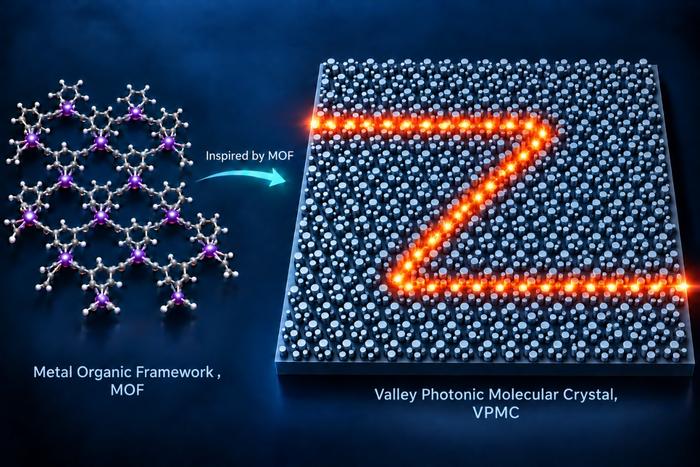
Inspired by Metal-Organic Framework based topological insulators, researchers at Tsinghua University proposed valley photonic molecular crystal (VPMC) and investigated the impact of molecular rotation on the valley-topological properties of VPMC. Credit: Tsinghua University/Xue Feng A research team led by Yidong Huang at Tsinghua University, including Xue Feng and Yongzhuo Li, has developed valley photonic molecular crystals (VPMCs) on a silicon platform. Combining theoretical modeling,...
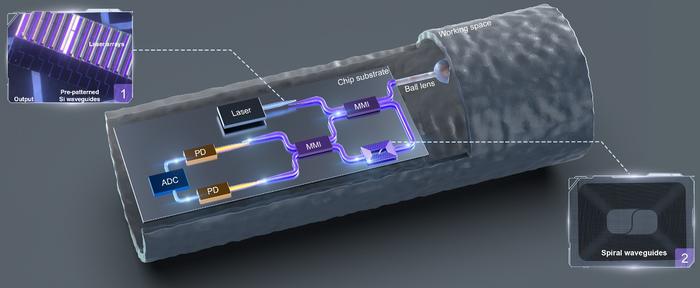
The system integrates a III-V semiconductor light source, SiN-based interferometers, Si-Ge photodetectors (PDs), and an integrated ball-lens microprobe, thereby combining the distinct advantages of multiple photonic integration platforms. The insets illustrate complementary technologies that can be incorporated to realize a miniaturized, fully integrated OCT system. Abbreviations: ADC, analog-to-digital converter. Inset 1: Foundry-scalable embedded III-V lasers on silicon-on-insulator (SOI)...

From left to right: Three photons with different quantum states enter an interferometer with three beam splitters. At each beam splitter, they can take different paths at the same time in superposition. The researchers then measured how often the three photons ended up together at the same output. Counterintuitively, it is possible to make the photons more similar to each other and at the same make them less likely to “bunch” together. AI-generated illustration, by Leonardo Novo. We usually...
