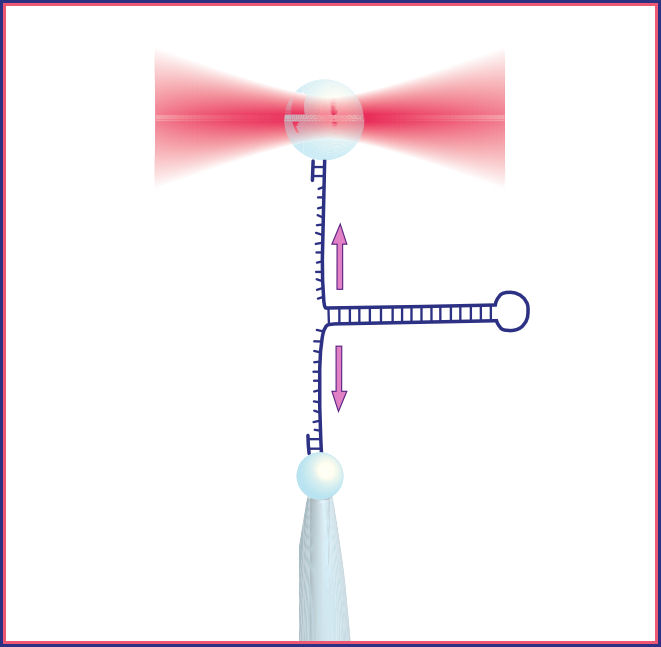
A study, led by researchers at the University of Barcelona (UB) and published in the journalNature Physics, presents the first direct experimental demonstration of the effective temperature by measuring correlations and responses in single molecules in non-equilibrium steady states generated under external random forces.
Results prove the existence of an effective temperature, a parameter for non-equilibrium systems, which quantifies violations of the fluctuation-dissipation theorem (FDT), a powerful tool of statistical physics that is applied in equilibrium conditions. It has been observed that a modified form of the FDT (often called the quasi-FDT) can be also applied to some non-equilibrium systems.
In the study, UB researchers, together with a research team from the University of Sttutgart (Germany), have determined the effective temperature of single molecules, particularly DNA hairpins. The study shows that small systems are fundamental concepts to study statistical physics, condensed-matter physics and biophysics.
The study combines experiments carried out at the Small Biosystems Lab —located at the Faculty of Physics of the UB and led by Félix Ritort, professor in the Department of Fundamental Physics—, analytical theory and simulations for systems with different levels of complexity. Together with Ritort, Joan Camuñas and Marco Ribezzi, researchers in the Department of Fundamental Physics, also participated in the study.
#Physics
This week in nanotech
21 deals tracked
New products
 Nion-compatible In Situ STEM Holders for Electrical BiasingHummingbird Scientific Featured
 Ti-WCMBN Nanomaterialia Featured
 CruciblesBasis Materials
Market insights
Last 30 days: Semiconductors & Electronics was the busiest vertical: 52 of 169 events (31%).
Money raised per month
Behind the deal
Who led Eindhoven University of Technology’s $1.1M Grant?
See the investors with Insights Pro →