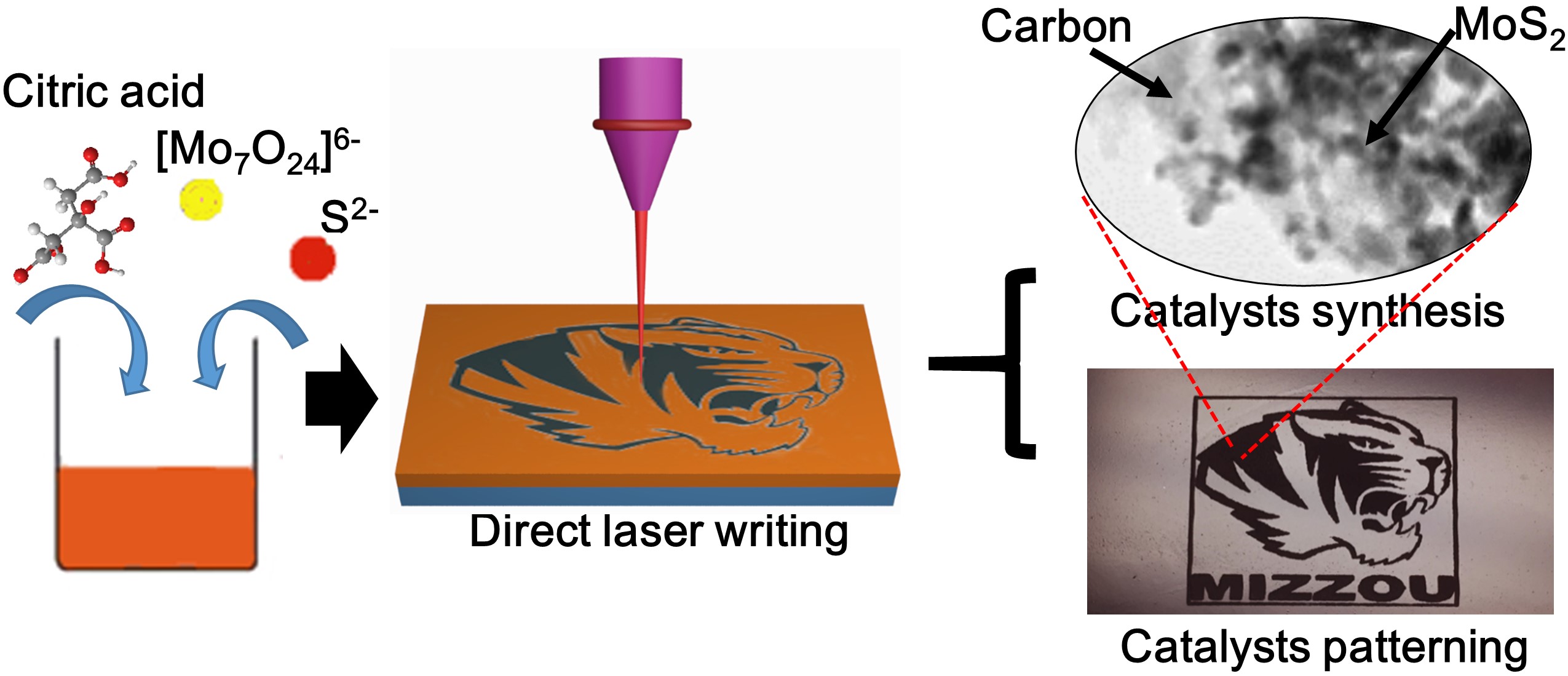
In the race to design smaller handheld devices and smartphones, a key factor is decreasing the sizes of components. As the demand for thinner and lighter microelectronic devices increases, manufacturers often are limited by how oddly shaped the energy sources must become to make them conform to the smaller space. Now, researchers at the University of Missouri, have developed a method of transferring an energy source to virtually any shape.
Using an efficient laser-writing technique, MU scientists can help smartphone manufacturers potentially fabricate energy storage units like microbatteries and micro fuel cells that are more environmentally friendly, highly designable and thin.
“The direct laser writing (DLW) method and technique has seen a rapid advancement in the past decade,” said Jian Lin, an assistant professor in the Department of Mechanical and Aerospace Engineering in theMU College of Engineering. “The main goal of our research was to find an efficient and cost-effective way to integrate nanostructures with micro energy storage units for applications in micro-electronics. Our lab decided to test whether catalysts could be synthesized and patterned on any surface by a one-step laser processing method to produce microbatteries and micro fuel cells in the shapes dictated by computer programs.”
With this in mind, Lin and his team, including Heng (Henry) Deng, a doctoral candidate at MU, set out to prove their theory. They adapted the DLW method to synthesize and pattern hybrid nanocatalysts, or fuel sources, into complex geometric shapes. Using computer-controlled laser writing that uses higher heat and pressure, the scientists were able to produce a surface that became electrically conducive and also has catalytic functionalities.
“This is the first step in manufacturing micro fuel cells that convert chemical energy into electrical energy and batteries that can integrate into microcircuits” said Lin. “Also this technique has been proven to produce microsupercapacitors. By honing the process, handheld device and smartphone manufacturers will be able to produce components in whatever shape or size they choose, greatly impacting the size of these devices. Also, manufacturers will be able to choose more environmentally friendly catalysts for generating energy such as hydrogen or oxygen, which are considered cleaner fuels. The possibilities will be endless.”
The paper, “Laser induced MoS2/carbon hybrids for hydrogen evolution reaction catalysts,” recently was published in a special issue of “Emerging Investigators 2016: Novel Design Strategies for New Functional Materials” in the Journal of Materials Chemistry-A.
University of Missouri
#Energy #Laser #Catalysts
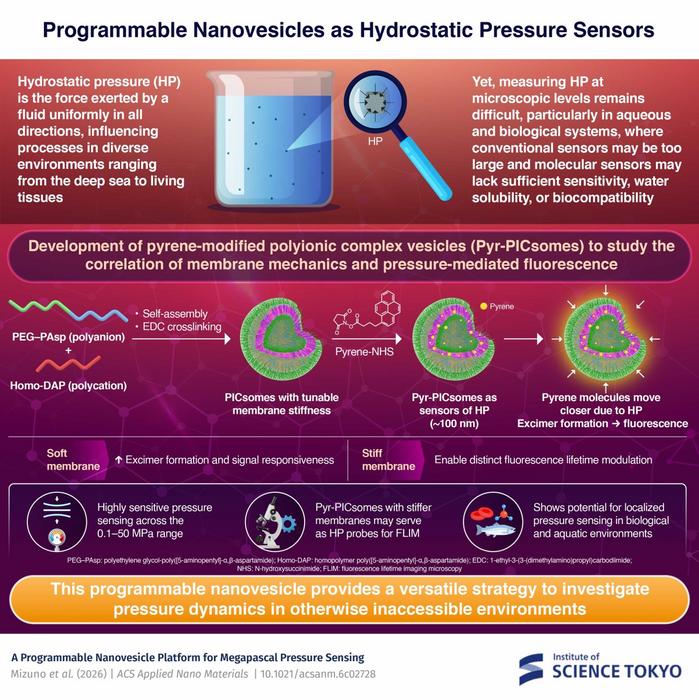
Pyrene-modified polyionic complex vesicles, or Pyr-PICsomes, convert hydrostatic pressure into measurable fluorescence. Crosslinking density tunes membrane stiffness, which governs sensing behavior: soft vesicles give strong excimer-to-monomer ratio changes from 0.1 to 50 MPa, while stiff membranes respond through fluorescence lifetime, suiting lifetime imaging.
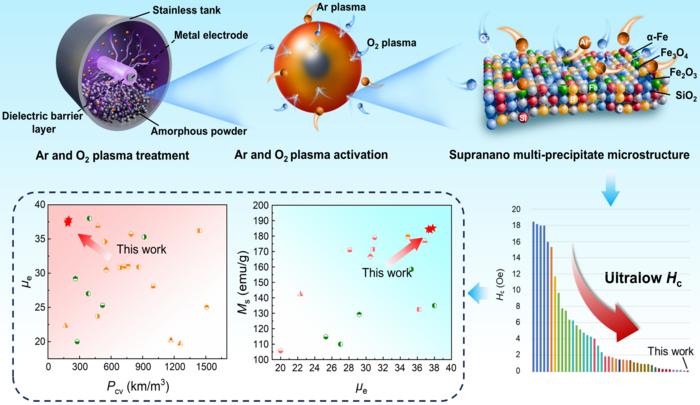
Ar/O₂ plasma treatment generates supranano α-Fe, Fe₃O₄, SiO₂ and Fe₂O₃ precipitates just 0.8–2.5 nm across amorphous powder surfaces, creating nucleation sites that ease magnetic-moment reversal. The resulting soft magnetic composite combines 0.13 Oe coercivity, 37.3 permeability, 185 emu g⁻¹ saturation magnetization and 191.18 kW m⁻³ core loss at 1 MHz and 20 mT. The surface route avoids bulk composition changes, aiding scale-up for high-frequency inductors and power chokes.
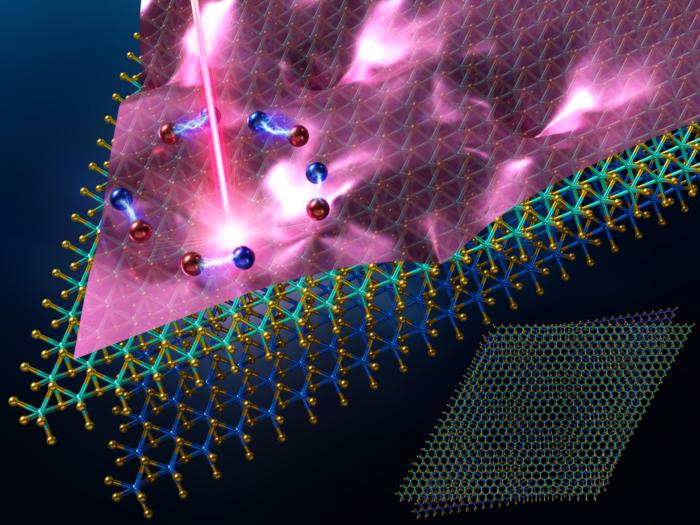
Researchers at MANA have introduced a theoretical framework that extracts hidden disorder from complex photoluminescence spectra in twisted MoSe2/WSe2 moiré heterostructures, bypassing unreliable peak-by-peak analysis. By tracking how simple descriptors like peak and average energy vary spatially, the work reveals a hierarchy of disorder, from micrometer-scale background variations to localized exciton-trapping defects.