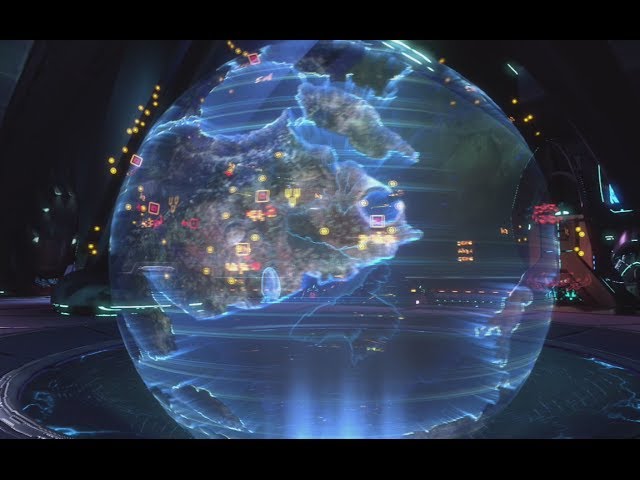
The first observational evidence that the universe could be a hologram has been published in the journal Physical Review Letters. The international study may lead to new beliefs on the Big Bang Theory and on quantum gravity, one of theoretical physics’ most profound problems.
Researchers from the University of Waterloo, Perimeter Institute for Theoretical Physics, University of Southampton (UK), INFN, Lecce (Italy) and the University of Salento (Italy), believe the study further explains how space and time emerged.
“We are proposing using this holographic universe, which is a very different model of the Big Bang than the popularly accepted one that relies on gravity and inflation,” said Niayesh Afshordi, professor of physics and astronomy at the University of Waterloo and Perimeter Institute, and lead author in the study.
“Each of these models makes distinct predictions that we can test as we refine our data and improve our theoretical understanding – all within the next five years.”
Theoretical physicists and astrophysicists first identified the concept of a holographic universe in the 1990s. Today, researchers have published observational evidence to support a 2D holographic explanation of the universe.
This work could lead to a functioning theory of quantum gravity, a theory that harmonizes quantum mechanics with Einstein’s theory of gravity.
“The key to understanding quantum gravity is understanding field theory in one lower dimension,” said Afshordi. “Holography is like a Rosetta Stone, translating between known theories of quantum fields without gravity and the uncharted territory of quantum gravity itself.”
Holography, with its more simplified approach, allows the researchers to study the dense conditions of quantum gravity during the Big Bang at its boundary, which provides as much information as studying the Big Bang itself.
From Planck Data to Planck Era: Observational Tests of Holographic Cosmology
Niayesh Afshordi, Claudio Corianò, Luigi Delle Rose, Elizabeth Gould, and Kostas Skenderis
Phys. Rev. Lett. 118, 041301 – Published 27 January 2017
DOI: 10.1103/PhysRevLett.118.041301
#QuantumMechanics