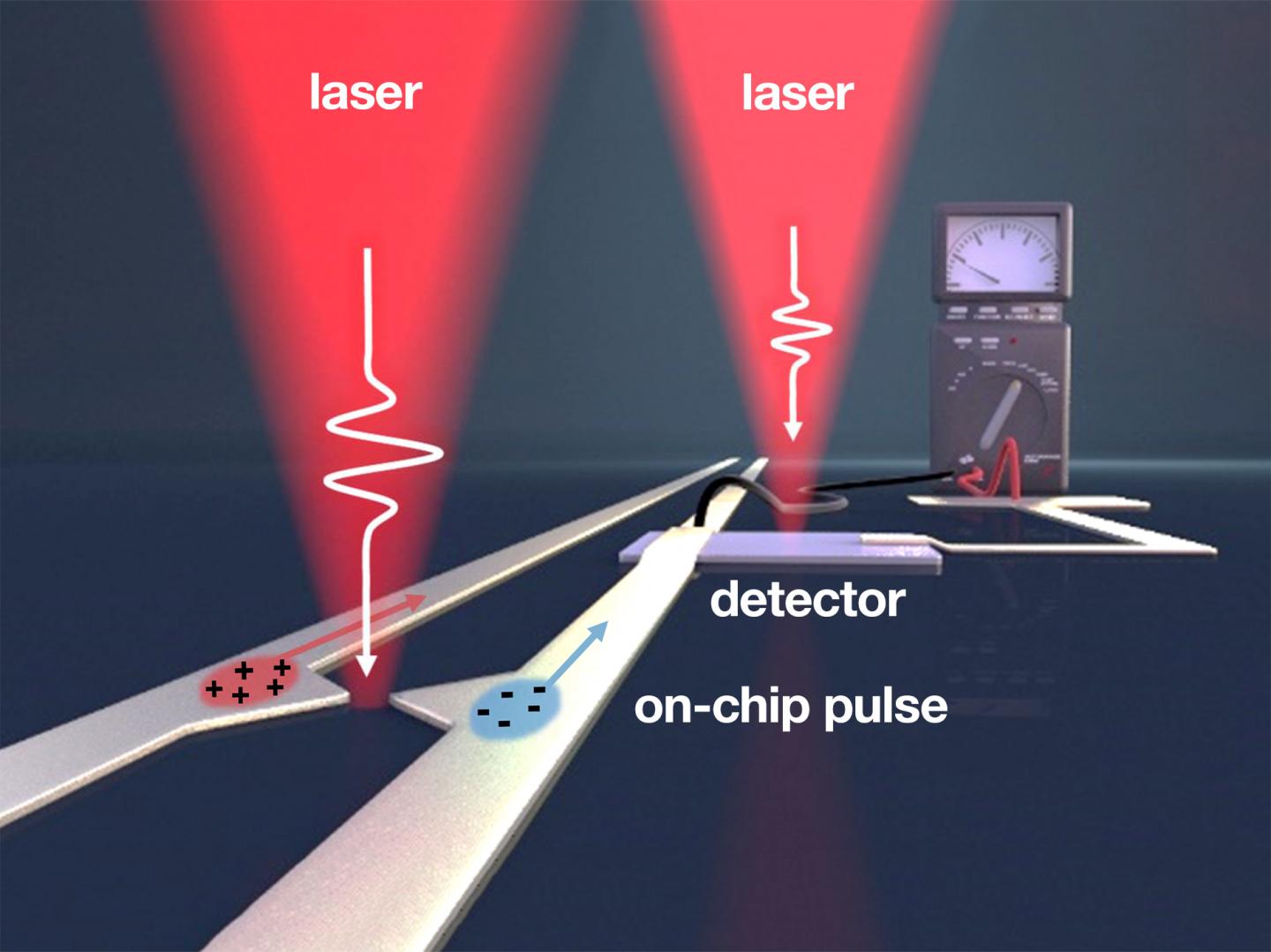
A team headed by the TUM physicists Alexander Holleitner and Reinhard Kienberger has succeeded for the first time in generating ultrashort electric pulses on a chip using metal antennas only a few nanometers in size, then running the signals a few millimeters above the surface and reading them in again a controlled manner.
Classical electronics allows frequencies up to around 100 gigahertz. Optoelectronics uses electromagnetic phenomena starting at 10 terahertz. This range in between is referred to as the terahertz gap, since components for signal generation, conversion and detection have been extremely difficult to implement.
The TUM physicists Alexander Holleitner and Reinhard Kienberger succeeded in generating electric pulses in the frequency range up to 10 terahertz using tiny, so-called plasmonic antennas and run them over a chip. Researchers call antennas plasmonic if, because of their shape, they amplify the light intensity at the metal surfaces.
Asymmetric antennas
The shape of the antennas is important. They are asymmetrical: One side of the nanometer-sized metal structures is more pointed than the other. When a lens-focused laser pulse excites the antennas, they emit more electrons on their pointed side than on the opposite flat ones. An electric current flows between the contacts - but only as long as the antennas are excited with the laser light.
"In photoemission, the light pulse causes electrons to be emitted from the metal into the vacuum," explains Christoph Karnetzky, lead author of the Nature work. "All the lighting effects are stronger on the sharp side, including the photoemission that we use to generate a small amount of current."
Ultrashort terahertz signals
The light pulses lasted only a few femtoseconds. Correspondingly short were the electrical pulses in the antennas. Technically, the structure is particularly interesting because the nano-antennas can be integrated into terahertz circuits a mere several millimeters across.
In this way, a femtosecond laser pulse with a frequency of 200 terahertz could generate an ultra-short terahertz signal with a frequency of up to 10 terahertz in the circuits on the chip, according to Karnetzky.
The researchers used sapphire as the chip material because it cannot be stimulated optically and, thus, causes no interference. With an eye on future applications, they used 1.5-micron wavelength lasers deployed in traditional internet fiber-optic cables.
An amazing discovery
Holleitner and his colleagues made yet another amazing discovery: Both the electrical and the terahertz pulses were non-linearly dependent on the excitation power of the laser used. This indicates that the photoemission in the antennas is triggered by the absorption of multiple photons per light pulse.
"Such fast, nonlinear on-chip pulses did not exist hitherto," says Alexander Holleitner. Utilizing this effect he hopes to discover even faster tunnel emission effects in the antennas and to use them for chip applications.
Towards femtosecond on-chip electronics based on plasmonic hot electron nano-emitters
Christoph Karnetzky, Philipp Zimmermann, Christopher Trummer, Carolina Duque Sierra, Martin Wörle, Reinhard Kienberger & Alexander Holleitner
Nature Communications vol.9, no.2471 (2018)
DOI: 10.1038%2Fs41467-018-04666-y
Contact information:
Christoph Karnetzky
Walter Schottky Institute, Center for Nanotechnology and Nanomaterials
Christoph.Karnetzky@wsi.tum.de
Tel: (+49) 089 289 11399
Technical University of Munich (TUM)
#Nanoelectronics #Plasmonics
The proposed TENG-driven g-IGT is a flexible, self-powered neuromorphic device capable of reproducing multiple memory states and spike-rate-dependent learning Neuromorphic devices, which are designed to emulate aspects of biological neural networks, are promising candidates for developing low-power and intelligent sensing technologies, including wearable applications. Among the device architectures explored for neuromorphic computing, graphene-channel ion-gel-gated transistors (g-IGTs) are...

Rice University researchers have shown that sub-nanometer wrinkles in graphene generate flexoelectric charge separation, reshaping local electrical behavior through curvature alone. Extreme bending produces polarization far stronger than in larger systems and may enable geometry-controlled electronics without chemical doping. Published in Advanced Materials.

Researchers at NC State have extended twistronics beyond van der Waals materials into strongly bonded crystalline oxides. By stacking sodium niobate membranes with twist angles controlled down to 0.1 degrees, and confirming results via synchrotron X-ray diffraction, the team found interlayer bonds distort the atomic lattice, shifting phase structure and domain configuration. The technique works at near-millimeter scale, far larger than typical twistronic devices, marking a real step toward pract






