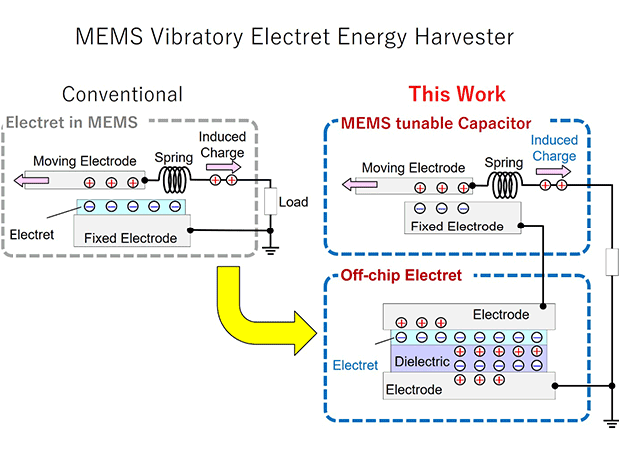
Tokyo Tech scientists developed a micro-electromechanical energy harvester that allows for more flexibility in design, which is crucial for the future of IoT.
Nowadays, it would be hard to not notice that electronic devices have become incredibly small. The use of miniature sensors in the upcoming Internet of Things (IoT) era could enable us to develop applications that were only seen in science fiction. However, microelectronic devices still require power to run, and energy-harvesting micro-electromechanical systems (MEMS) can be used so that these minuscule contraptions can run on ambient energy, such as that coming from mechanical vibrations.
Conventional MEMS energy harvesters use an electret (the electrical equivalent of a permanent magnet; it has permanent charge stored in it) placed in an MEMS tunable capacitor, which has a moving electrode that is pushed by ambient forces, inducing the movement of charges. Unfortunately, this design is very constrained because the fabrication processes for both the electret and the MEMS components have to be compatible. Therefore, a team of scientists, led by Assistant Professor Daisuke Yamane, proposed a new MEMS electret-based energy harvester that consists of two separate chips: one for the MEMS tunable capacitor, and one containing an electret and dielectric material to form another capacitor. This allows us to physically separate MEMS structures and electrets for the first time," states Yamane.
"The proposed method can be a promising way to enhance the design and fabrication flexibility of both MEMS structures and electrets," concludes Yamane. Loosening up design constraints expands the limits for engineers and will accelerate the onset of the IoT era so that we can reap its benefits.
A MEMS Vibratory Energy Harvester Charged by an Off-chip Electret
Daisuke Yamane, Hiroaki Honma and Hiroshi Toshiyoshi
Conference: The 32nd International Conference on Micro Electro Mechanical Systems
Contact information:
Daisuke Yamane
Assistant Professor at Institute of Innovative Research in Tokyo Tech
yamane.d.aa@m.titech.ac.jp
Tel: +81-45-924-5031
URL: Laboratory for Future Interdisciplinary Research of Science and Technology
Tokyo Institute of Technology (Tokyo Tech)
#Nanosystems #Nanoelectronics
Kopin Corporation has secured an $18.6 million sole source award from the Office of the Secretary of War through the U.S. Army Contracting Command under the IBAS program. The award brings Kopin's total IBAS funding to $34 million.

Emerson has integrated NevadaNano's MPS 6.0 technology into the Rosemount 628MP Combustible Gas Sensor for use with the Rosemount 928 Wireless Gas Monitor. MPS 6.0 consumes 1.35 mW and needs no field calibration.
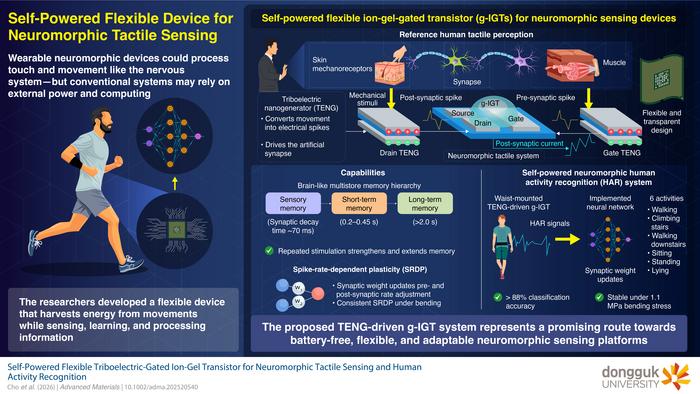
The proposed TENG-driven g-IGT is a flexible, self-powered neuromorphic device capable of reproducing multiple memory states and spike-rate-dependent learning Neuromorphic devices, which are designed to emulate aspects of biological neural networks, are promising candidates for developing low-power and intelligent sensing technologies, including wearable applications. Among the device architectures explored for neuromorphic computing, graphene-channel ion-gel-gated transistors (g-IGTs) are...
This week in nanotech
$271M raised
6 funding rounds · 28 deals tracked
New products
 Nion-compatible In Situ STEM Holders for Electrical BiasingHummingbird Scientific Featured
 Ti-WCMBN Nanomaterialia Featured
 GiiiGii
Market insights
Last 30 days: Quantum Technologies drew the most money: $3.17B.
Money raised per month
Behind the deal
Who led Institut de Microelectronica de Barcelona (IMB-CNM, CSIC)’s $185.7M Grant?
See the investors with Insights Pro →