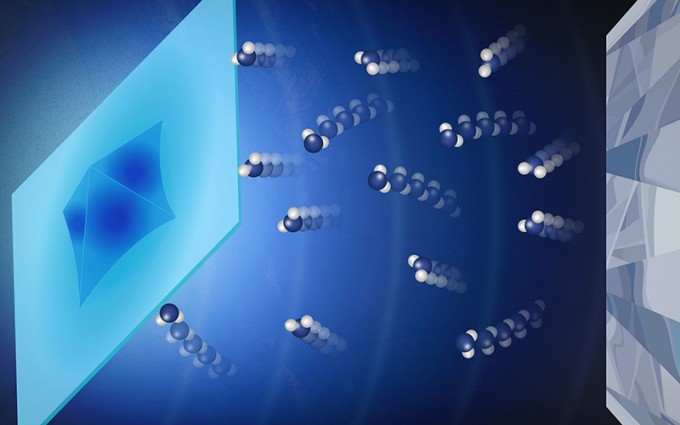
Crystal growth is a crucial issue for fundamental science and wide applications. The growth morphology and speed are generally determined by an interplay between macroscopic thermodynamic driving forces and the microscopic kinetic process at crystal-liquid interface.
While crystal growth is well understood at near-equilibrium growth conditions, the growth transition with diverse growth morphologies are poorly understood under nonequilibrium growth conditions (e.g. dynamic compression).
A study recently published in the Proceedings of the National Academy of Sciences (PNAS) provides a new insight of crystal growth under dynamic compression using an advanced dynamic diamond anvil cell (dDAC) technique, which bridges the unknown behaviors of crystal growth between static and dynamic pressure conditions. The work was conducted by a collaborative research team from the Korea Research Institute of Standards and Science (KRISS), University of Science and Technology (UST) in South Korea and Japan’s National Institute of Advanced Industrial Science and Technology (AIST). Co-lead author Yong-Jae Kim, a physicist at Lawrence Livermore National Laboratory, conducted the research as a postdoctoral researcher at KRISS.
“Our study makes a step forward in better understanding and predicting crystal growth in the real world, from diverse snowflakes to planet interiors at extreme conditions,” Kim said.
The team revealed the origin of pressure-induced shock growth of single ice crystals showing reduced dimensionality by controlling local growth conditions using the advanced dDAC. The local structure at the water-ice interface is enhanced by fast compression, facilitating fast interface kinetics and thus two-dimensional (2D) shock growth initiation, even near equilibrium melting pressure.
With the advanced dDAC, the team simultaneously measured morphology evolution, microstructures (with Raman spectroscopy or X-ray diffraction) and surrounding growth conditions (such as pressure and cell volume) during crystal growth. They also performed molecular dynamics simulations for more elaborate microscopic understanding of the physical situation at the water-ice interface.
“Generally, rapid crystal growth results from the fast growth of crystal corners under a large driving force, finally leading to the formation of a dendritic morphology. Contrary to the general expectation, fast compression initiated the 2D shock growth from the edges of the initial 3D crystal with at least one order higher growth speed, rather than from its corners, although the measured pressure of the entire system is almost close to the melting pressure of ice (i.e. small driving force),” Kim said. “This implies the fast compression causes effectively large overpressure at the crystal edges. Such a large effective driving force leads to a similar interface structure as bulk crystals along the shock growth plane, finally facilitating fast interface kinetics causing 2D shock growth.”
Looking ahead, Kim plans to expand on this research by using laser-driven shock compression to explore the kinetics of crystal growth and phase transitions at even faster timescales, with applications to a better understanding of the interior structure and evolution of icy planets like Uranus and Neptune.
Shock growth of ice crystal near equilibrium melting pressure under dynamic compression
Yong-Jae Kim, Yun-Hee Lee, Sooheyong Lee, Hiroki Nada, and Geun Woo Lee
PNAS April 30, 2019 116 (18) 8679-8684; first published April 15, 2019 https://doi.org/10.1073/pnas.1818122116
LLNL.
#Nanocrystals
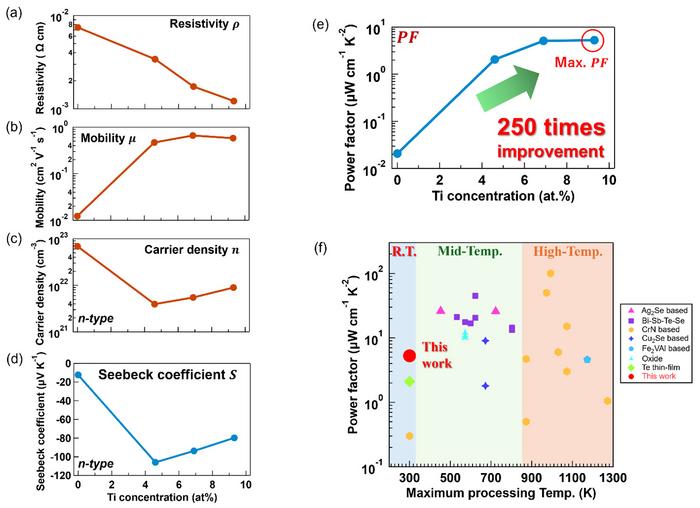
Researchers at Tohoku University have raised the power factor of chromium nitride thin films 250-fold by doping them with small amounts of titanium, reaching 5.26 µW cm⁻¹ K⁻². Titanium's stronger affinity for nitrogen suppresses nitrogen vacancies, cutting carrier concentration while boosting electron mobility by roughly two orders of magnitude.

Neutron diffraction at Oak Ridge National Laboratory has shown that a modest mechanical squeeze can substantially reshape the magnetic behavior of altermagnets, a class of materials under investigation for spintronics. Squeezing manganese telluride and iron sulfide crystals between titanium plates altered their magnetic domain populations and changed the anomalous Hall effect, which governs electron transport.
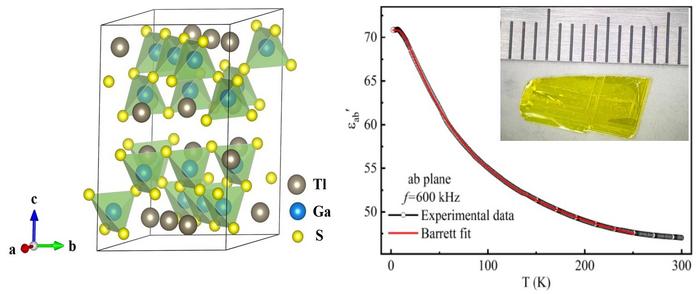
TlGaS2 single crystals show both in-plane and out-of-plane polarization, a rare combination in two-dimensional ferroelectrics that could widen options for ferroelectric transistors and non-volatile memory. Infrared spectroscopy revealed a soft phonon mode below 75 K, a signature tied to quantum ferroelectricity, along with weak structural changes across temperatures that lack clear heat-capacity signals, hinting at local rearrangements rather than conventional phase transitions.
This week in nanotech
$558.4M raised
5 funding rounds · 35 deals tracked
New products
 Nion-compatible In Situ STEM Holders for Electrical BiasingHummingbird Scientific Featured
 Ti-WCMBN Nanomaterialia Featured
 Aether®Lam Research
Market insights
Last 30 days: Quantum Technologies drew the most money: $2.15B.
Money raised per month