
An expression for the maximum speed at which changes in macroscopic systems can occur has been derived by a theoretical physicist at RIKEN. This will deepen our understanding of quantum phenomena in systems that are not in equilibrium.
One of the hardest aspects of quantum mechanics to grasp is the Heisenberg uncertainty principle that states that it is not possible to simultaneously pin down both the position and momentum of an object. In other words, the more precisely a particle’s position is determined, the broader the range of its possible momentum becomes (and vice versa).
In 1945, two physicists, Leonid Mandelstam and Igor Tamm, focused on another type of the uncertainty relation, namely one between time and energy fluctuation, and showed that transitions in quantum systems don’t happen instantaneously; rather, the speed at which a transition occurs is capped by an amount determined by how much the energy of the system fluctuates.
Many other so-called quantum speed limits have subsequently been derived, which have helped better understand the physics of quantum systems and have been useful in various quantum applications.
But big problems arise when quantum speed limits are applied to macroscopic systems. “Previous quantum speed limits, which are useful for small systems, typically become meaningless for macroscopic transitions,” notes Ryusuke Hamazaki of the Nonequilibrium Quantum Statistical Mechanics RIKEN Hakubi Research Team. “For example, conventional quantum speed limits give an infinite upper bound for the speed of transitions in a gas made up of atoms.”
Now, Hamazaki has succeeded in deriving a quantum speed limit for transitions in macroscopic systems.
“This new derivation provides fundamental limits that can be applied to various types of non-equilibrium quantum macroscopic phenomena,” he says. “I hope that many fundamental laws and applications concerning macroscopic quantum dynamics will appear based on the concepts introduced in this study.”
Hamazaki derived the more stringent quantum speed limit by developing a general framework based on the conservation law of probability, a fundamental principle in physics.
One unexpected outcome for Hamazaki was the discovery of a new trade-off relationship. “Instead of a trade-off relationship between time and energy fluctuation, as in the Mandelstam–Tamm bound, I found one between time and the gradient of the quantum phase—a fundamental quantity in quantum physics.”
Hamazaki now intends to extend his strategy to see whether it can be used to derive quantum speed limits for quantities like the growth of quantum entanglement.
Reference
Speed Limits for Macroscopic Transitions
Ryusuke Hamazaki
https://journals.aps.org/prxquantum/abstract/10.1103/PRXQuantum.3.020319
RIKEN
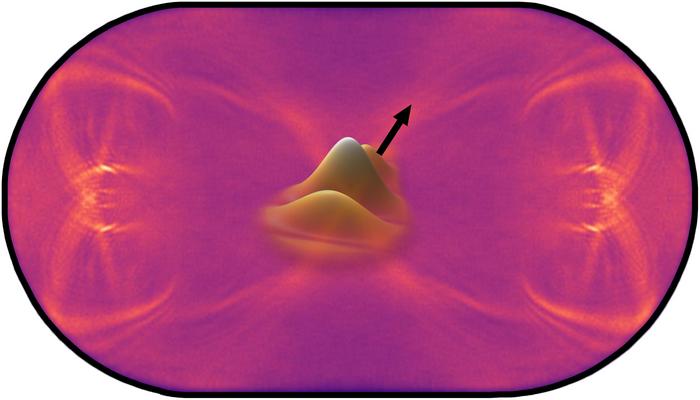
A quantum "wave packet" (in the middle) launched from the same kind of starting point behaves differently. Even after bouncing around for a very long time, faint filament-like patterns (bright glow) are still visible, a tattoo tracing back to its early history. This lingering imprint is the "quantum birthmark" described in the study. Credit: Joonas Keski-Rahkonen, Tampere University Even the most chaotic quantum systems keep a permanent mark of their own past – a "quantum birthmark" – that...
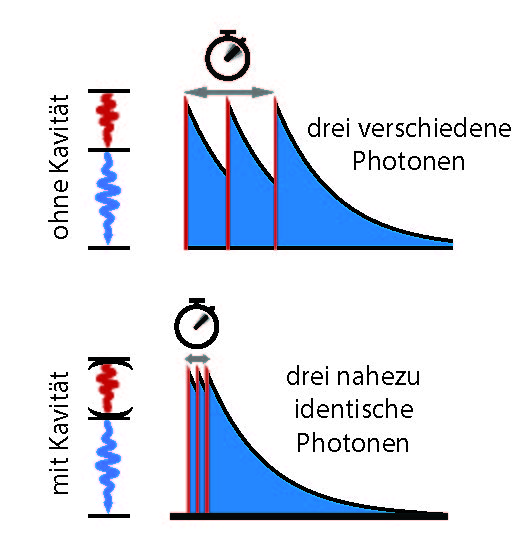
Illustration (University of Basel, Timon Baltisberger): Biexziton decay can generate photons of very high quality if the system is specifically controlled using an optical cavity. Under these conditions, 90 per cent of the photons are indistinguishable. Working in close collaboration, researchers from Paderborn University, the University of Basel and Ruhr University Bochum have made a significant breakthrough in the field of quantum communication. In their recently published paper in the...
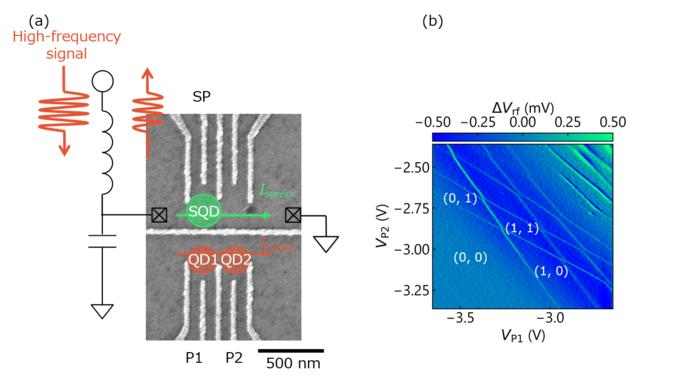
(a) The structure of the gate electrodes on the ZnO device used in the experiment in this paper. (b) The charge stability diagram indicating the formation of ZnO double quantum dot in few-electron regime. Researchers at Tohoku University, in collaboration with the National Institute for Materials Science (NIMS) and the University of Tokyo, have taken an important step toward semiconductor quantum computing using zinc oxide (ZnO). The team successfully demonstrated charge sensing,...
