American Chemical Society (ACS)
Scary movies about dolls that can move, like Anabelle and Chucky, are popular at theaters this summer. Meanwhile, a much less menacing animated doll has chemists talking. Researchers have given a foil "paper doll" the ability to move and do sit-ups with a new material called polymer covalent organic frameworks (polyCOFs). They report their results in ACS Central Science.
Scientists make conventional COFs by linking simple organic building blocks, such as carbon-containing molecules with boric acid or aldehyde groups, with covalent bonds. The ordered, porous structures show great potential for various applications, including catalysis, gas storage and drug delivery. However, COFs typically exist as nano- or micro-sized crystalline powders that are brittle and can't be made into larger sheets or membranes that would be useful for many practical applications. Yao Chen, Shengqian Ma, Zhenjie Zhang and colleagues wondered if they could improve COFs' mechanical properties by using linear polymers as building blocks.
The researchers based their polyCOF on an existing COF structure, but during the compound's synthesis, they added polyethylene glycol (PEG) to the reactants. The PEG chains bridged the pore space of the COF, making a more compact, cohesive and stable structure. In contrast to the original COF, the polyCOF could be incorporated into flexible membranes that were repeatedly bent, twisted or stretched without damage. To demonstrate how polyCOFs could be used as an artificial muscle, the team made a doll containing the membrane as the waist and aluminum foil as its other parts. Upon exposure to ethanol vapors, the doll sat up; when the vapors were withdrawn, it laid down. The researchers repeated these actions several times, making the doll do "sit-ups." The expansion of polyCOF pores upon binding the gas likely explains the doll's calisthenics, the researchers say
PolyCOFs: A New Class of Freestanding Responsive Covalent Organic Framework Membranes with High Mechanical Performance
Zhifang Wang, Qi Yu Yubo, Huang Hongde An, Yu Zhao, Yifan Feng, Xia Li, Xinlei Shi, Jiajie Liang, Fusheng Pan, Peng Cheng, Yao Chen, Shengqian Ma, Zhenjie Zhang
ACS Cent. Sci. 2019
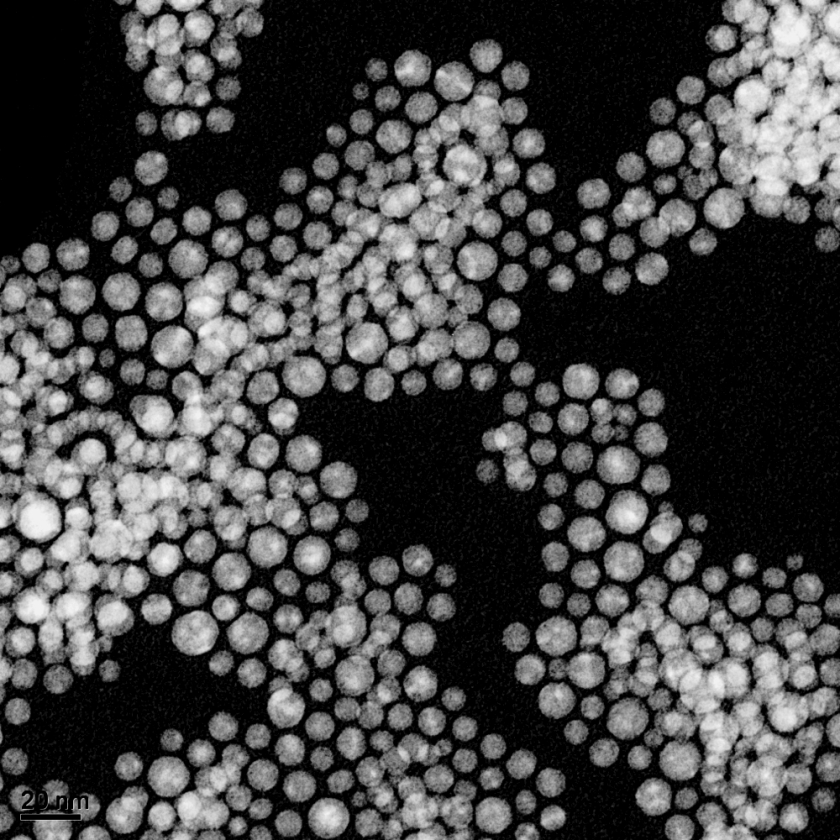
Silver nanoparticles with diameters of ~10 nm deliver the best performance as electrocatalysts. The silver particles are sprayed onto the electrode together with a conductive carbon powder. The ideal mixture consists of 20 per cent by mass silver and 80 per cent by mass carbon powder. This image was taken using a transmission electron microscope (TEM). © HZB Via electrolysis, CO₂ can be reduced to CO, a raw material for further chemical products such as fuels. Within the GreenQuest Project,...
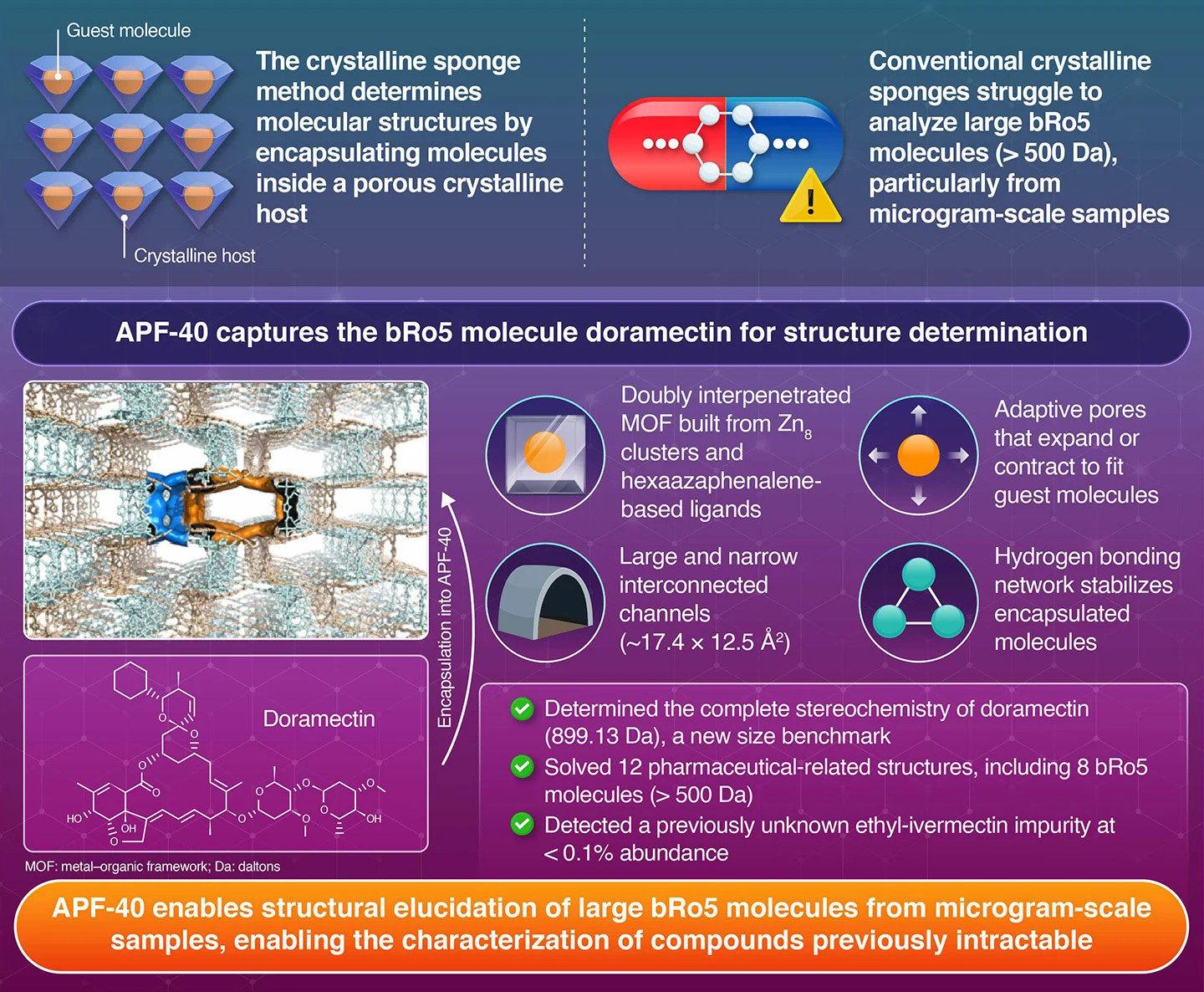
A flexible metal–organic framework developed by researchers from Institute of Science Tokyo enables the structural determination of large "beyond rule of 5" molecules from microgram-scale samples. Using APF-40 as a crystalline sponge, the researchers determined the structures of 12 pharmaceutical-related molecules, including the 899 Da drug molecule doramectin and trace ivermectin derivatives. The method could aid drug discovery, natural products research, and the characterization of rare...
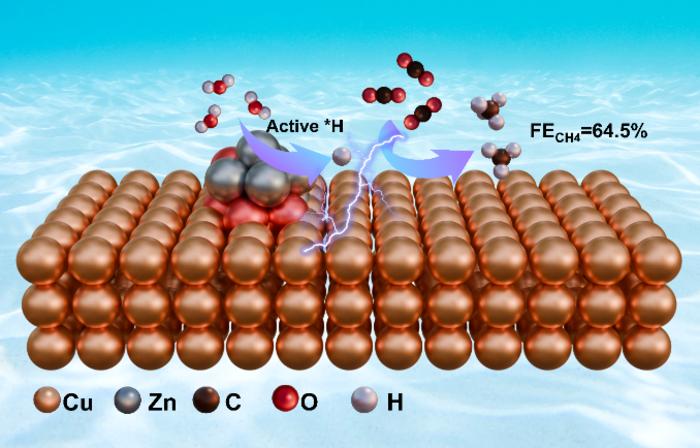
image: CuZn800@C was constructed via solvothermal method and utilizes the high-temperature volatility of zinc to prepare through calcination at different temperatures, which displays a high methane Faradaic efficiency of 64.5% and a remarkable partial current density of -551.3 mA/cm2 at -1.7 V vs. RHE, along with excellent stability. Zn and Cu form a tandem reaction system. Zn sites promote water splitting to provide protons, while Cu sites reduce the energy barrier for *CO hydrogenation....
