top of page

Discovery unlocks potential of “miracle material” for future electronics

  • Sep 8, 2025
  • 2 min read
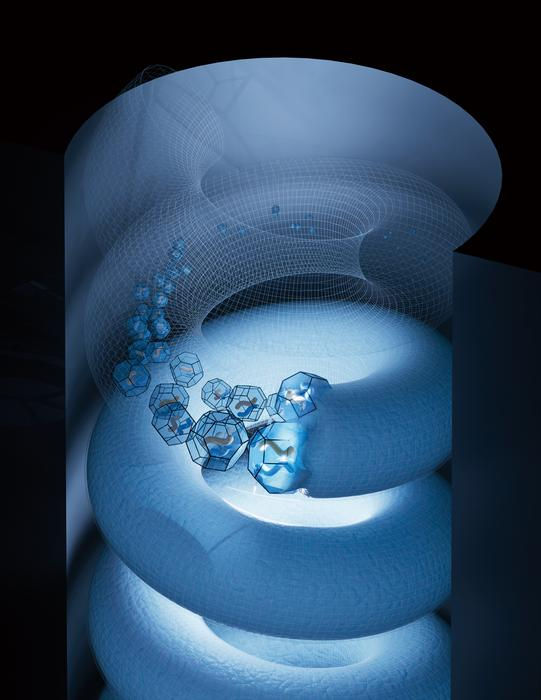
The phenomenon in physics known as “Floquet states”, which have now been observed in graphene for the first time, as envisaged by artist Lina Segerer. This image “Dirac Cones I” explores the concept of Floquet states in graphene generated by light pulses. The painting shows the three-dimensional electronic structure of graphene – known as Dirac cones – and their replicas created by light.
The phenomenon in physics known as “Floquet states”, which have now been observed in graphene for the first time, as envisaged by artist Lina Segerer. This image “Dirac Cones I” explores the concept of Floquet states in graphene generated by light pulses. The painting shows the three-dimensional electronic structure of graphene – known as Dirac cones – and their replicas created by light. @ Lina Segerer (www.linasegerer.de)

Graphene is an extraordinary material – a sheet of interlocking carbon atoms just one atom thick that is stable and extremely conductive. This makes it useful in a range of areas, such as flexible electronic displays, highly precise sensors, powerful batteries, and efficient solar cells. A new study – led by the University of Göttingen, working together with colleagues from Braunschweig and Bremen in Germany, and Fribourg in Switzerland – now takes graphene’s potential to a whole new level. Researchers have directly observed “Floquet effects” in graphene for the first time. This resolves a long-standing debate: Floquet engineering – a method in which the properties of a material are very precisely altered using pulses of light – also works in metallic and semi-metallic quantum materials such as graphene. The study was published in Nature Physics.


The researchers used femtosecond momentum microscopy to experimentally investigate Floquet states in graphene. In this technique, the samples are first excited with rapid flashes of light and then examined with a delayed light pulse in order to track dynamic processes in the material. “Our measurements clearly prove that ‘Floquet effects’ occur in the photoemission spectrum of graphene,” explains Dr Marco Merboldt, physicist at the University of Göttingen and first author of the study. “This makes it clear that Floquet engineering actually works in these systems – and the potential of this discovery is huge.” The study shows that Floquet engineering works in many materials. This means the goal of designing quantum materials with specific properties – and doing so with laser pulses in an extremely short time – is getting closer.


Tailoring materials in this way for specific applications could form the basis for the electronics, computer, and sensor technology of the future. Professor Marcel Reutzel, who led the research in Göttingen together with Professor Stefan Mathias, says: "Our results open up new ways of controlling electronic states in quantum materials with light. This could lead to technologies in which electrons are manipulated in a targeted and controlled manner.” Reutzel adds: “What is particularly exciting is that this also enables us to investigate topological properties. These are special, very stable properties which have great potential for developing reliable quantum computers or new sensors for the future."


Reference Observation of Floquet states in graphene

Marco Merboldt, Michael Schüler, David Schmitt, Jan Philipp Bange, Wiebke Bennecke, Karun Gadge, Klaus Pierz, Hans Werner Schumacher, Davood Momeni, Daniel Steil, Salvatore R. Manmana, Michael A. Sentef, Marcel Reutzel & Stefan Mathias

2 Comments


iamsubhkumarr
Mar 31

This is one of the best explanations of the Epfo Login Portal I have come across. The details you shared about ID creation, searching, and updating information are very helpful. Many users get confused while using government websites, but your guide makes everything straightforward. It’s informative, well-structured, and easy to read. Thanks for sharing such a valuable post.

Like

fasofe7290
Mar 03

So they finally proved Floquet states exist in graphene. This has been debated for years—whether you can actually manipulate a semi-metal like graphene with light pulses or if the decoherence happens too fast. Turns out you can. The sidebands show up clear as day in the photoemission data, even with s-polarized light where Volkov effects should be zero. That's the smoking gun. The asymmetry in the momentum maps seals it. Volkov alone can't produce that. You need interference between Floquet and Volkov paths. Physics nerd stuff, but basically means light really can dress the band structure in these materials. For anyone trying to explain complex tech like this to normal people, visuals matter. A clean static banner with the right…

Like

FREE LISTING

Get Found by Gobal Nanotech Buyer

Join 2,000+ companies in our directory. Claim your profile in 2 minutes.

Reach 220k+ professionals

Instant credibility boost

Start free, upgrade anytime

List your Nanotech Products

Showcase your innovations to our 220k+ network of industry professionals and 14k newsletter subscribers

Stay Ahead in Nanotech

Monthly insights, breakthroughs, and opportunities delivered to 14,000+ industry professionals.

Thank you registering!

More News

Join the Global Nanotechnology Network

Connect with 220k+ nanotech professionals across our network and grow your business visibility

FOR COMPANIES

  • Free basic profile

  • Showcase your products

  • Connect with global buyers

  • Premium options available

STAY INFORMED

  • Monthly industry insights

  • Latest breakthroughs & trends

  • New products & innovations

  • Exclusive opportunities

bottom of page