
In the age of ever-present technology, dead batteries are a common hindrance. But for those relying on a wearable health care device to monitor glucose, reduce tremors or even track heart function, taking time to recharge can pose a big risk.
For the first time, researchers in Carnegie Mellon University’s Department of Mechanical Engineering have shown that a health care device can be powered using body heat alone. By combining a pulse oximetry sensor with a flexible, stretchable, wearable thermoelectric energy generator composed of liquid metal, semiconductors and 3D printed rubber, the team has introduced a promising way to address battery life concerns.
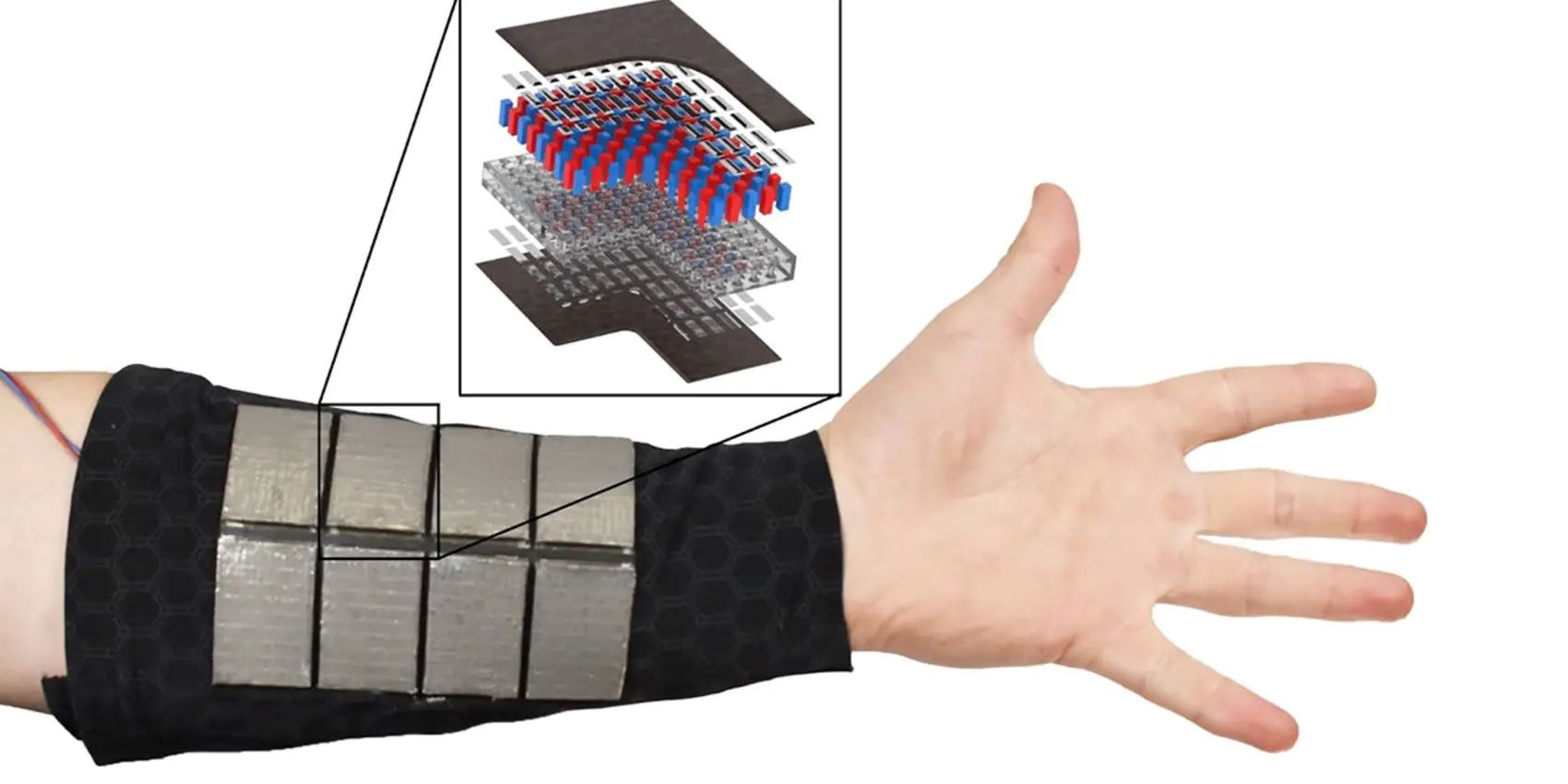
“This is the first step toward battery-free wearable electronics,” said Mason Zadan, Ph.D. candidate and first author of the research published in Advanced Functional Materials.
The system, designed to achieve high mechanical and thermoelectric performance with seamless materials integration, features advancements in soft-materials, TEG array design, low energy circuit board design and onboard power management.
“Compared to our past research, this design improves power density by roughly 40 times or 4,000%. The liquid metal epoxy composite enhances thermal conductivity between the thermoelectric component and the device’s point of contact on the body,” explained Carmel Majidi, professor of mechanical engineering and director of the Soft Machines Laboratory.
To test its voltage output, the device was worn on a participant’s chest and wrist at rest and in motion.
“We saw greater output while the device was on the participant’s wrist and while they were in motion,” Zadan said. “As the participant moves, one side of the device is cooled by the increase in airflow, and the other is heated from the rise in body temperature. Walking and running created an ideal temperature differential.”
Moving forward, Dinesh K. Patel, a research scientist on the team, is eager to work on improving electrical performance and explore how to additively manufacture the device. “We want to move it from a proof-of-concept into a product people can start using.”
Reference
Stretchable Thermoelectric Generators for Self-Powered Wearable Health Monitoring
Mason Zadan, Anthony Wertz, Dylan Shah, Dinesh K. Patel, Wuzhou Zu, Youngshang Han, Jeff Gelorme, Hing Jii Mea, Lining Yao, Mohammad H. Malakooti, Seung Hwan Ko, Navid Kazem, Carmel Majidi
https://onlinelibrary.wiley.com/doi/full/10.1002/adfm.202404861
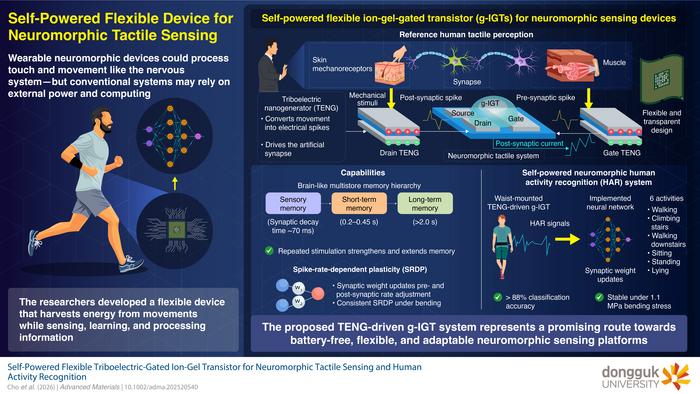
The proposed TENG-driven g-IGT is a flexible, self-powered neuromorphic device capable of reproducing multiple memory states and spike-rate-dependent learning Neuromorphic devices, which are designed to emulate aspects of biological neural networks, are promising candidates for developing low-power and intelligent sensing technologies, including wearable applications. Among the device architectures explored for neuromorphic computing, graphene-channel ion-gel-gated transistors (g-IGTs) are...

Rice University researchers have shown that sub-nanometer wrinkles in graphene generate flexoelectric charge separation, reshaping local electrical behavior through curvature alone. Extreme bending produces polarization far stronger than in larger systems and may enable geometry-controlled electronics without chemical doping. Published in Advanced Materials.

Researchers at NC State have extended twistronics beyond van der Waals materials into strongly bonded crystalline oxides. By stacking sodium niobate membranes with twist angles controlled down to 0.1 degrees, and confirming results via synchrotron X-ray diffraction, the team found interlayer bonds distort the atomic lattice, shifting phase structure and domain configuration. The technique works at near-millimeter scale, far larger than typical twistronic devices, marking a real step toward pract
