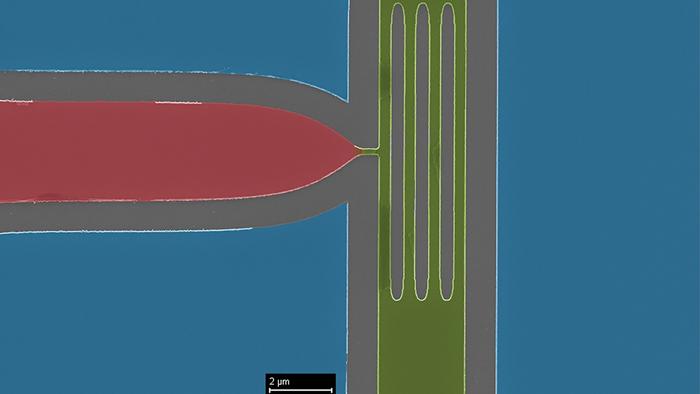
In particle colliders that reveal the hidden secrets of the tiniest constituents of our universe, minute particles leave behind extremely faint electrical traces when they are generated in enormous collisions. Some detectors in these facilities use superconductivity — a phenomenon in which electricity is carried with zero resistance at low temperatures — to function.
For scientists to more accurately observe the behavior of these particles, these weak electrical signals, or currents, need to be multiplied by an instrument capable of turning a faint electrical flicker into a real jolt.
Scientists at the U.S. Department of Energy’s (DOE) Argonne National Laboratory have developed a new device that acts as a “current multiplier.” This device, called a nanocryotron, is a prototype for a mechanism that could turn up a particle’s electrical signal high enough to a level where it temporarily turns off the superconductivity of the material, essentially creating a kind of on-off switch.
“We’re taking a small signal and using it to trigger an electric cascade,” said Tomas Polakovic, one of Argonne’s Maria Goeppert Mayer Fellows and an author of the study. “We’re going to funnel the very small current of these detectors into the switching device, which can be then used to switch a much bigger current.”
To prepare the nanocryotron for a collider experiment will take some more work because of the high magnetic fields involved. While today’s particle detectors can withstand magnetic fields of several tesla in strength, this switch’s performance degrades in high magnetic fields.
“Finding ways to make the device work in higher magnetic fields is key to incorporating it into a real experiment,” said Argonne graduate research assistant Timothy Draher, another author of the study.
To make this possible, the researchers plan to change the geometry of the material and introduce defects, or tiny holes. These defects will help researchers stabilize small superconducting vortices in the material, the movement of which can lead to an unanticipated disruption of superconductivity.
The nanocryotron was created by using electron beam lithography, a kind of stenciling technique that uses a beam of electrons to remove a polymer film to expose a particular region of interest. That region of interest is then etched using plasma ion etching.
“We basically just strip away the parts that are exposed, leaving behind the device that we want to use,” Draher said.
According to Argonne physicist Valentine Novosad, another author of the study, the new device also could serve as the basis for a kind of electronic logic circuitry.
“This work is especially important for collider experiments, such as those that will be performed at the Electron-Ion Collider at Brookhaven National Laboratory. There, superconducting nanowire detectors, positioned close to the beams, would require microelectronics immune to magnetic fields,” said Argonne Distinguished Fellow and group leader Zein-Eddine Meziani.
Reference
Design and performance of parallel-channel nanocryotrons in magnetic fields
Timothy Draher, Tomas Polakovic, Yi Li, John Pearson, Alan Dibos, Zein-Eddine Meziani, Zhili Xiao, Valentine Novosad
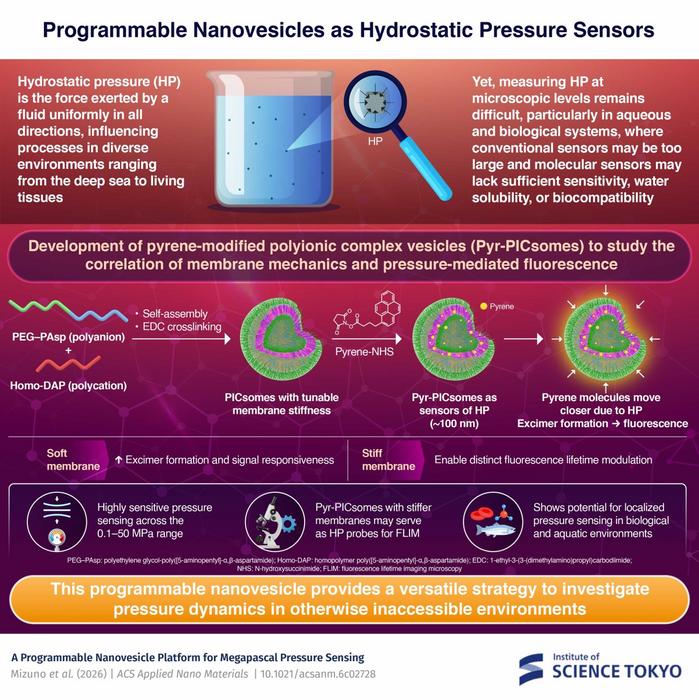
Pyrene-modified polyionic complex vesicles, or Pyr-PICsomes, convert hydrostatic pressure into measurable fluorescence. Crosslinking density tunes membrane stiffness, which governs sensing behavior: soft vesicles give strong excimer-to-monomer ratio changes from 0.1 to 50 MPa, while stiff membranes respond through fluorescence lifetime, suiting lifetime imaging.
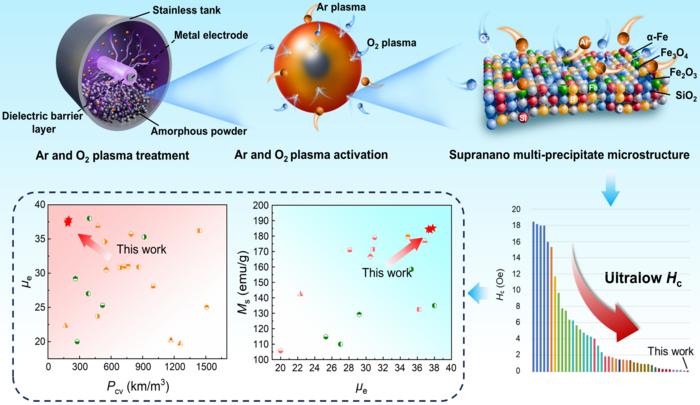
Ar/O₂ plasma treatment generates supranano α-Fe, Fe₃O₄, SiO₂ and Fe₂O₃ precipitates just 0.8–2.5 nm across amorphous powder surfaces, creating nucleation sites that ease magnetic-moment reversal. The resulting soft magnetic composite combines 0.13 Oe coercivity, 37.3 permeability, 185 emu g⁻¹ saturation magnetization and 191.18 kW m⁻³ core loss at 1 MHz and 20 mT. The surface route avoids bulk composition changes, aiding scale-up for high-frequency inductors and power chokes.
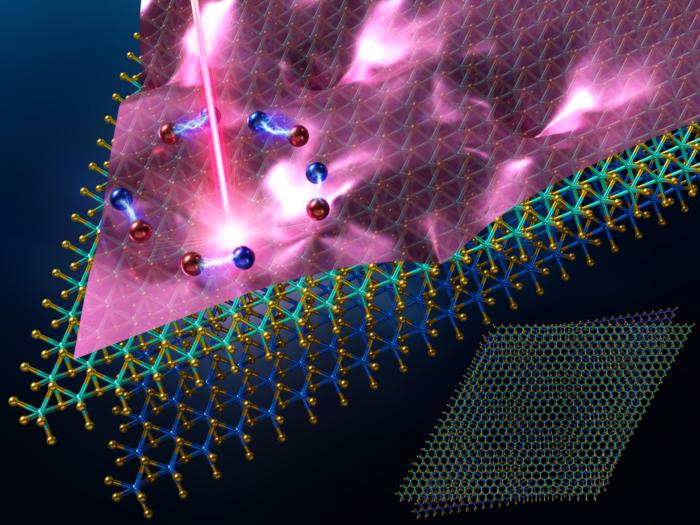
Researchers at MANA have introduced a theoretical framework that extracts hidden disorder from complex photoluminescence spectra in twisted MoSe2/WSe2 moiré heterostructures, bypassing unreliable peak-by-peak analysis. By tracking how simple descriptors like peak and average energy vary spatially, the work reveals a hierarchy of disorder, from micrometer-scale background variations to localized exciton-trapping defects.






