
Research is underway around the world to find alternatives to our current electronic computing technology, as great, electron-based systems have limitations. A new way of transmitting information is emerging from the field of magnonics: instead of electron exchange, the waves generated in magnetic media could be used for transmission, but magnonics-based computing has been (too) slow to date. Scientists at the University of Vienna have now discovered a significant new method: When the intensity is increased, the spin waves become shorter and faster – another step towards magnon computing. The results were published in the renowned journal Science Advances.
Magnonics is a relatively new field of research in magnetism. Spin waves play a central role: A local disturbance in the magnetic order of a magnet can propagate as waves through a material. These waves are called spin waves, and the associated quasiparticles are called magnons. They carry information in the form of angular momentum pulses. Because of this property, they can be used as low-power data carriers in smaller and more energy-efficient computers of the future. The main challenge in magnonics is wavelength. The larger it is, the slower magnon-based data processing units are. Until now, the wavelength could only be shortened with very complex hybrid structures or a synchrotron. The research group "Nanomagnetism and Magnononics" at the University of Vienna, together with colleagues from Germany, the Czech Republic, Ukraine and China, has developed a simpler alternative. First author Qi Wang made the crucial observation after months of work in the Brillouin light scattering spectroscopy laboratory at the University of Vienna's Faculty of Physics: if you increase the intensity, the spin waves become shorter and faster - a breakthrough method for magnonic computing.
Co-author of the study and leader of the Vienna NanoMag team, Andrii Chumak, explains the discovery with a metaphor: "It is helpful to imagine the method with light. If you change the wavelength of light, its color changes. But if you change the intensity, only the luminosity changes. In this case, we found a way to change the color by changing the intensity of the spin waves. This phenomenon allowed us to excite much shorter and much better spin waves," Chumak said.
The current wavelength found with this system is about 200 nanometers. According to numerical simulations, it would be possible to excite even smaller wavelengths, but at this stage it is very difficult to excite or measure these orders of magnitude.
The amplitudes of the spin waves are also crucial for future magnetic integrated circuits. The discovered system exhibits a self-locking nonlinear shift, which means that the amplitude of the excited spin waves is constant. This property is very relevant for integrated circuits, as it allows different magnetic elements to work together with the same amplitude. This, in turn, is fundamental to the construction of more complex systems and to the realization of the distant goal of a magnon-based computer. The ultimate goal, a fully functional magnon computer, has not yet been achieved. Nevertheless, this solid milestone brings researchers a good deal closer to their goal.
Reference
Deeply nonlinear excitation of self-normalized short spin waves
Qi Wang, Roman Verba, Björn Heinz, Michael Schneider, Ondřej Wojewoda, Kristýna Davídková, Khrystyna Levchenko, Carsten Dubs, Norbert J. Mauser, Michal Urbánek, Philipp Pirro, Andrii V. Chumak
https://www.science.org/doi/10.1126/sciadv.adg4609
University of Vienna
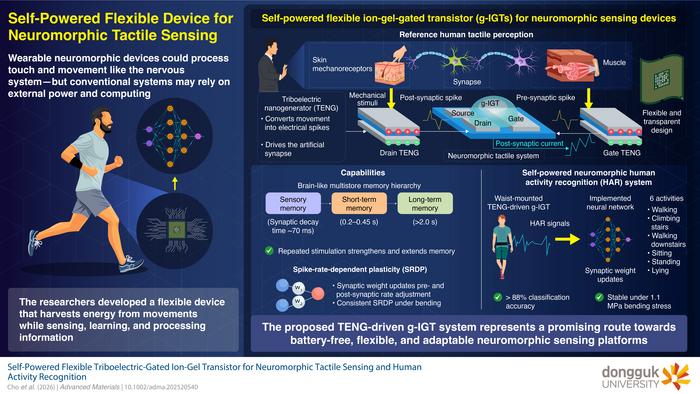
The proposed TENG-driven g-IGT is a flexible, self-powered neuromorphic device capable of reproducing multiple memory states and spike-rate-dependent learning Neuromorphic devices, which are designed to emulate aspects of biological neural networks, are promising candidates for developing low-power and intelligent sensing technologies, including wearable applications. Among the device architectures explored for neuromorphic computing, graphene-channel ion-gel-gated transistors (g-IGTs) are...
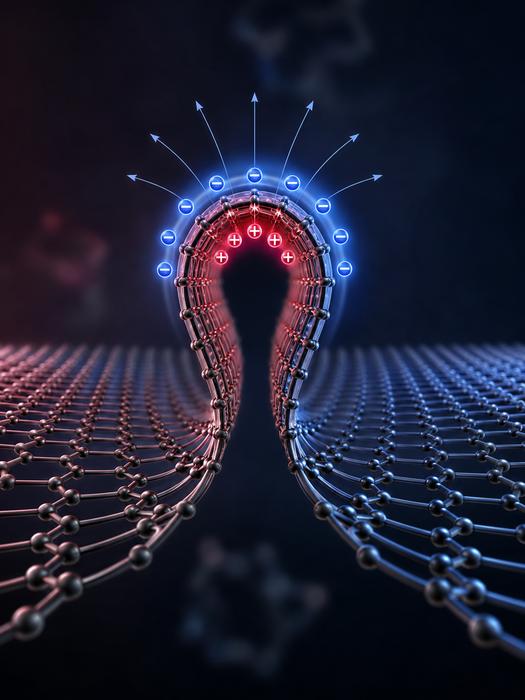
Rice University researchers have shown that sub-nanometer wrinkles in graphene generate flexoelectric charge separation, reshaping local electrical behavior through curvature alone. Extreme bending produces polarization far stronger than in larger systems and may enable geometry-controlled electronics without chemical doping. Published in Advanced Materials.
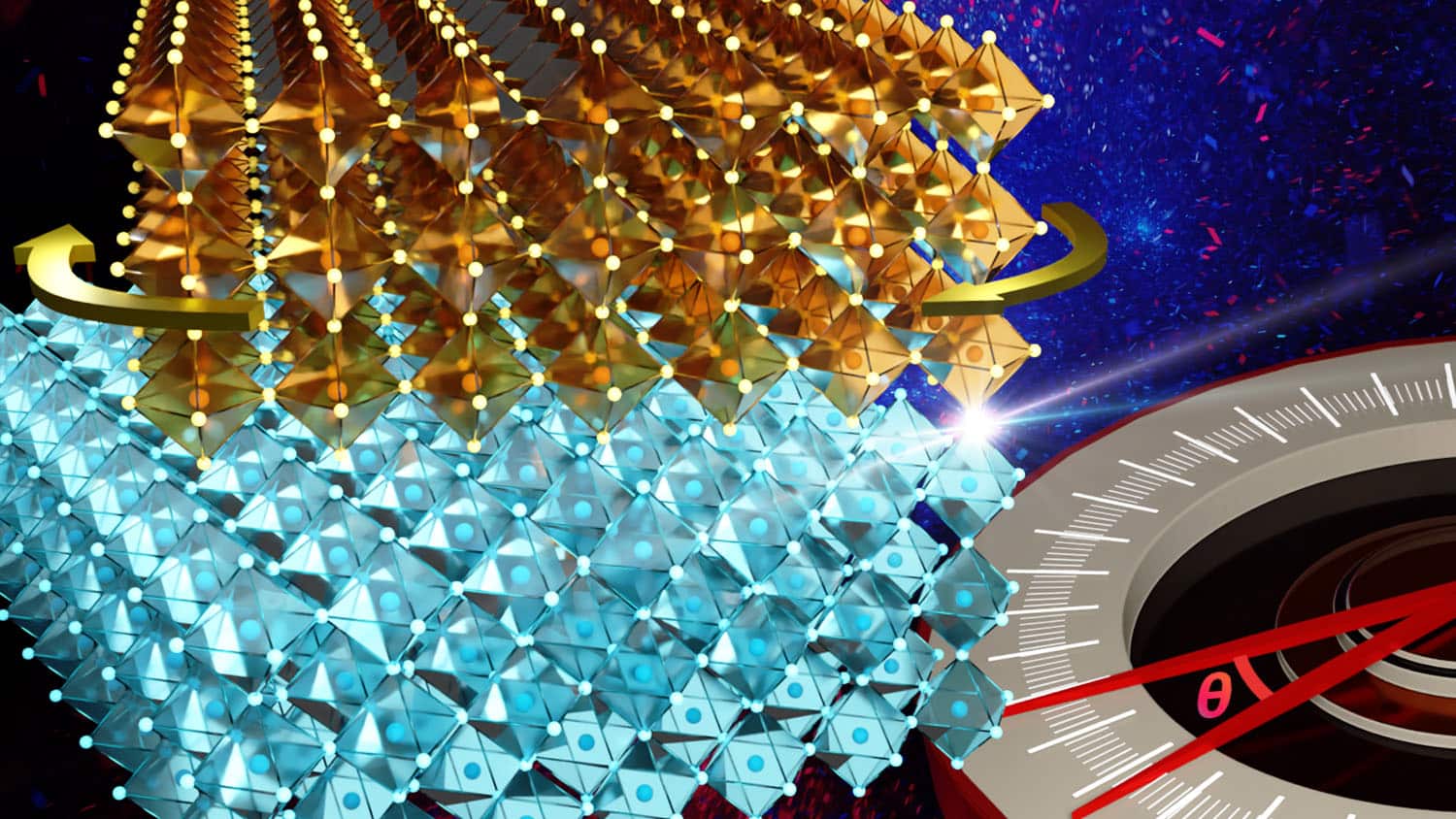
Researchers at NC State have extended twistronics beyond van der Waals materials into strongly bonded crystalline oxides. By stacking sodium niobate membranes with twist angles controlled down to 0.1 degrees, and confirming results via synchrotron X-ray diffraction, the team found interlayer bonds distort the atomic lattice, shifting phase structure and domain configuration. The technique works at near-millimeter scale, far larger than typical twistronic devices, marking a real step toward pract
