Australian National University (ANU)
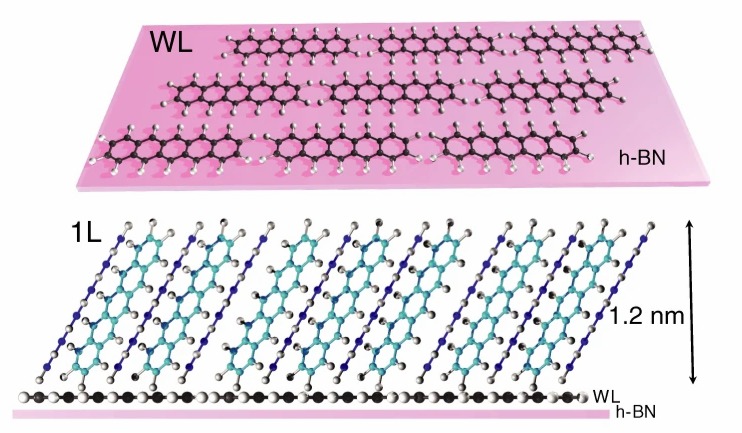
Mobile phones and other electronic devices made from an organic material that is thin, bendable and more powerful are now a step closer thanks to new research led by scientists at The Australian University (ANU).
Lead researchers Dr Ankur Sharma and Associate Professor Larry Lu say it would help create the next generation of ultra-fast electronic chips, which promise to be much faster than current electronic chips we use.
"Conventional devices run on electricity - but this material allows us to use light or photons, which travels much faster," Dr Sharma said.
"The interesting properties we have observed in this material make it a contender for super-fast electronic processors and chips.
"We now have the perfect building block, to achieve flexible next generation electronics."
Associate Professor Lu said they observed interesting functions and capabilities in their organic material, previously unseen.
"The capabilities we observed in this material that can help us achieve ultra-fast electronic devices," said Associate Professor Lu.
The team were able to control the growth of a novel organic semiconductor material - stacking one molecule precisely over the other.
"The material is just one carbon atom thick, a hundred times thinner than a human hair, which gives it the flexibility to be bent into any shape. This will lead to its application in flexible electronic devices."
In 2018 the same team developed a material that combined both organic and inorganic elements.
Now, they've been able to improve the organic part of the material, allowing them to completely remove the inorganic component.
"It's made from just carbon and hydrogen, which would mean devices can be biodegradable or easily recyclable, thus avoiding the tonnes of e-waste generated by current generation electronic devices," Dr Sharma said.
Dr Sharma says while the actual devices might still be some way off, this new study is an important next step, and a key demonstration of this new material's immense capabilities.
Supertransport of excitons in atomically thin organic semiconductors at the 2D quantum limit
Ankur Sharma, Linglong Zhang, Jonathan O. Tollerud, Miheng Dong, Yi Zhu, Robert Halbich, Tobias Vogl, Kun Liang, Hieu T. Nguyen, Fan Wang, Shilpa Sanwlani, Stuart K. Earl, Daniel Macdonald, Ping Koy Lam, Jeffrey A. Davis & Yuerui Lu
Light: Science & Applications volume 9, Article number: 116 (2020)
DOI: 10.1038/s41377-020-00347-y
Contact information:
Lecturer at ANU Research School of Energy, Electrical and Materials Engineering
ankur.sharma@anu.edu.au
Phone: +(61) 2 61253762
Associate Professor at ANU College of Engineering and Computer Science
yuerui.lu@anu.edu.au
Phone: +(61) 2 61259582
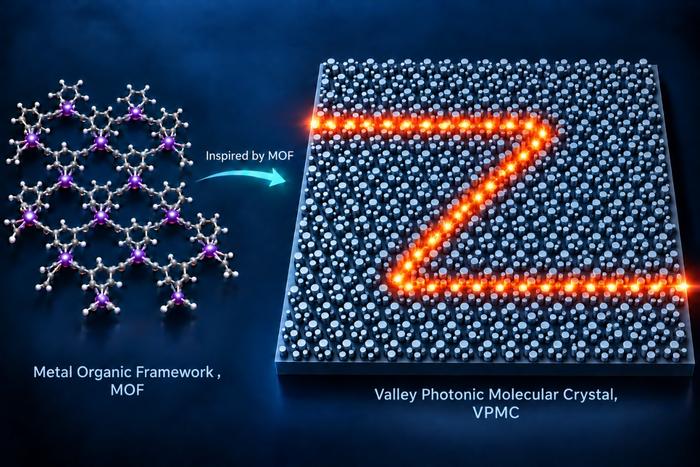
Inspired by Metal-Organic Framework based topological insulators, researchers at Tsinghua University proposed valley photonic molecular crystal (VPMC) and investigated the impact of molecular rotation on the valley-topological properties of VPMC. Credit: Tsinghua University/Xue Feng A research team led by Yidong Huang at Tsinghua University, including Xue Feng and Yongzhuo Li, has developed valley photonic molecular crystals (VPMCs) on a silicon platform. Combining theoretical modeling,...
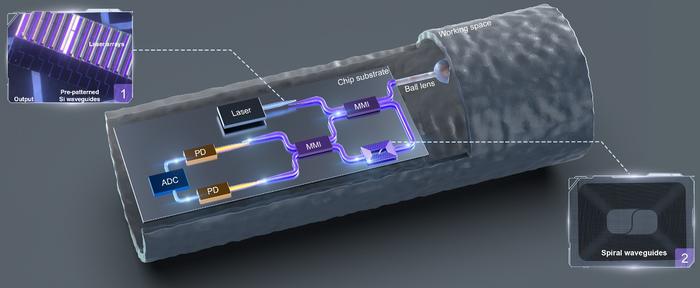
The system integrates a III-V semiconductor light source, SiN-based interferometers, Si-Ge photodetectors (PDs), and an integrated ball-lens microprobe, thereby combining the distinct advantages of multiple photonic integration platforms. The insets illustrate complementary technologies that can be incorporated to realize a miniaturized, fully integrated OCT system. Abbreviations: ADC, analog-to-digital converter. Inset 1: Foundry-scalable embedded III-V lasers on silicon-on-insulator (SOI)...
From left to right: Three photons with different quantum states enter an interferometer with three beam splitters. At each beam splitter, they can take different paths at the same time in superposition. The researchers then measured how often the three photons ended up together at the same output. Counterintuitively, it is possible to make the photons more similar to each other and at the same make them less likely to “bunch” together. AI-generated illustration, by Leonardo Novo. We usually...
