National Institute of Standards and Technology (NIST)
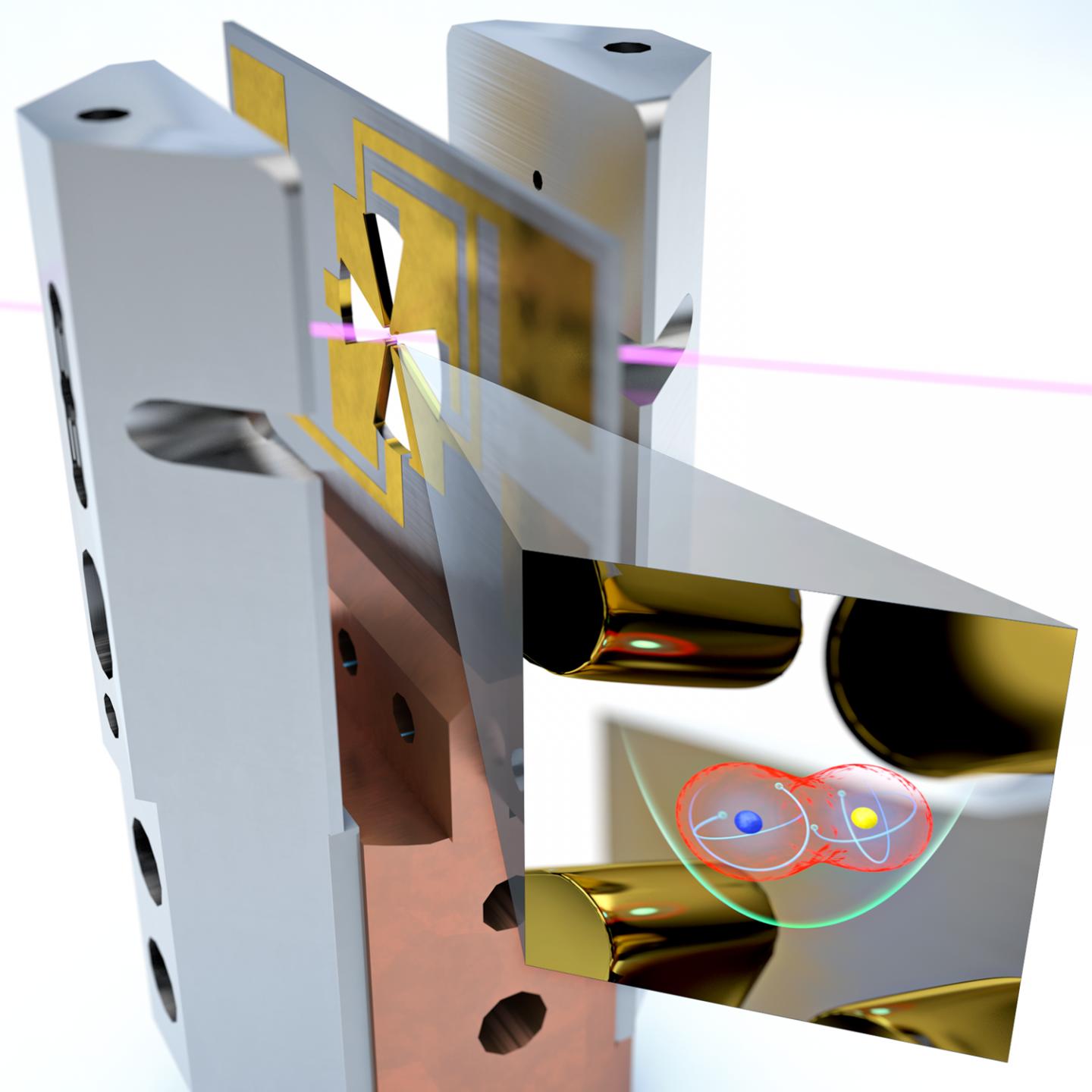
The quantum logic clock--perhaps best known for showing you age faster if you stand on a stool--has climbed back to the leading performance echelons of the world's experimental atomic clocks.
Physicists at the National Institute of Standards and Technology (NIST) have been quietly upgrading their quantum logic clock design for the past eight years, mainly to reduce errors from unwanted motion of the single aluminum ion (electrically charged atom) that provides the clock "ticks."
As described in Physical Review Letters, the quantum logic clock's systematic uncertainty (how closely the clock represents the ion's natural vibrations, or frequency) is 9.4E-19, the best of any clock worldwide. This means the logic clock would now neither gain nor lose one second in 33 billion years, which is about two-and-a-half times the estimated age of the universe.
In this metric, it now outpaces both NIST clocks using neutral atoms trapped in lattices of laser beams, the ytterbium lattice clock and the strontium lattice clock.
"The logic clock's performance is not surprising to me," project leader David Leibrandt said. "Ion clocks are naturally better isolated from the environment--which is the source of inaccuracy for atomic clocks--than lattice clocks are. It's important to distinguish between precision and stability on this point. People expect that lattice clocks should perform the best in stability, and they currently do. Our newest quantum logic clock is the world leader in precision but not stability."
The logic clock's stability (how long it takes to measure the time) is 1.2E15 for a 1-second measurement, which is near the best achieved by a single ion clock but about 10 times worse than both NIST lattice clocks.
The quantum logic clock got its nickname because it borrows logical decision-making techniques from experimental quantum computing. Aluminum is an exceptionally stable source of clock ticks, vibrating between two energy levels over a million billion times per second, but its properties are not easily manipulated or detected with lasers. So, logic operations with a partner magnesium ion are used to cool the aluminum and to signal its ticks.
Back in 2010, NIST's quantum logic clock had the best performance of any experimental atomic clock. The clock also attracted attention for 2010 demonstrations of "time dilation" aspects of Einstein's theories of relativity: that time passes faster at higher elevations but more slowly when you move faster.
Since then, NIST's lattice clocks have been continually leapfrogging each other in performance, giving the impression of a race to identify a single winner. In fact, all the clocks are useful for research purposes and are possible contenders for future time standards or other applications.
The international definition of the second (in the International System of Units, or SI) has been based on the cesium atom since 1967, so cesium remains the "ruler" for official timekeeping. The logic clock is one contender for a future time standard to be selected by the international scientific community. NIST scientists are working on several different types of experimental clocks, each based on different atoms and offering its own advantages. All these experimental clocks are based on optical frequencies, which are higher than the microwave frequencies used in today's timekeeping standards based on cesium.
Several technical advances enabled the improved performance of the logic clock, including a new ion trap design that reduced heat-induced ion motion, enabling operation near the desirable ground state, or lowest motional energy level. In addition, a lower frequency was used to operate the ion trap, reducing unwanted ion motion caused by the electric field used to trap the ions. Finally, improved quantum control has reduced the uncertainty of measurements of frequency shifts due to ion motion.
The clock's precision was determined by measuring and adding up the frequency shifts caused by nine different effects. Stability was measured by comparison to NIST's ytterbium lattice clock.
Additional improvements in trap design and other features are planned to further improve performance. Already, NIST's three experimental clocks can be compared to improve measurements of possible changes in some of the fundamental "constants" of nature, a line of inquiry that has important implications for cosmology and tests of the laws of physics such as Einstein's theories of special and general relativity.
An 27Al+ quantum-logic clock with systematic uncertainty below 10E-18.
S.M. Brewer, J.-S. Chen, A. M. Hankin, E.R. Clements, C.W. Chou, D.J. Wineland, D.B. Hume and D.R. Leibrandt
Physical Review Letters. Published 15 July 2019.
DOI: 10.1103/PhysRevLett.123.033201
Contact information:
David Leibrandt
Associate Professor at NIST and JILA Member
david.leibrandt@nist.gov
Tel: +(303) 497-7292
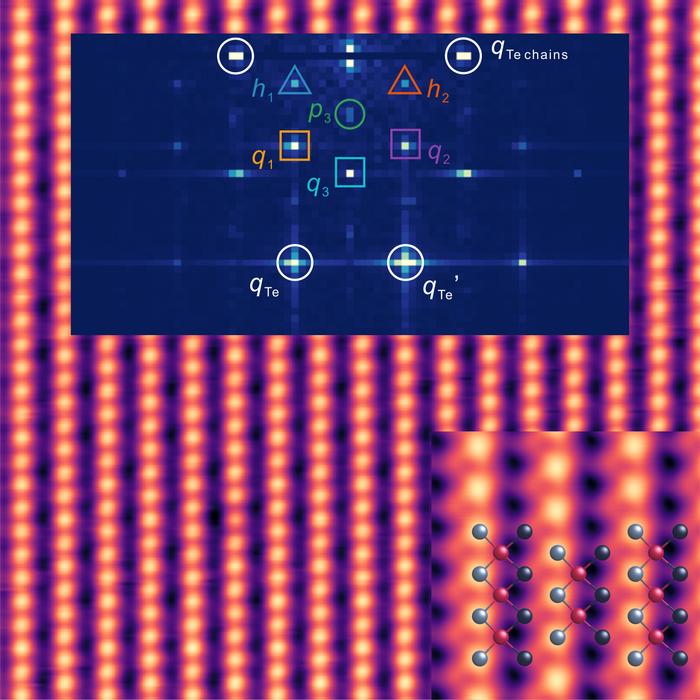
A Fourier transform revealing spatial patterns on the surface at 300 millikelvins. A charge density wave signals the presence of the pair density wave. The background is tellurium atoms on the surface of uranium ditelluride. @University of Illinois Urbana-Champaign’s Grainger College of Engineering Physicists with the University of Illinois Urbana-Champaign’s Grainger College of Engineering have identified a new form of superconducting behavior. Experiments on the metal uranium ditelluride...
Stack two atomically thin layers, rotate one slightly against the other, and a new material emerges. The resulting moiré pattern can slow electrons down so much that their interactions take over. This produces superconductivity, magnetism and exotic fractional quantum states that neither layer shows on its own. This field, known as twistronics, has become one of the most active frontiers in condensed matter physics. So far, however, it has been built on only a handful of materials, mainly...
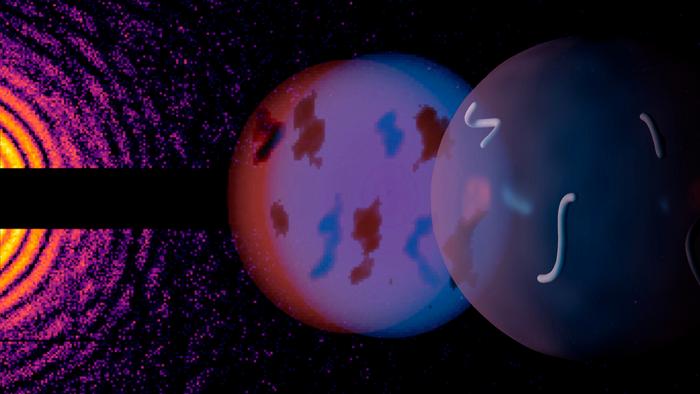
From a two-colour diffraction pattern (left), two snapshots of a helium droplet doped with xenon nanoparticles can be reconstructed (centre). These images can inform a potential 3D rendering of a xenon-doped helium nanodroplet (right). An overarching goal of ultrafast science is to enable researchers to watch structural changes in matter on their natural timescale. Experimentally, this translates into taking two snapshots of the same nanoscale object that are only femtoseconds apart to...
