Karlsruher Institut für Technologie (KIT)
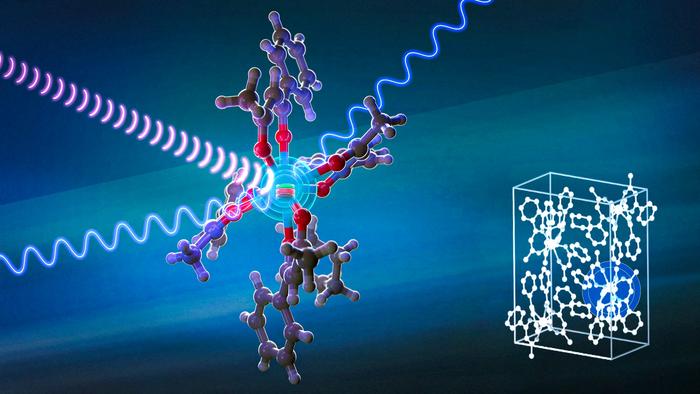
Nuclear magnetic resonance (NMR) is an established method for analyzing materials and molecules, with applications ranging from chemical analysis to quantum information processing. For a new paper, KIT researchers analyzed a molecular crystal containing europium ions. Such ions have especially narrow optical transitions that allow direct addressing of nuclear spin states. Using laser light, they were able to initialize nuclear spins in defined states and then read out those states.
In addition to optical addressing, the researchers used high-frequency fields to control the spins and protect them from interfering environmental influences. They achieved nuclear spin quantum coherence with a lifetime of up to two milliseconds, an interval during which a quantum system maintains a precisely defined quantum mechanical state.
Nuclear Spins as Stable Quantum Information Carriers
“The results show that molecular materials can be a promising platform for future quantum components,” said Professor David Hunger of the Physikalisches Institut at KIT. “A special advantage is that we can address the nuclear spins without interference from electron spins, making it possible to implement especially stable and dense qubit registers in the future.”
At KIT’s Institute for Quantum Materials and Technologies and Institute of Nanotechnology, a group of researchers headed by Professor Mario Ruben synthesized the molecular crystals and investigated their suitability for use in quantum platforms.
Tailored Molecules for Atomically Precise Qubit Registers
In the long term, optically addressable nuclear spins in molecules offer new prospects for the development of scalable quantum computers. Molecular systems can be chemically customizedtailored, potentially enabling atomically precise qubit registers. In addition, optically detected NMR facilitates the implementation of new high-resolution NMR methods that will allow detailed analysis of complex materials in the future.
The results of this research underscore the great potential of molecular systems for future quantum technologies and are an important step toward optically networked quantum processing systems.
Reference
Optically detected nuclear magnetic resonance of coherent spins in a molecular complex
Evgenij Vasilenko, Vishnu Unni Chorakkunnath, Jeremias Resch, Nicholas Jobbitt, Diana Serrano, Philippe Goldner, Senthil Kumar Kuppusamy, Mario Ruben, David Hunger: Optically detected nuclear magnetic resonance of coherent spins in a molecular complex. Nature Materials, 2026.

Good vibrations for quantum communications
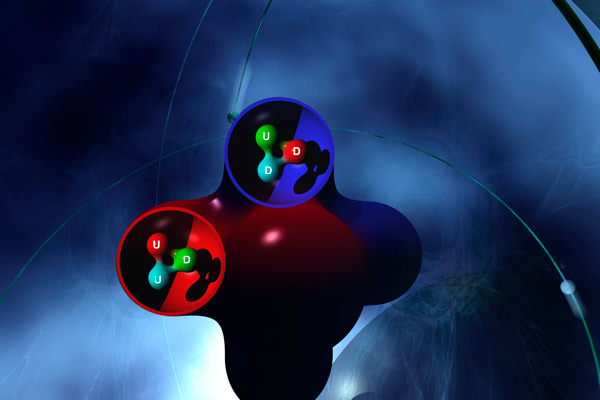
The internal structure of a proton (left) in a lithium atom. The proton is made up of three quarks, but its spin does not correspond to the sum of the spins of the quarks. @ CAROL & MIKE WERNER/SCIENCE PHOTO LIBRARY An analysis by physicists of colliding protons is tackling the mystery of where protons get their intrinsic property known as spin1. Along with neutrons, protons are housed inside an atom’s nucleus. Like many subatomic particles, they carry spin—an internal property that can point...
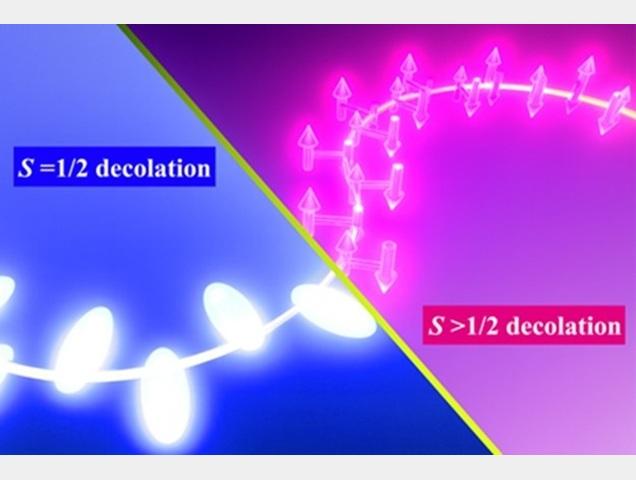
Quantum spins interacting collectively create unique behaviors impossible for individual particles. The Kondo effect—where localized spins interact with conduction electrons—is central to understanding these phenomena, but in real materials, additional electron behaviors obscure the pure spin interactions. For nearly 50 years, physicists sought to realize the Kondo necklace model, which isolates spin interactions by removing this complexity. Researchers at Osaka Metropolitan University achiev...